 MSK Academy
Ultrasound examination
Examination protocol
Ventral view
- Transverse plane
- Sagittal plane
Lateral view
- Transverse plane
- Frontal plane
Dorsal view
- Transverse plane
Interaktive Funktion, verfügbar in der App
1. Ventral view
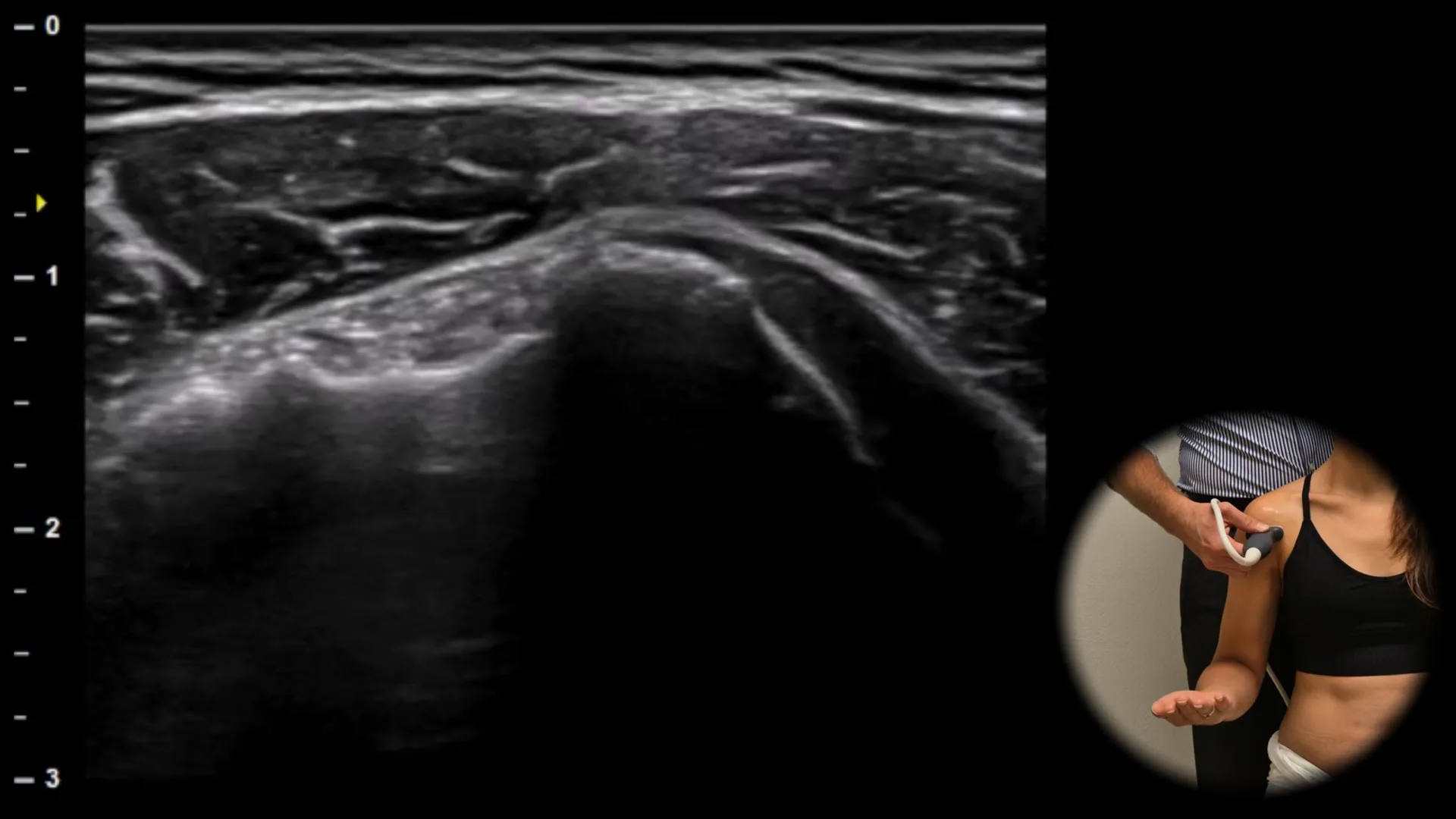
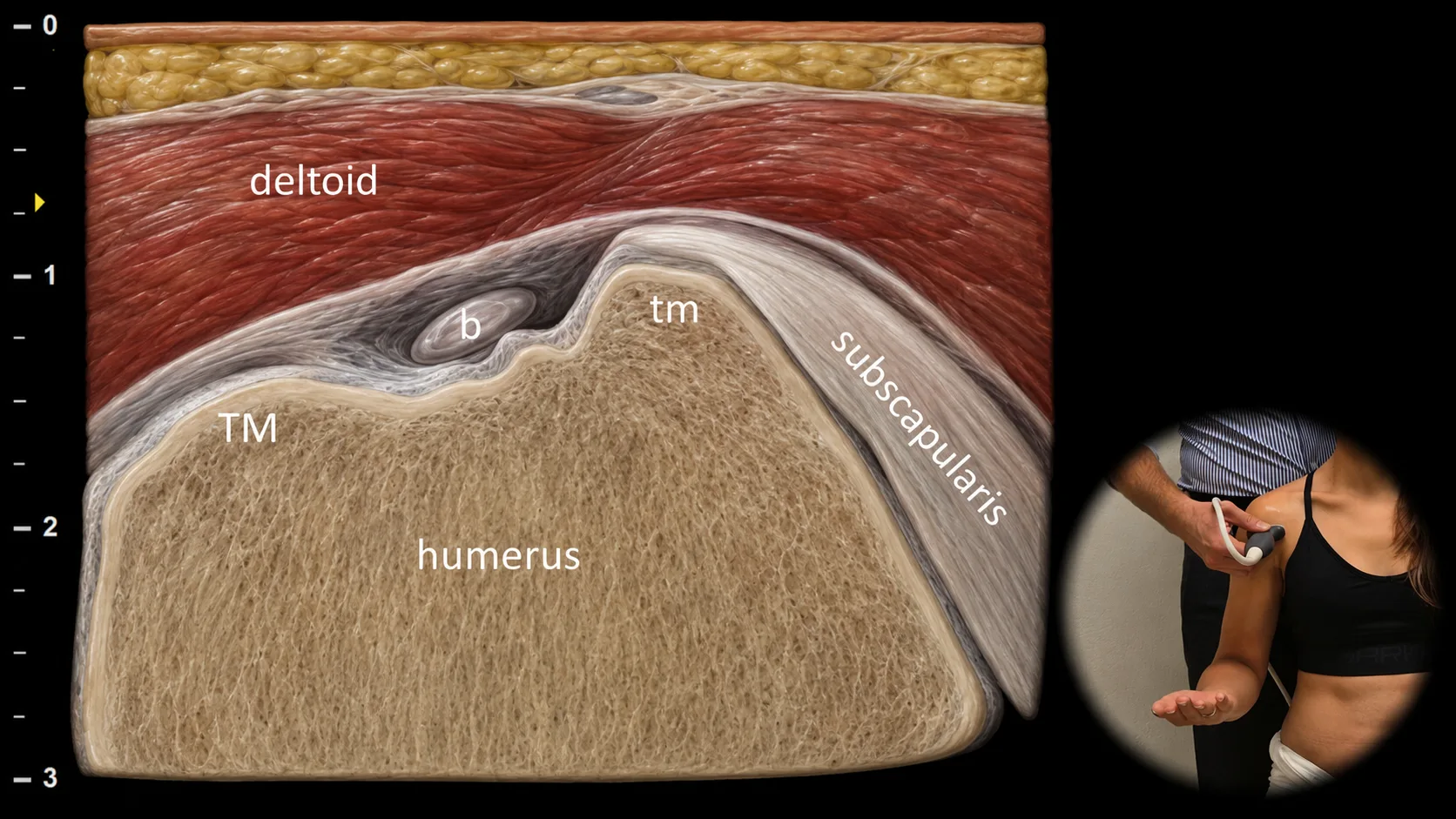
Figure 1. Ventral view, transverse plane. b: tendon of the long head of biceps brachii, TM: tuberculum majus, tm: tuberculum minus
Transverse ultrasound section of the anterior part of the shoulder joint. The proximal humerus is displayed with the greater (TM) and lesser (tm) tubercle, between which the tendon of the long head of biceps brachii (b) is located in the intertubercular sulcus. In the surrounding area, the tendon of subscapularis inserting on the lesser tubercle of the humerus and the superficially located deltoid muscle are also visible, whereby this projection provides an overview of the main anatomical landmarks of the anterior part of the shoulder and enables targeted evaluation of tendons, soft tissues, and any pathological changes.
Clinical Note
The area around the long head of biceps tendon represents a typical site of fluid accumulation, because the tendon sheath communicates with the joint cavity; the presence of fluid in this location can therefore be a sign of effusion in the shoulder joint and requires careful assessment of its extent and character.
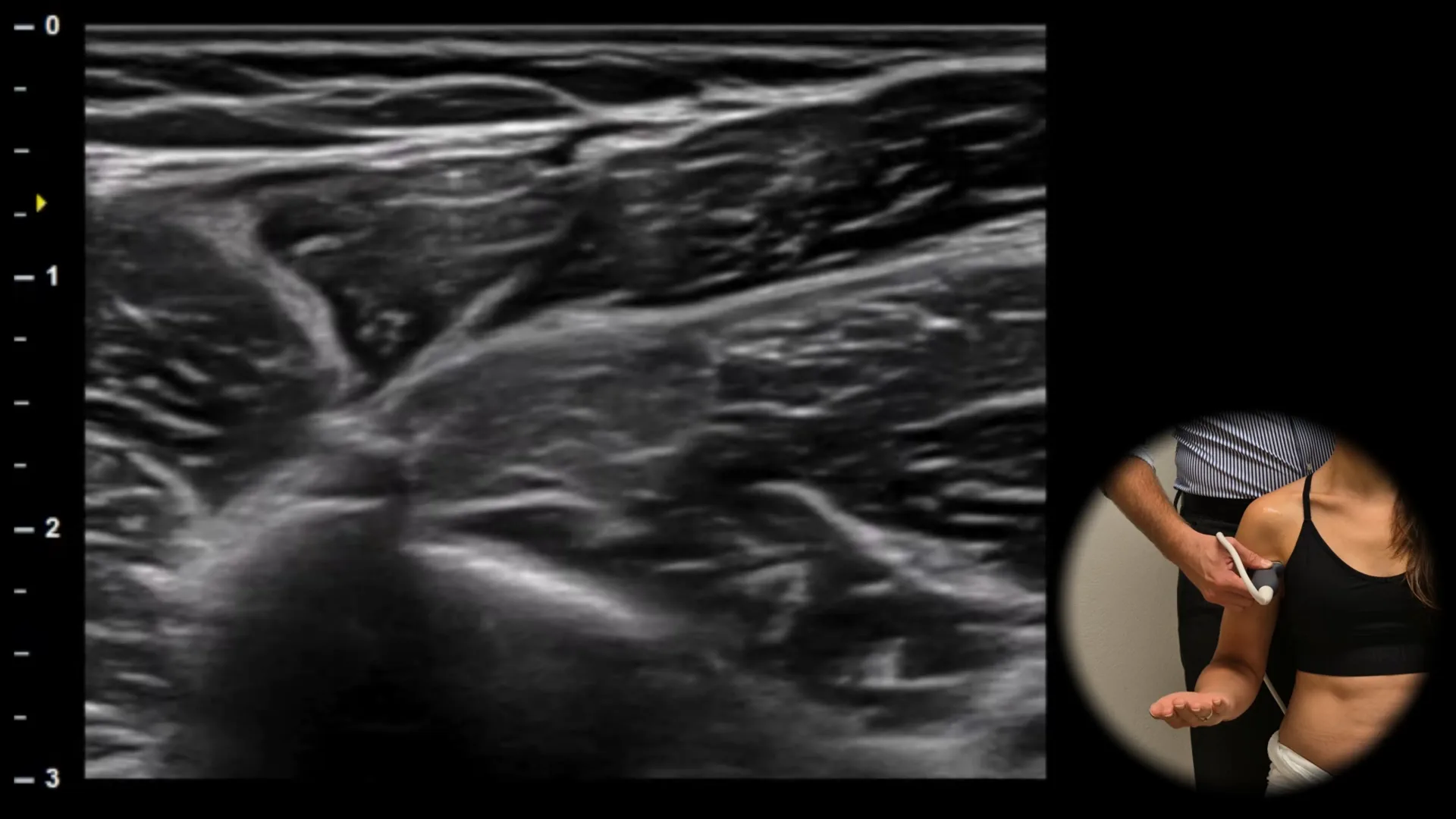
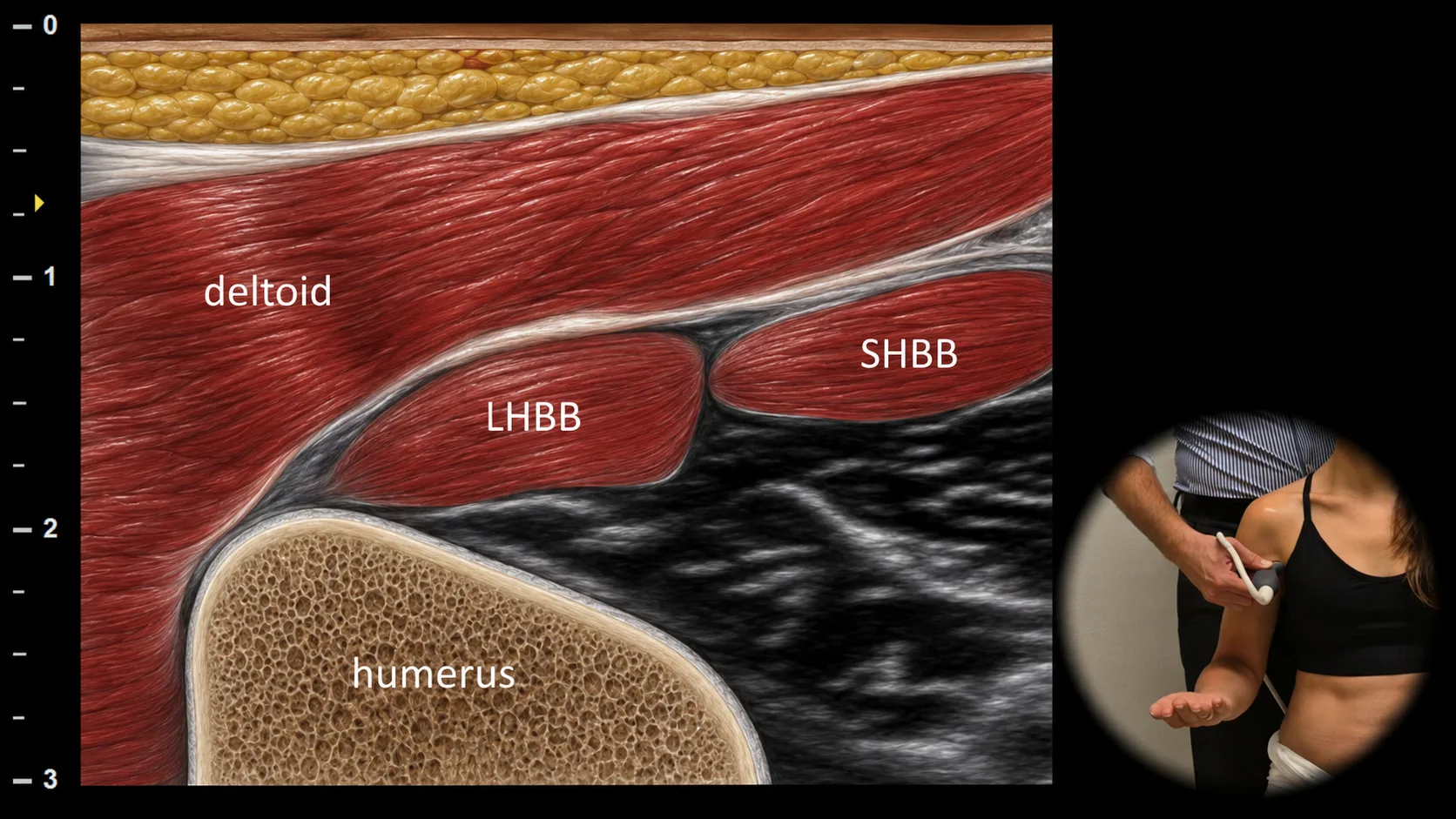
Figure 2. Ventral view, transverse plane. LHBB: long head of biceps brachii m., SHBB: short head of biceps brachii m.
Transverse ultrasound section of the anterior part of the arm with distal movement of the probe along the biceps brachii m. In this projection, both heads of the muscle are clearly visible, the long head (LHBB) and short head (SHBB), which form the muscle belly in the anterior region of the arm. This projection is suitable for assessing the structure and symmetry of the muscle belly and for detecting pathological changes such as partial or complete ruptures, hematomas, or signs of muscle atrophy.
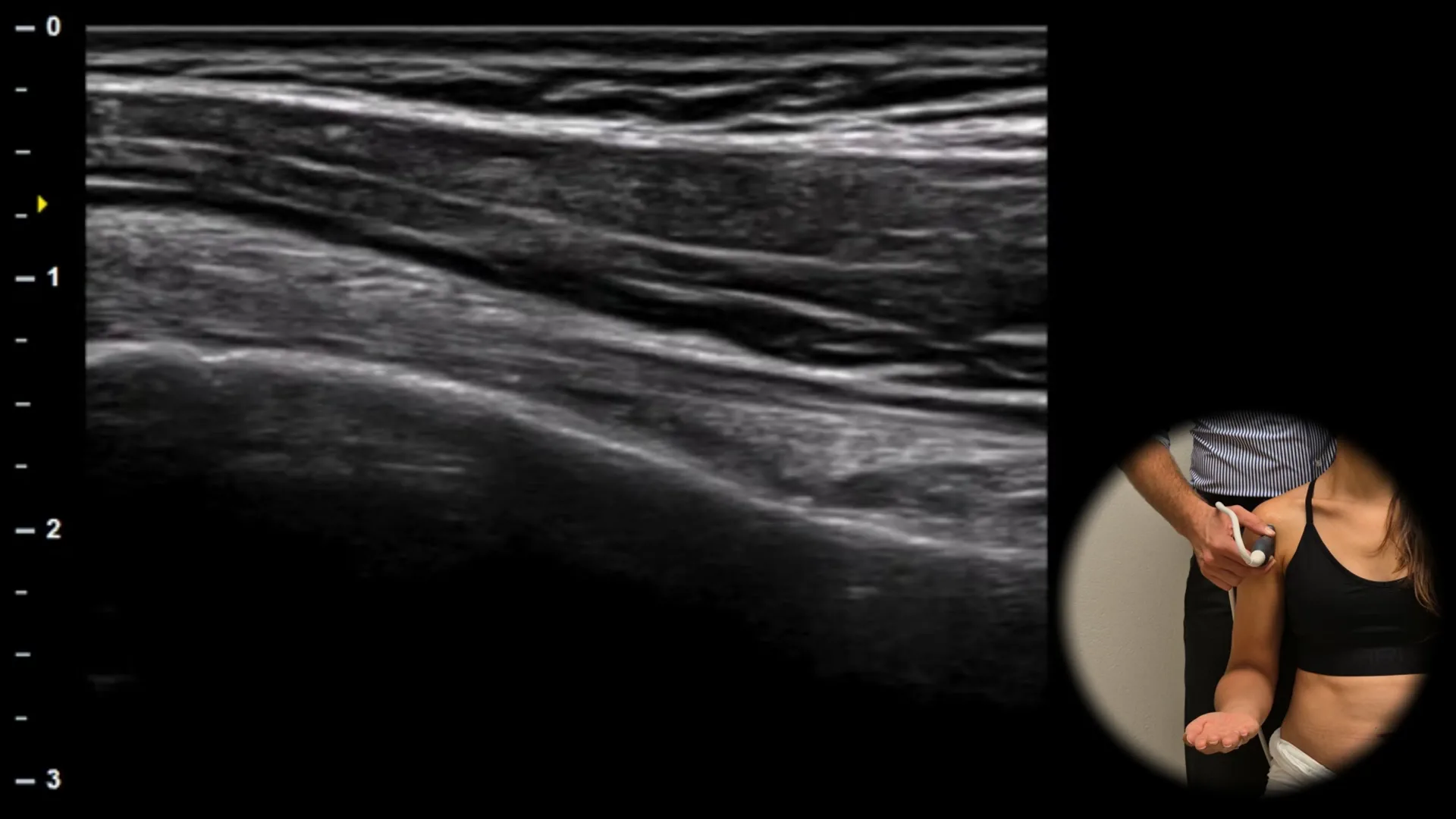
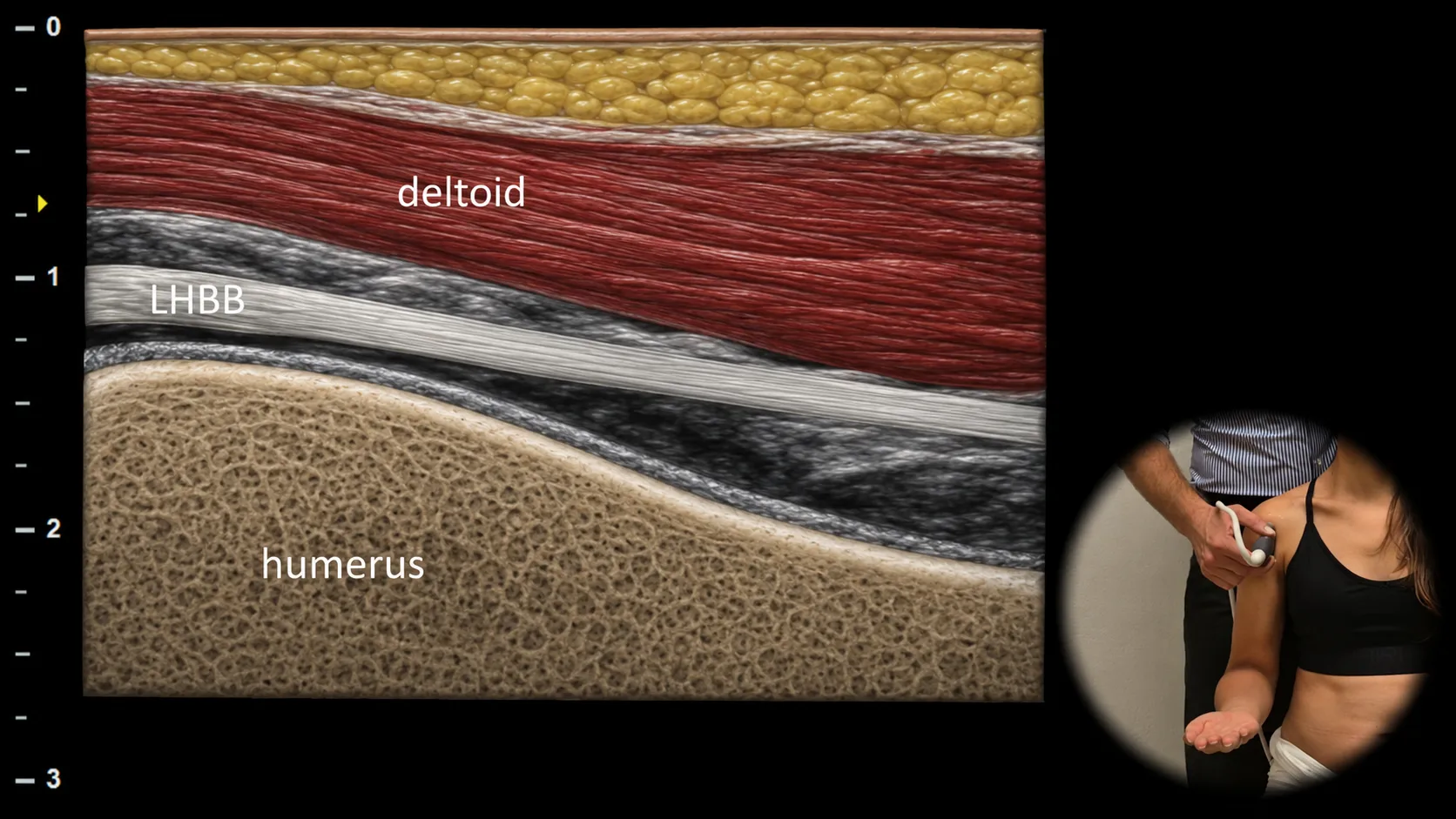
Figure 3. Ventral view, sagittal plane. b: tendon of the long head of m. biceps brachii
Longitudinal ultrasound section of the anterior shoulder, created by rotating the probe 90° from the transverse projection. The tendon of the long head of m. biceps brachii (b) is displayed in long axis in this plane as it courses through the intertubercular sulcus and shows the typical linear fibrillar appearance. This projection is essential for assessing tendon continuity and integrity and enables detection of pathological changes such as fluid around the tendon, tenosynovitis, or partial rupture.
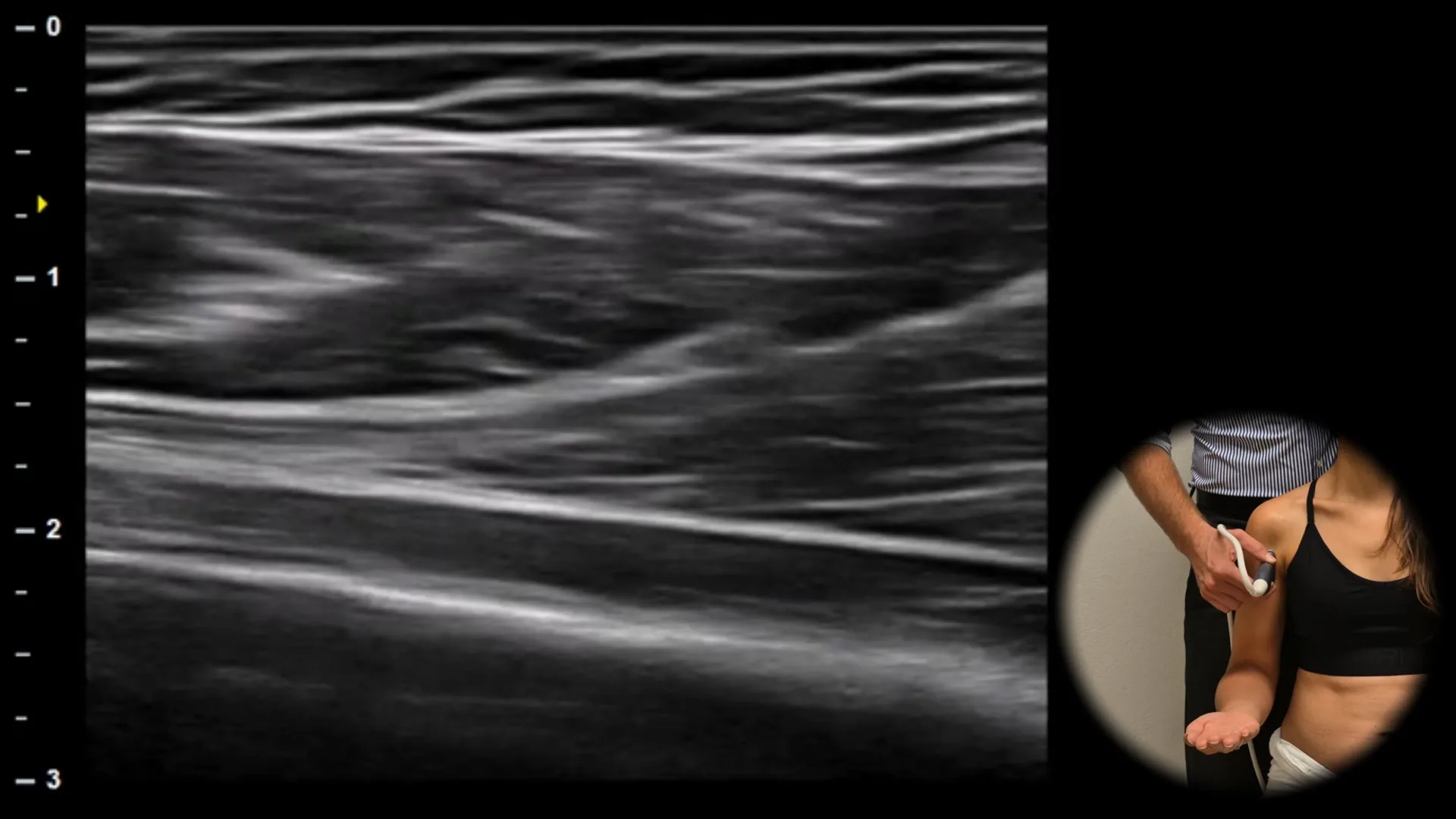
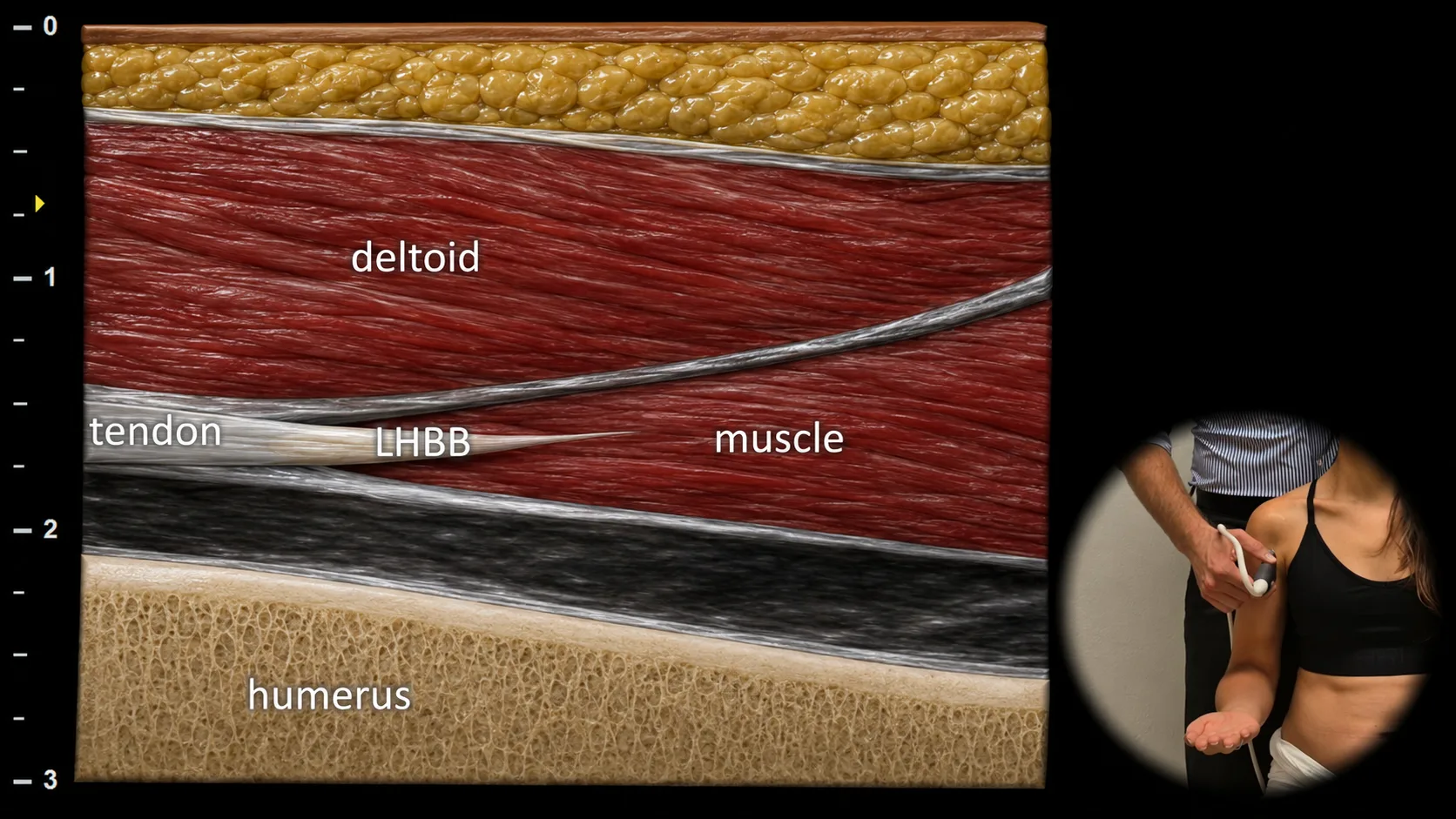
Figure 4. Ventral view, sagittal plane. LHBB: myotendinous junction of the long head of biceps brachii
Longitudinal ultrasound section of the anterior arm with more distal probe placement, showing the myotendinous junction area of the long head of biceps brachii (LHBB). In this projection, the transition from fibrillar tendon to hypoechoic muscle tissue is visible, corresponding to the transition from collagen fibers to muscle belly. This area represents a common site of injury and is important for detecting partial ruptures, tendinopathy, or muscle strain, especially in patients with anterior arm pain or following acute trauma.
2. Lateral view
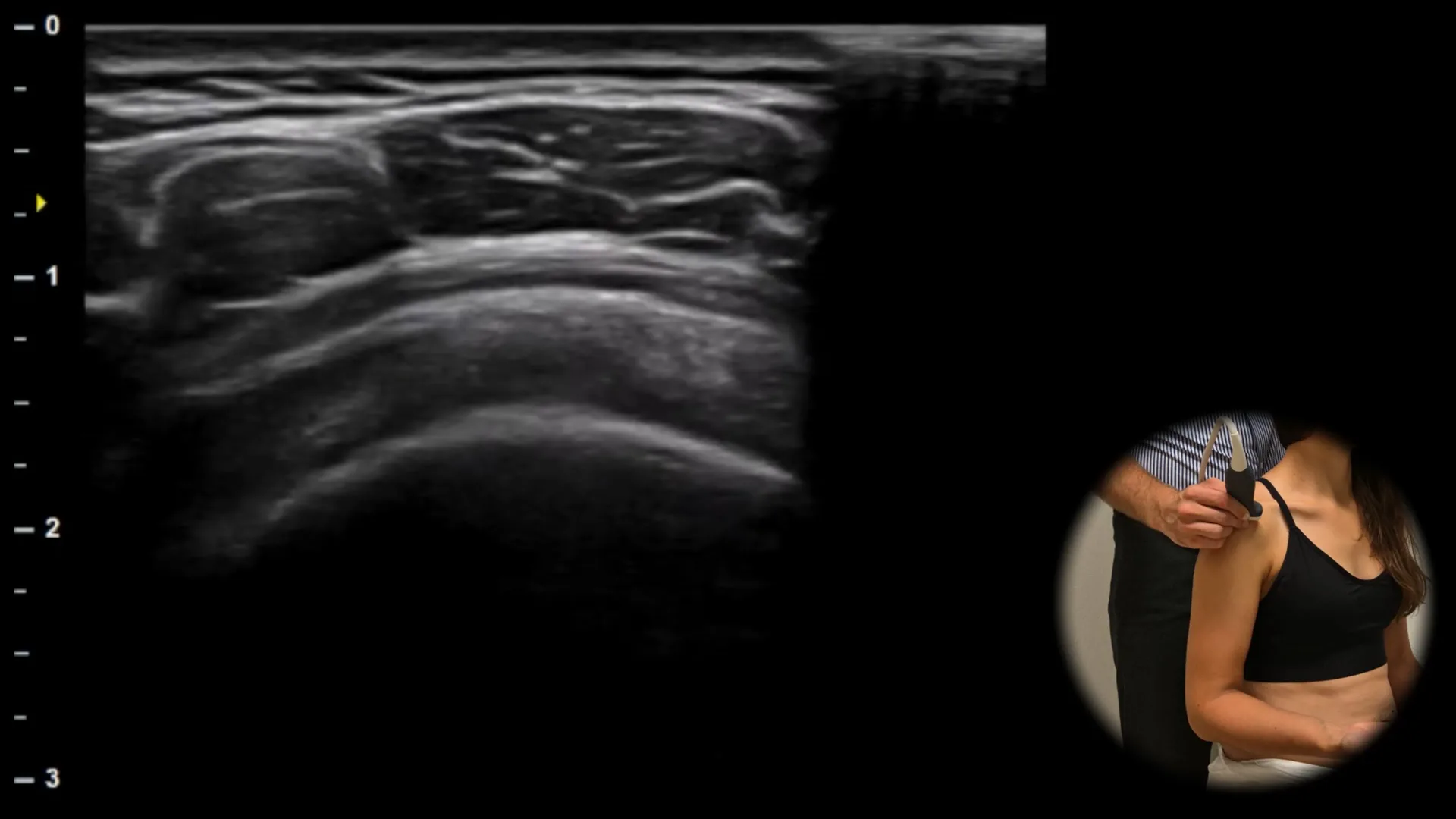
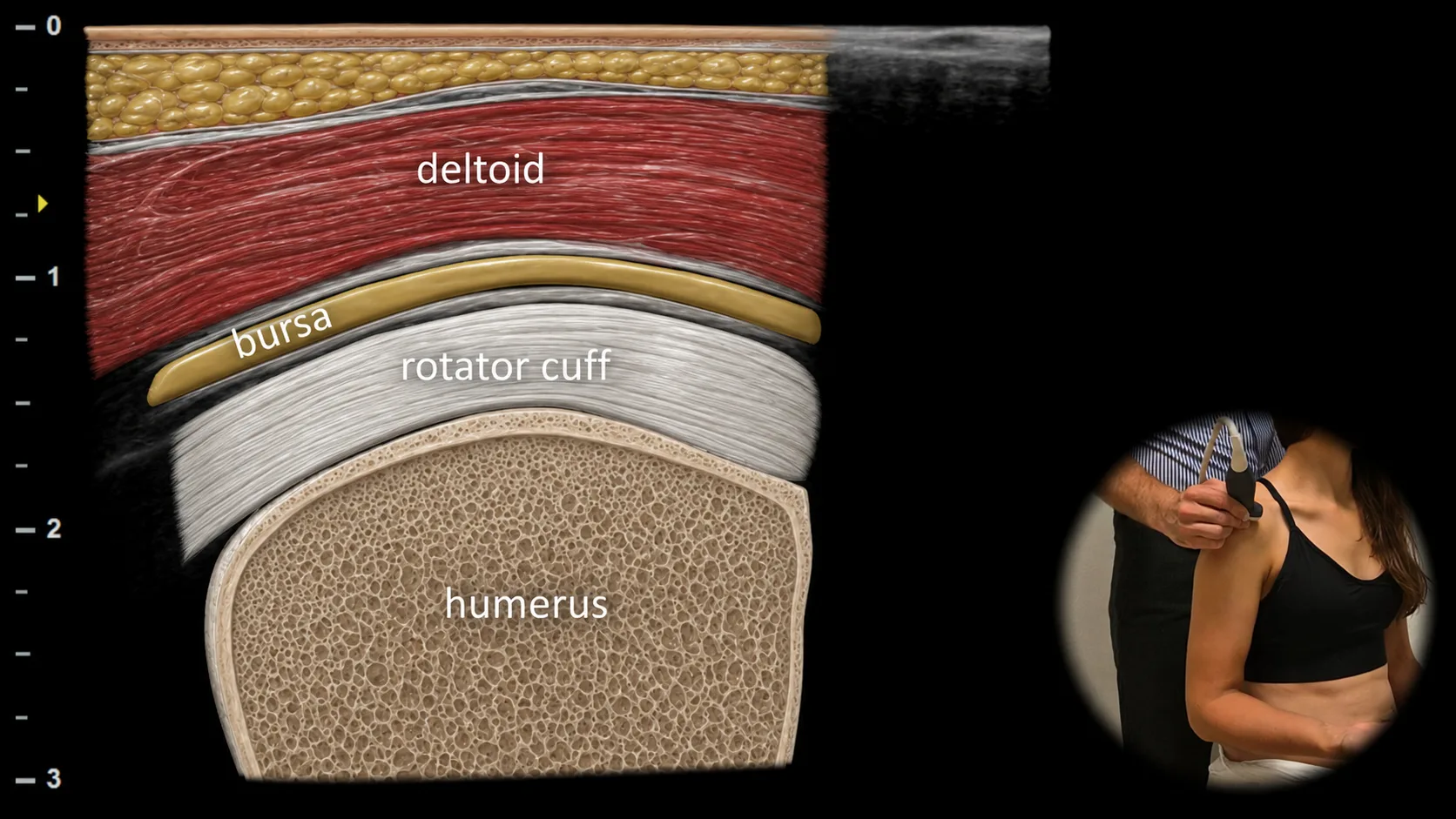
Figure 5. Lateral view, transverse plane.
Transverse ultrasound section of the lateral part of the shoulder showing the rotator cuff tendon in short axis, typically referred to as the "tire sign". In this projection, the integrity of the tendon can be assessed with gentle probe compression, where a healthy tendon maintains its firmness, resists pressure and has a rounded shape, while in case of rupture or significant damage it tends to be soft, easily compressible and may resemble a "flat tire". This projection is important for assessing continuity of the rotator cuff tendon and for detecting focal pathological changes, such as tears or calcifications, which may be visible only in part of its course.
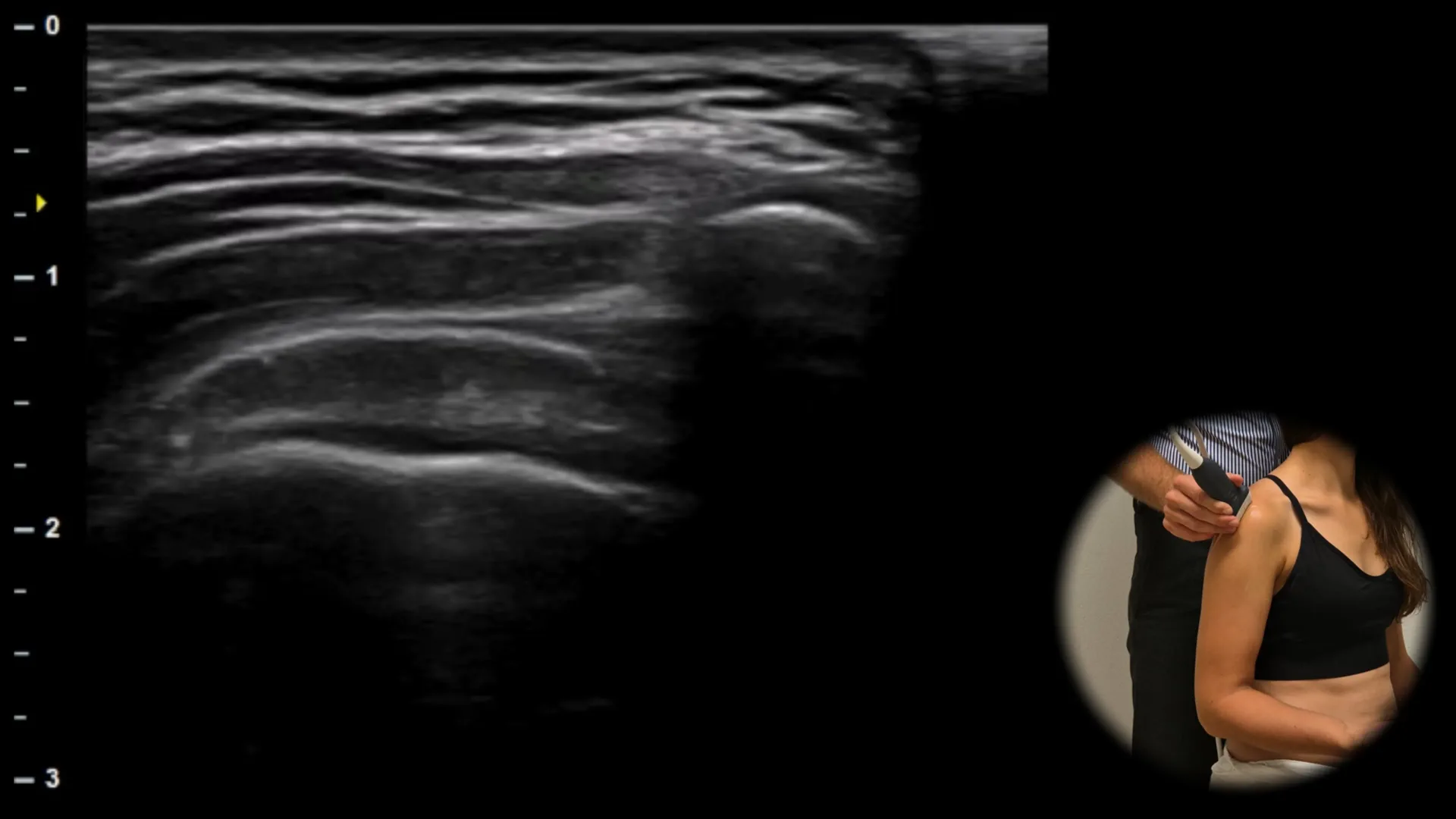
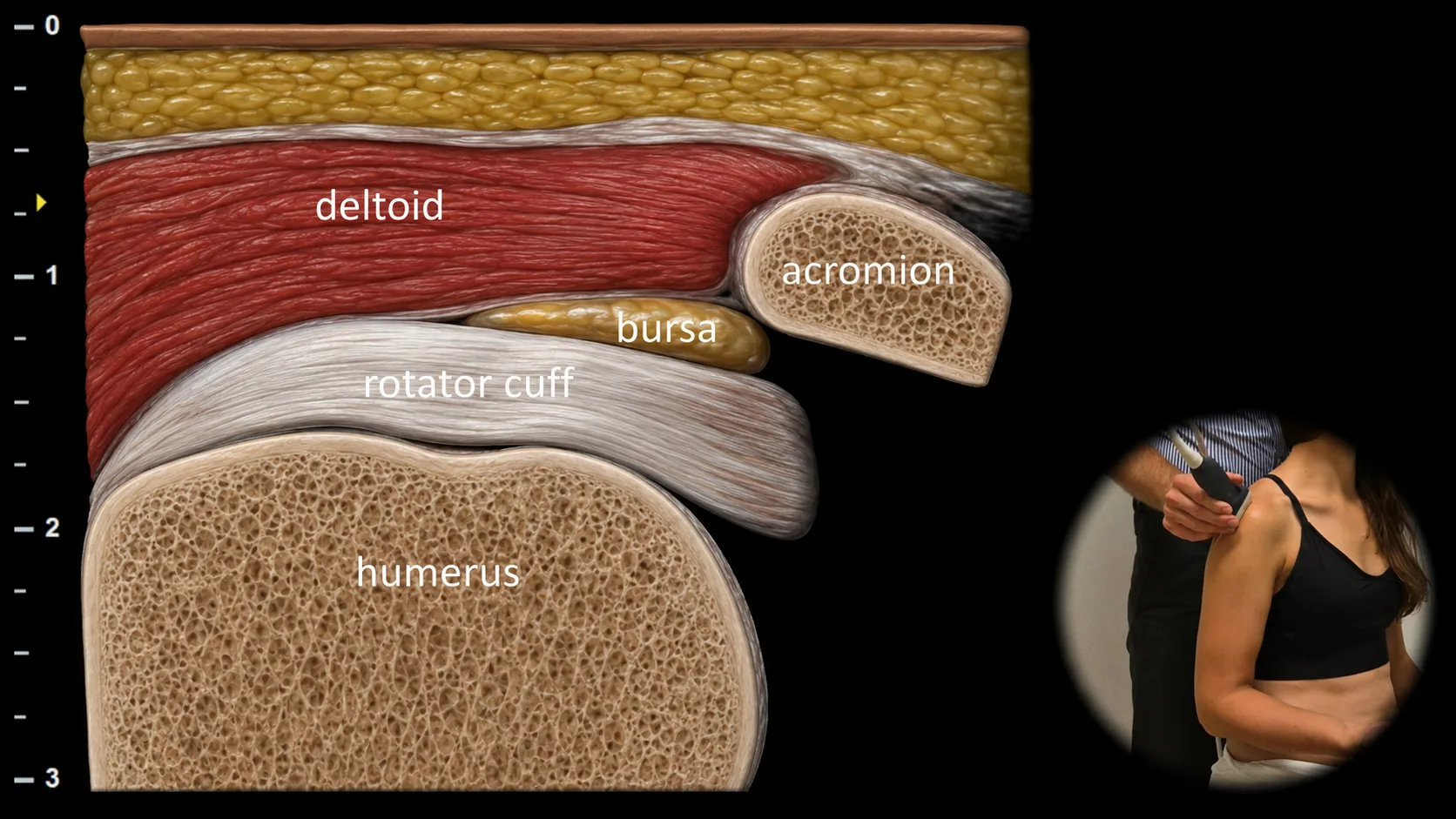
Figure 6. Lateral view, frontal plane.
Longitudinal ultrasound section of the lateral part of the shoulder showing the acromion and greater tubercle of the humerus as main bony landmarks. Between them, the supraspinatus tendon is visible in long axis with its typical "bird's beak" shape, and for complete evaluation of its approximately 4 cm wide structure, it is necessary to move the probe in an anteroposterior direction. Above the tendon lies the subacromial-subdeltoid bursa, which becomes more apparent when enlarged or inflamed. This projection is essential for evaluating tendinopathy, partial and complete ruptures of the supraspinatus tendon, and signs of subacromial impingement.
3. Dorsal view
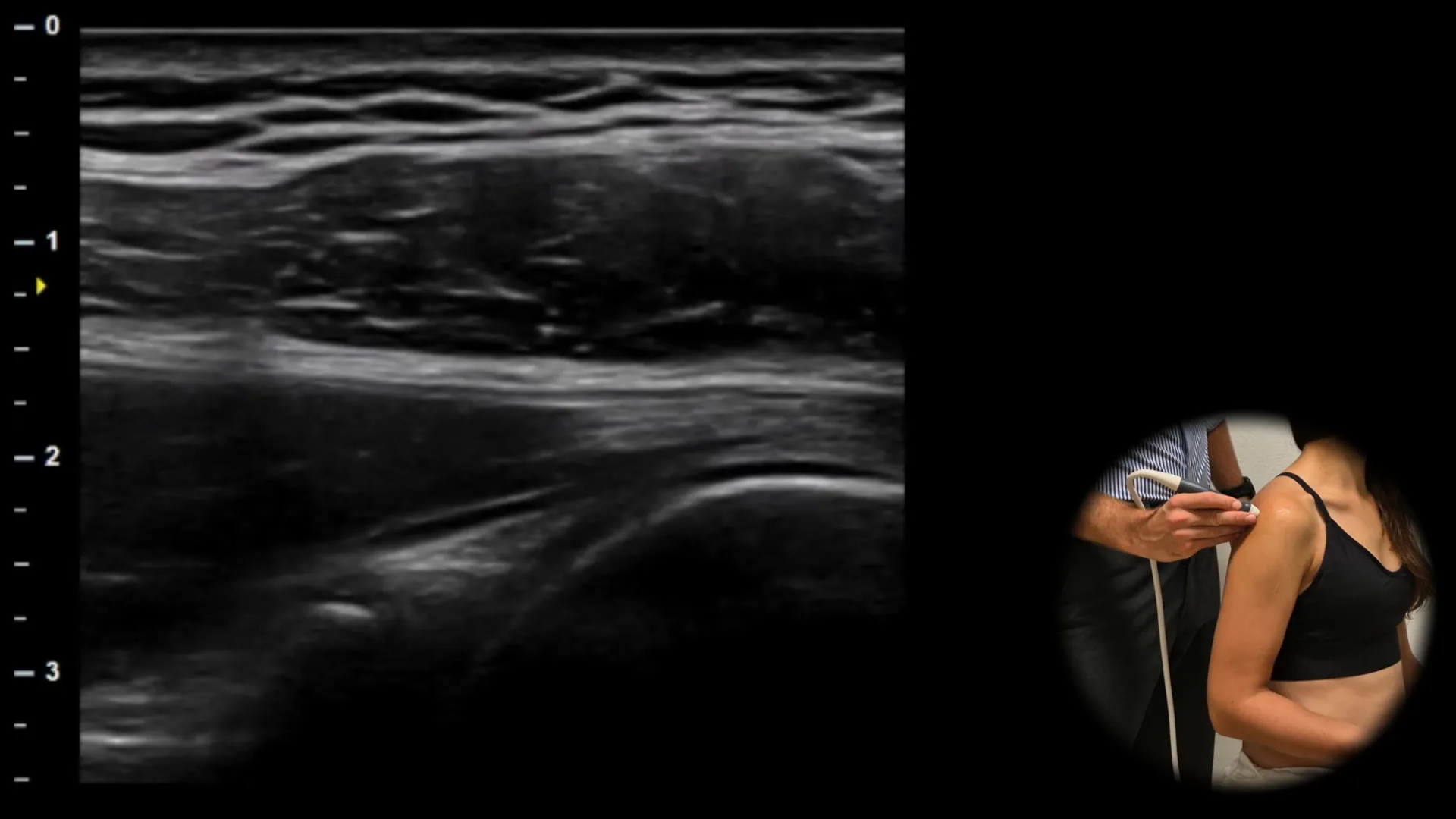
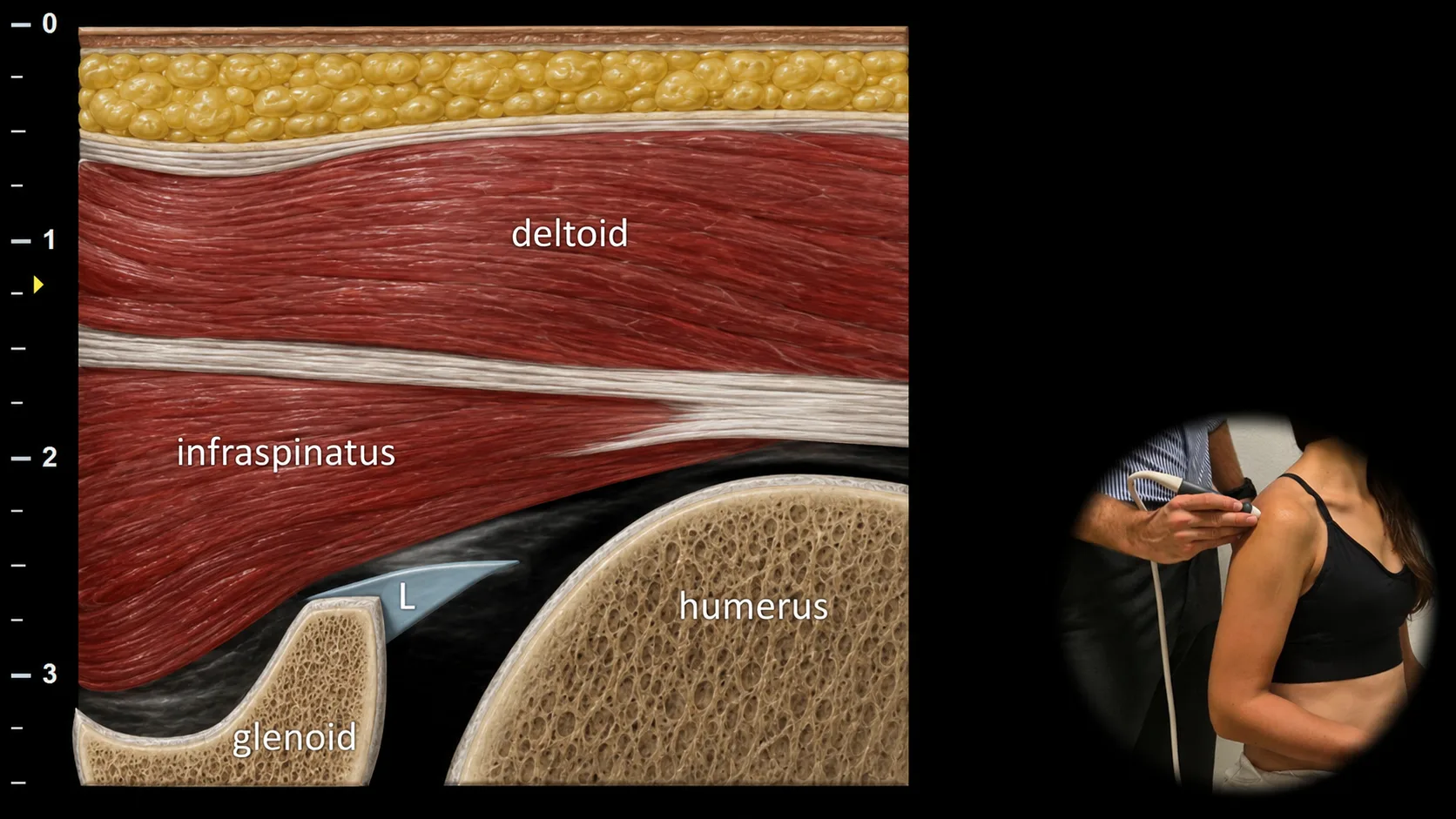
Figure 7. Dorsal view, transverse plane. L: glenoid labrum
Transverse ultrasound section of the posterior part of the shoulder joint with the probe positioned below the scapular spine. The humeral head and glenoid form the main bony landmarks, with a triangular hyperechoic structure visible in the upper part of the glenoid corresponding to the glenoid labrum (L), which contributes to shoulder joint stability.
Clinical Note
This projection is significant for detecting intraarticular fluid in the posterior part of the shoulder joint, whose presence around the glenoid labrum may be better visible during external rotation of the shoulder.
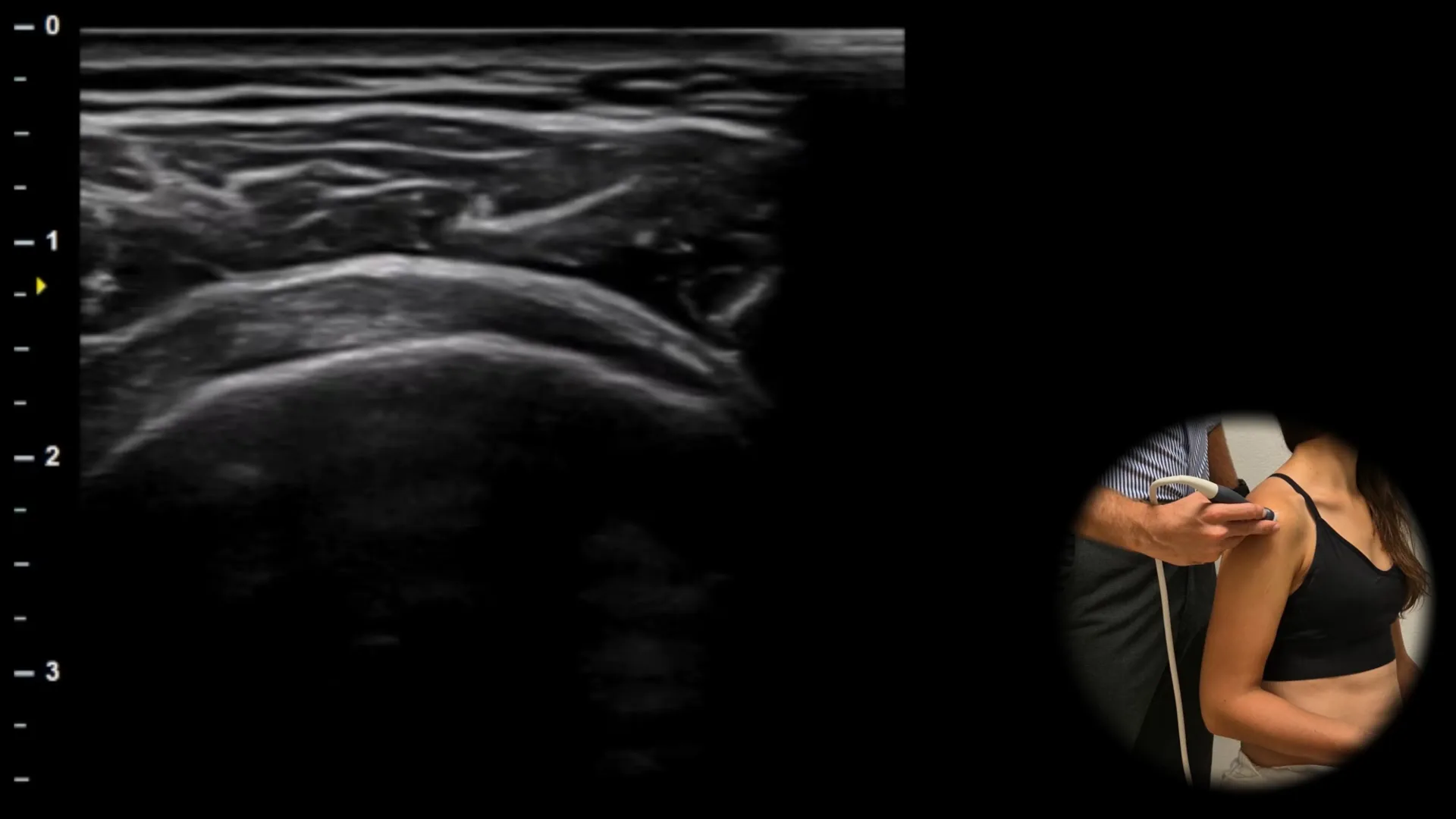
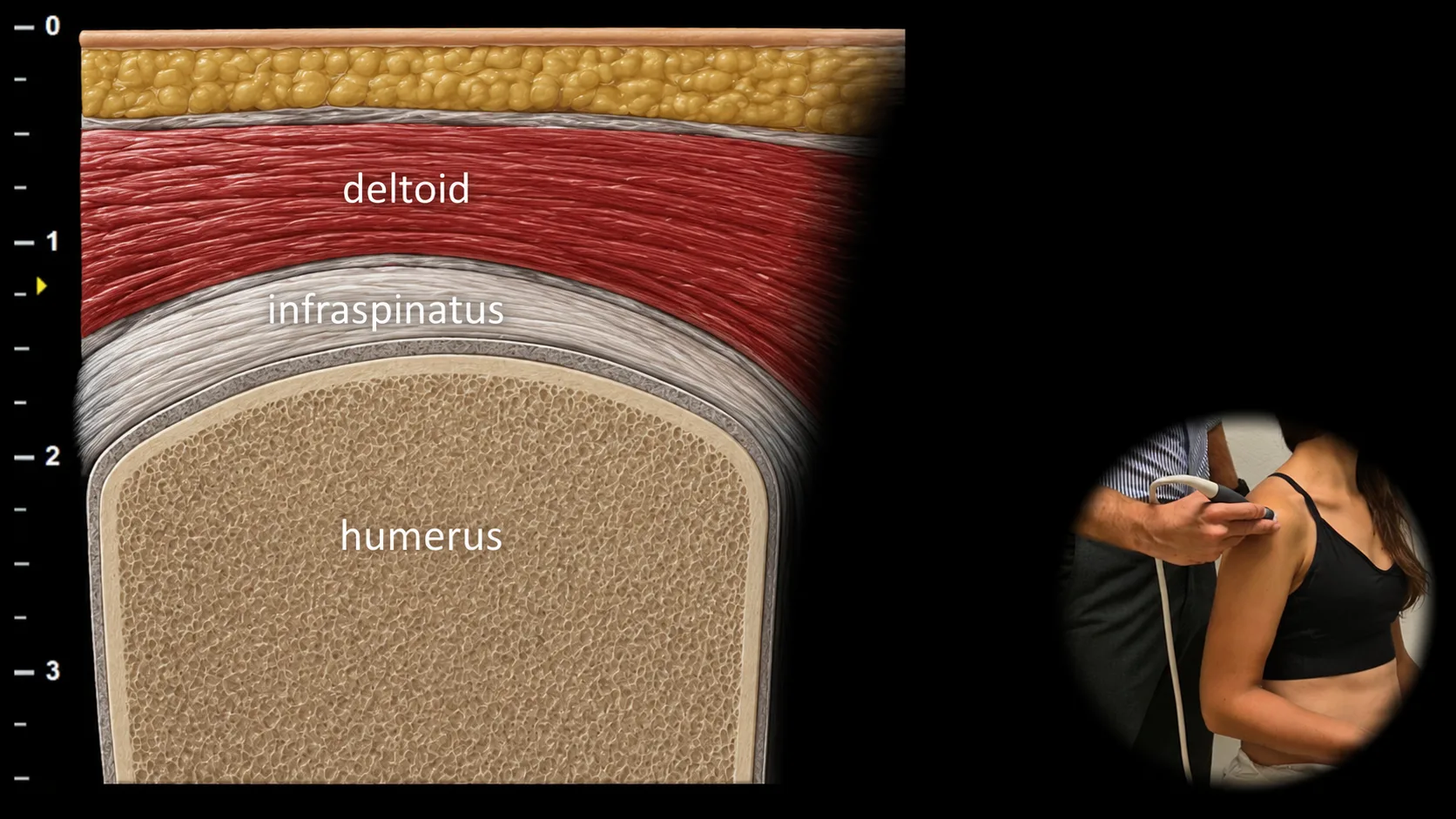
Figure 8. Dorsal view, transverse plane.
Transverse ultrasound section of the posterior part of the shoulder with lateral displacement of the probe, showing the infraspinatus tendon as a fibrillar structure overlying the posterior aspect of the humeral head. With caudal displacement of the probe, the teres minor tendon also comes into the field of view, located directly below the infraspinatus tendon. This projection is important for assessing the integrity of the posterior part of the rotator cuff and for distinguishing isolated infraspinatus tendon involvement from combined pathology that also includes the teres minor.