 MSK Academy
Kompressionsstellen
Häufigste Kompressionsstellen peripherer Nerven
- Struthers-Ligament - fibröses Band in der Nähe eines Processus supracondylaris, proximale Kompression des N. medianus.
- Lacertus fibrosus - Bizepsaponeurose in der Fossa cubitalis, kann den Nerv komprimieren.
- Pronator teres - Verlauf zwischen zwei Köpfen, klassische Stelle des Pronator-Syndroms.
- FDS-Arkade - fibröser Bogen des M. flexor digitorum superficialis.
- Gantzer-Muskel - akzessorischer Kopf des M. flexor pollicis longus.
- AINS (Kiloh-Nevin) - Neuropathie des N. interosseus anterior.
- Karpaltunnel - Verlauf unter dem Retinaculum flexorum, häufigste distale Kompressionsstelle.
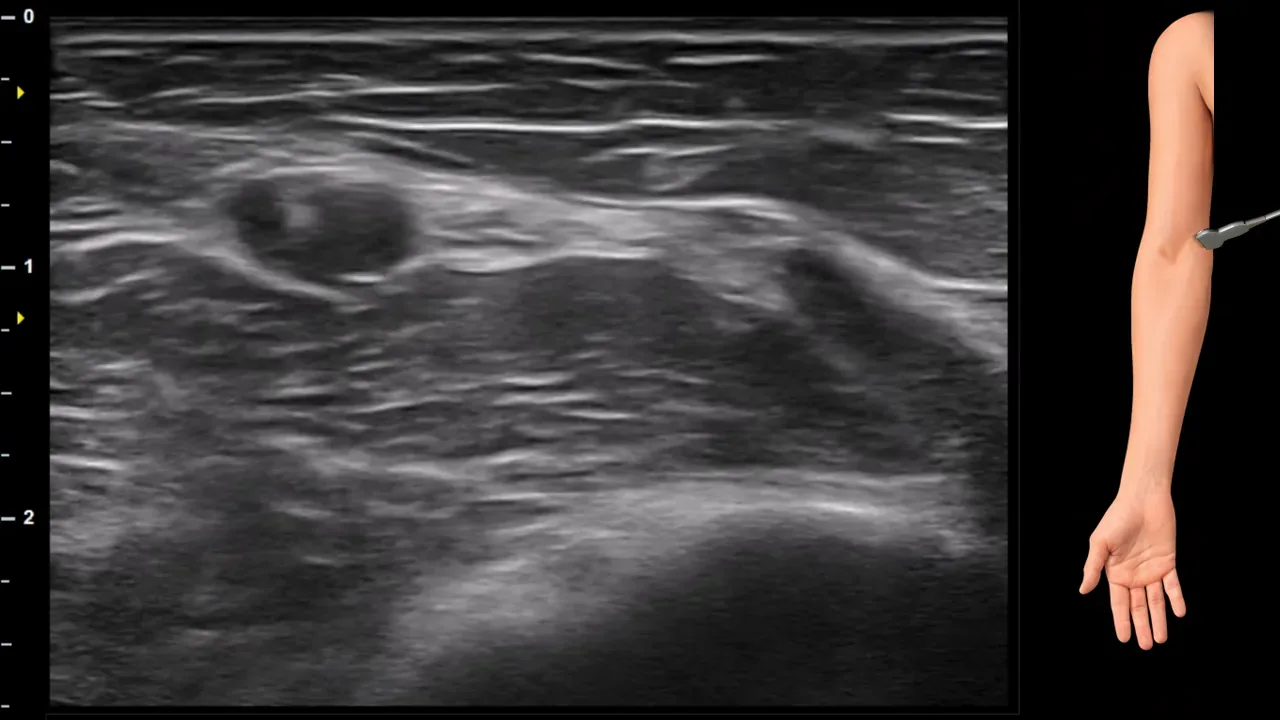
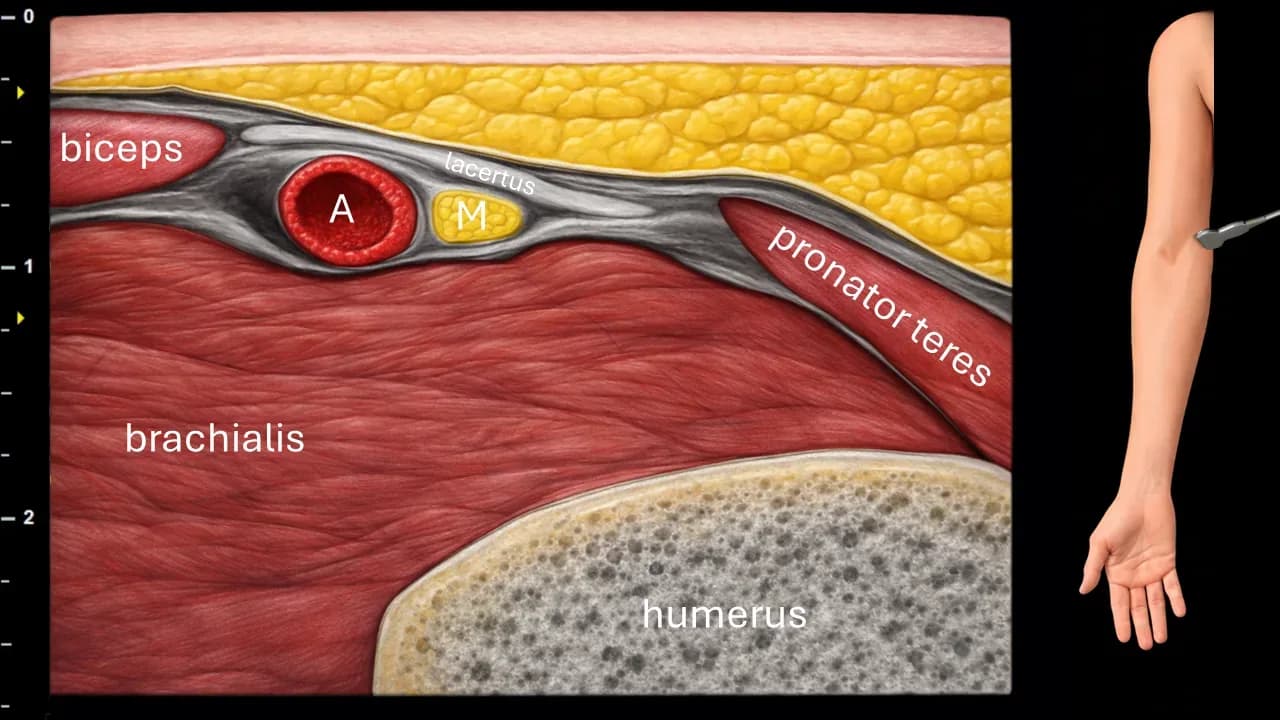
Abbildung 1. Cubitum, Transversalebene, Verlauf des n. medianus unter dem lacertus fibrosus. A: a. brachialis, M: n. medianus.
Sonografischer Querschnitt im Bereich der Fossa cubitalis. Das Bild zeigt die a. brachialis (A) und den n. medianus (M), der in dieser Projektion medial der a. brachialis liegt. Der n. medianus verläuft weiter unter dem lacertus fibrosus und liegt im Raum zwischen dem m. brachialis und dem m. pronator teres. Das Bild zeigt außerdem den m. biceps brachii, den m. brachialis, den m. pronator teres und die Kontur des Humerus.
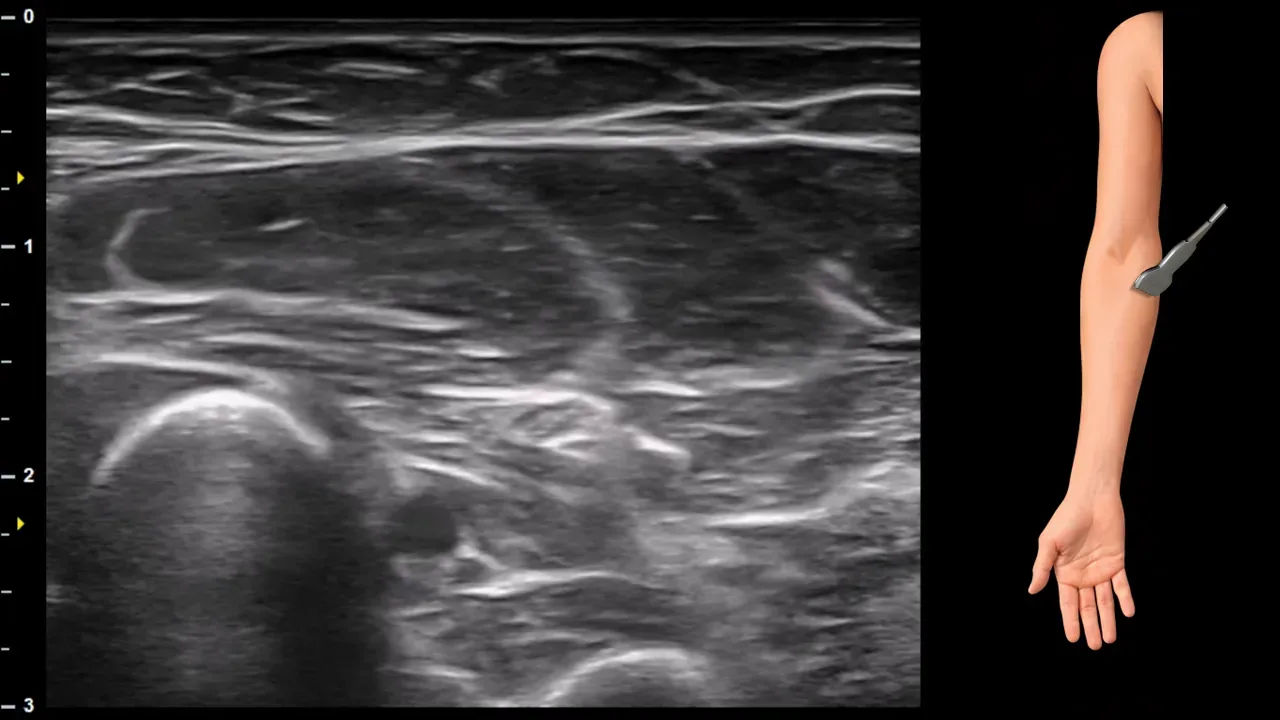
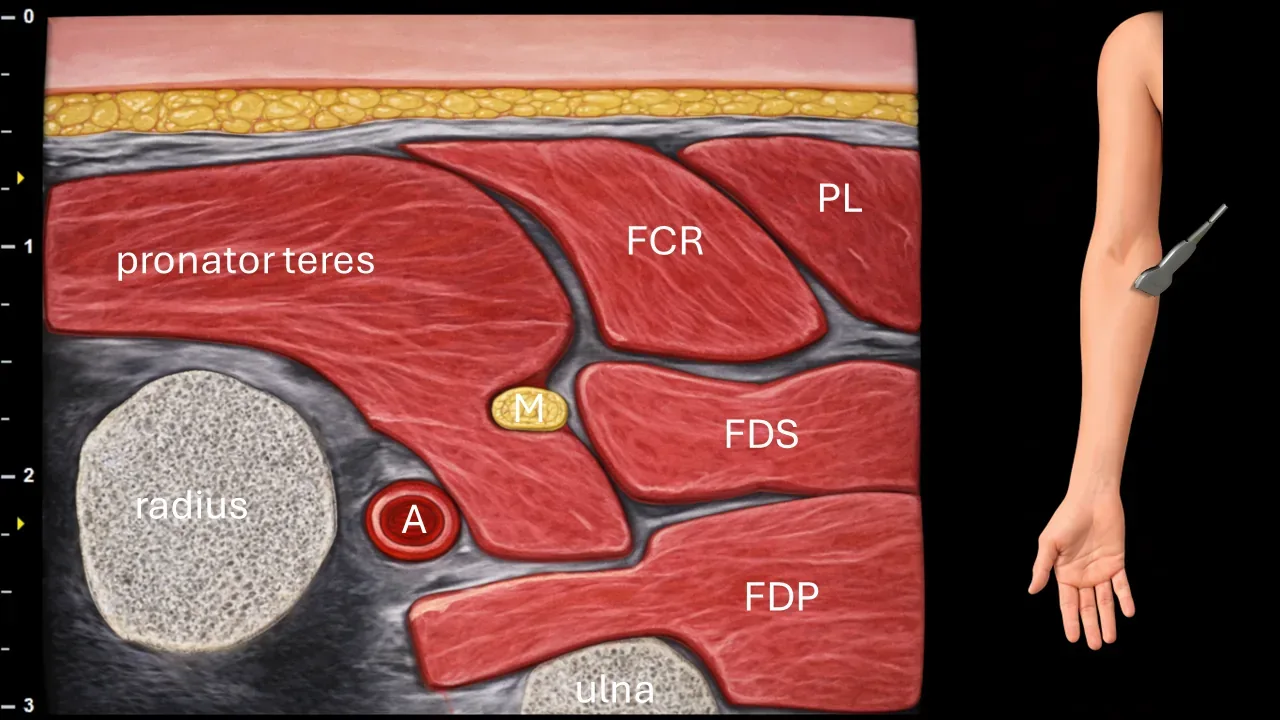
Abbildung 2. Ellenbogen, Transversalebene, Verlauf des N. medianus zwischen den beiden Köpfen des M. pronator teres. A: A. ulnaris, M: N. medianus, FCR: M. flexor carpi radialis, PL: M. palmaris longus, FDS: M. flexor digitorum superficialis, FDP: M. flexor digitorum profundus.
Transversaler sonografischer Schnitt im Bereich des proximalen Unterarms. Der N. medianus (M) verläuft in dieser Projektion zwischen den beiden Köpfen des M. pronator teres, dem oberflächlichen (humeralen) und dem tiefen (ulnaren) Kopf. Der tiefe Kopf des M. pronator teres trennt den N. medianus von der A. ulnaris (A) und ist bei etwa 80% der Personen vorhanden. Das Bild zeigt außerdem den M. flexor carpi radialis (FCR), den M. palmaris longus (PL), den M. flexor digitorum superficialis (FDS), den M. flexor digitorum profundus (FDP) sowie Radius und Ulna.
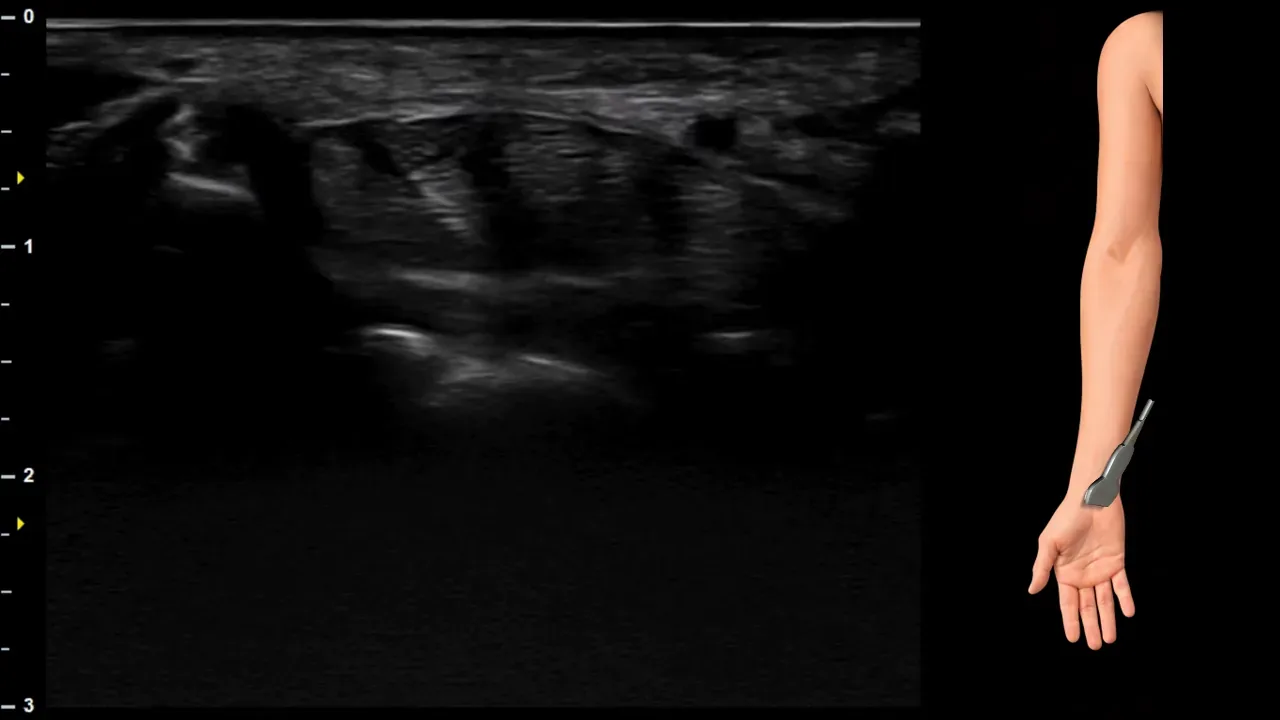
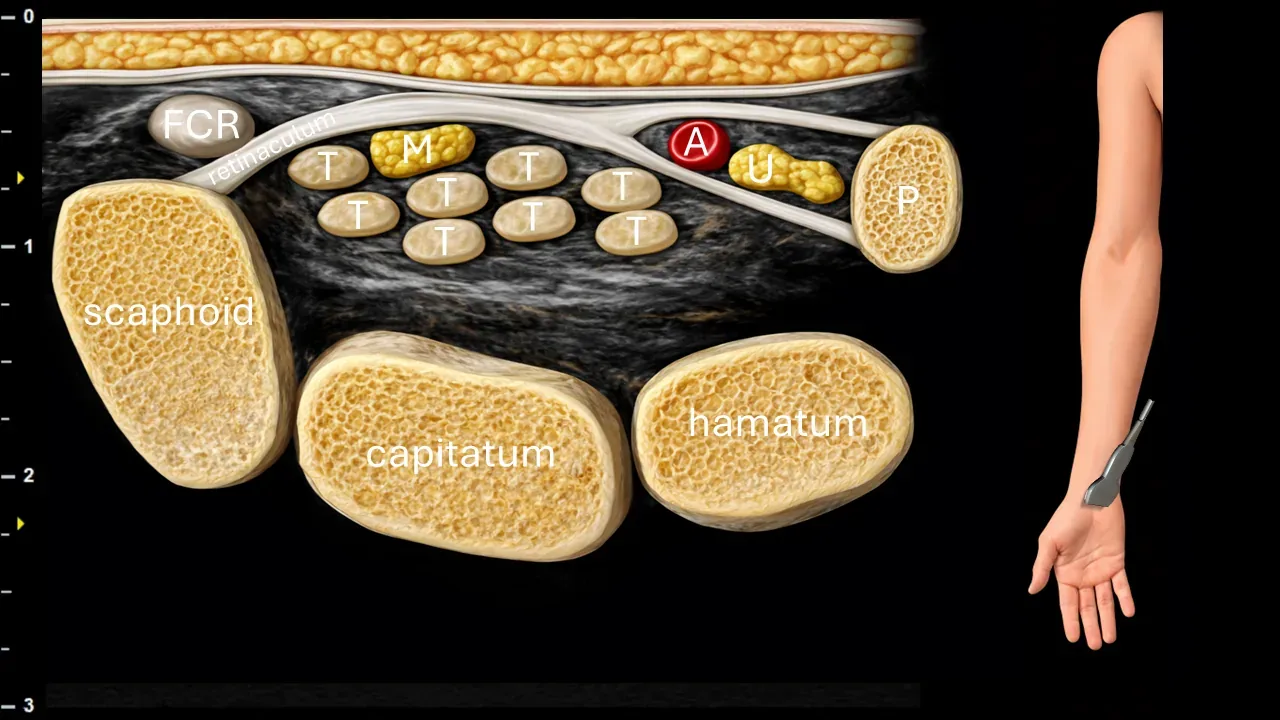
Abbildung 3. Carpus, Transversalebene, Verlauf des n. medianus durch den Karpaltunnel. M: n. medianus, T: Beugesehnen, A: a. ulnaris, U: n. ulnaris, P: os pisiforme, FCR: Sehne des m. flexor carpi radialis.
Transversaler sonografischer Schnitt in der Karpalregion. N. medianus (M) verläuft unter dem Retinaculum flexorum im Karpaltunnel, wo er oberflächlich über den Beugesehnen (T) liegt. Im Bild sind außerdem die Sehne des m. flexor carpi radialis (FCR), die a. ulnaris (A) und der n. ulnaris (U), die ulnarseitig außerhalb des Karpaltunnels liegen, sowie das os pisiforme (P) und die Handwurzelknochen, insbesondere os scaphoideum, os capitatum und os hamatum, dargestellt.