 MSK Academy
Ultraschalluntersuchung
Untersuchungsprotokoll
Nervus medianus im gesamten Verlauf an der oberen Extremität
- Axilla
- Brachium
- Ellenbogen
- Unterarm
- Carpus
Nervus interosseus anterior
- Abstand des AIN vom Hauptstamm des N. medianus
Palmarer Hautnerv
- Abstand des PCN vom Hauptstamm des N. medianus
- Durchtritt des PCN durch die Faszie
Terminaläste und Ramus recurrens
- Terminale Aufzweigung des Nervus medianus
Interaktive Funktion, verfügbar in der App
1. Nervus medianus entlang der gesamten oberen Extremität
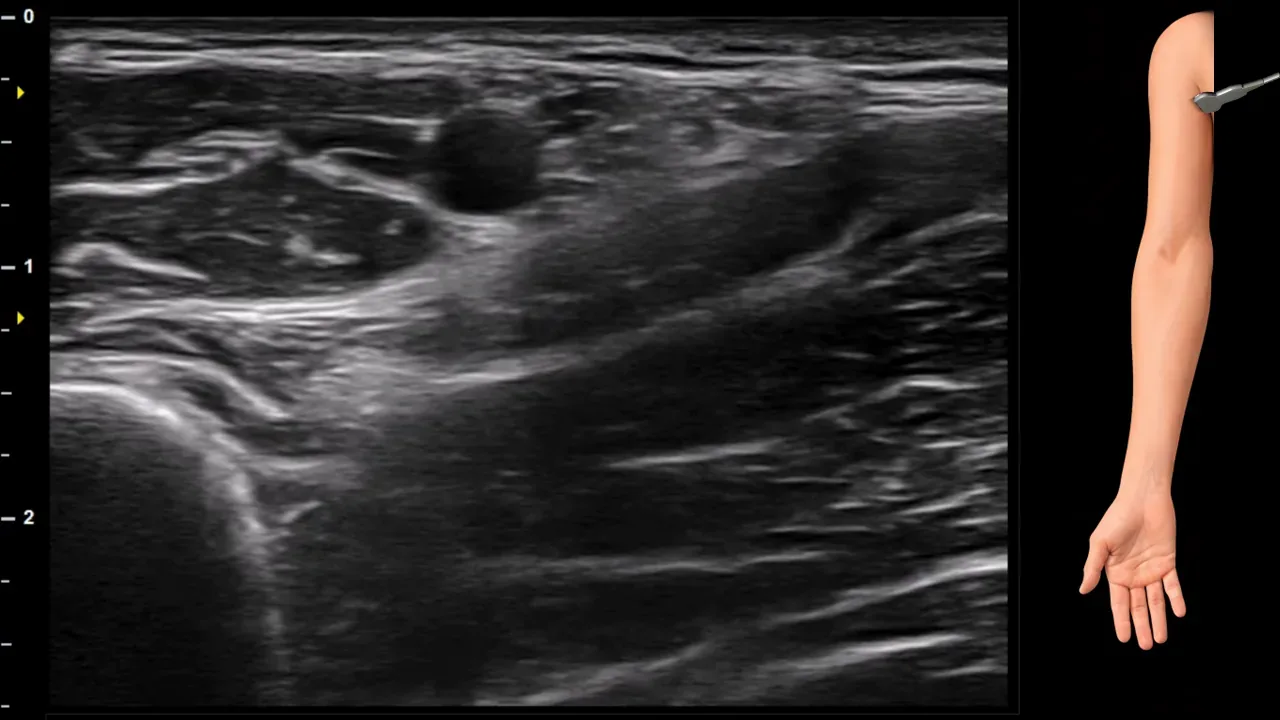
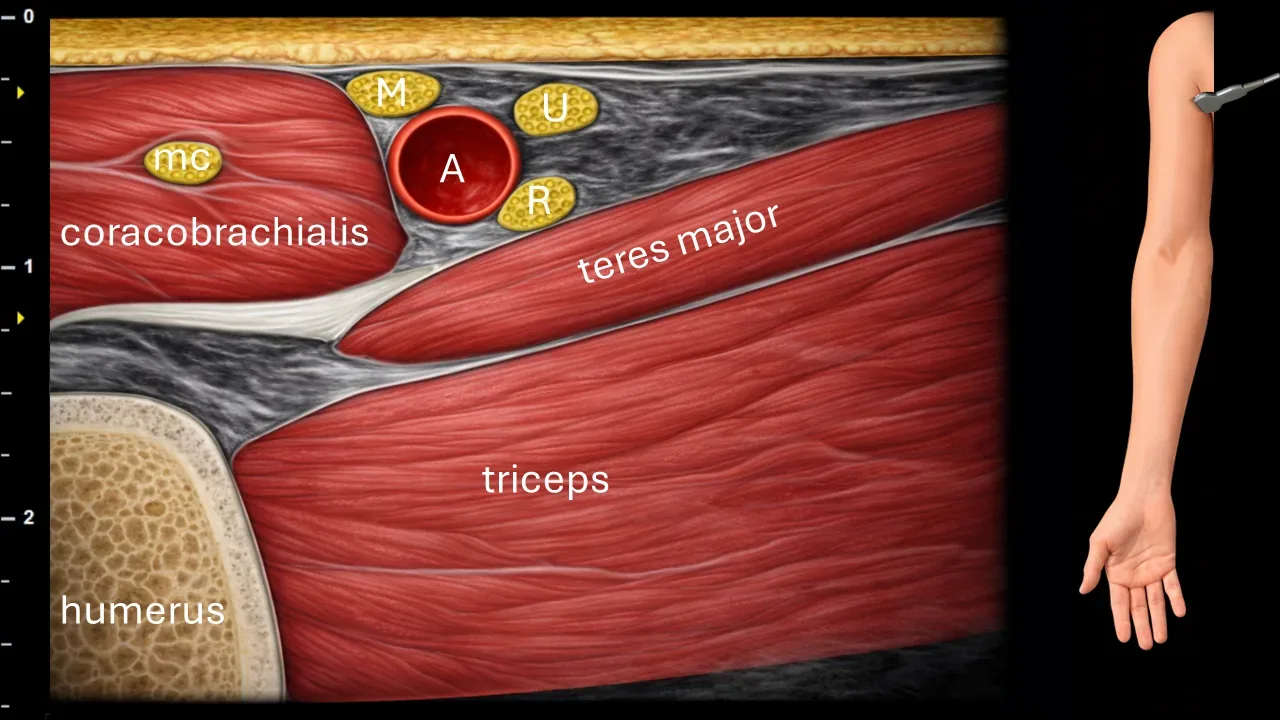
Abbildung 1. Axilla, Transversalebene. A: a. axillaris, M: n. medianus, R: n. radialis, U: n. ulnaris, mc: n. musculocutaneus
Transversaler sonografischer Schnitt durch die Axilla. Das Bild zeigt die a. axillaris (A), um die herum die Nervenstrukturen des Plexus brachialis liegen. Der n. medianus (M) liegt in dieser Projektion leicht ventral, medial und oberflächlich der a. axillaris. In der Umgebung sind außerdem der n. radialis (R), der n. ulnaris (U) und der n. musculocutaneus (mc) sichtbar. Das Bild erfasst zudem Muskelstrukturen, insbesondere den m. coracobrachialis, den m. teres major und den m. triceps brachii, sowie die Kontur des Humerus.
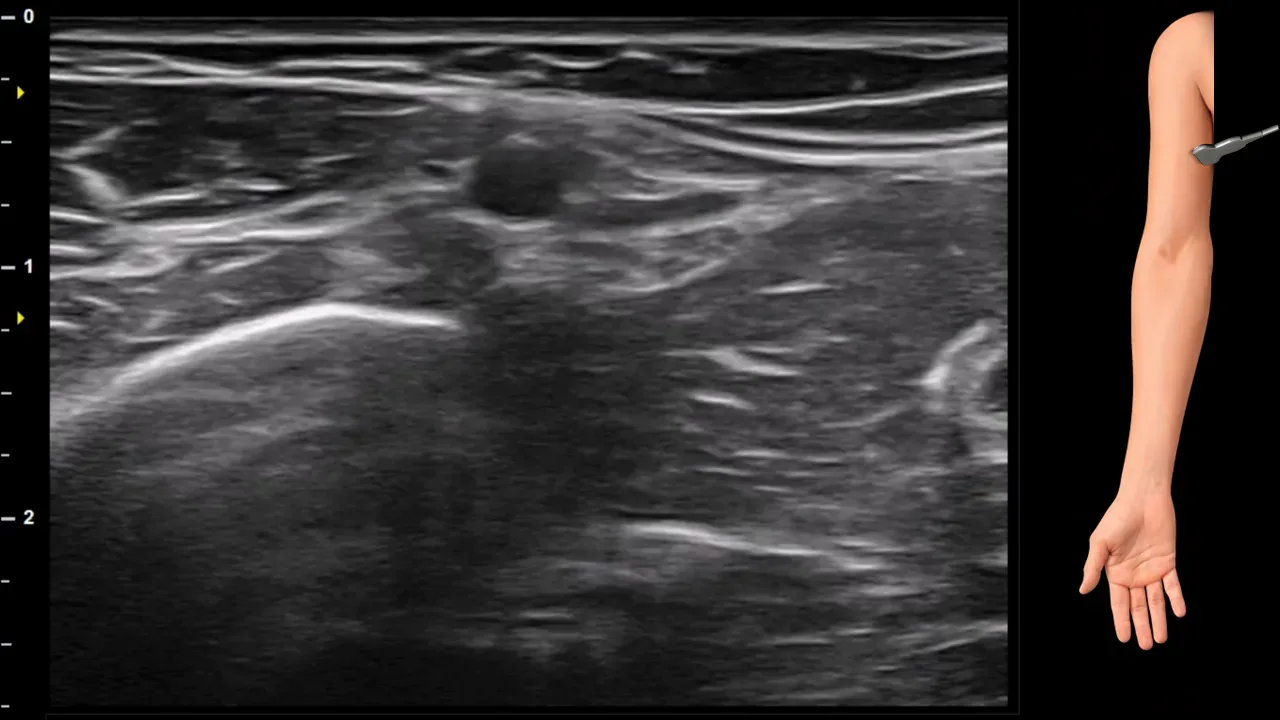
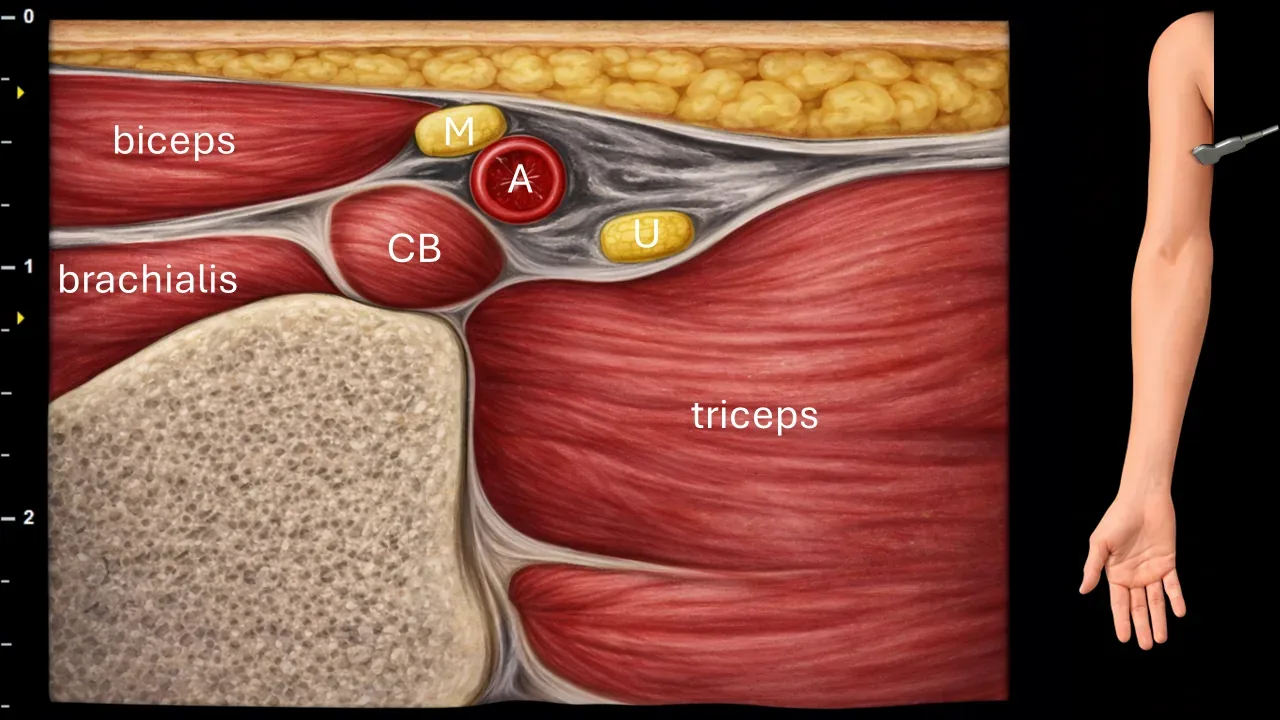
Abbildung 2. Brachium, Transversalebene. A: a. brachialis, M: n. medianus, U: n. ulnaris, CB: m. coracobrachialis.
Sonografischer Transversalschnitt des Oberarms. Das Bild zeigt die a. brachialis (A), die in unmittelbarer Nähe zu nervalen Strukturen verläuft. Der n. medianus (M) liegt in dieser Projektion angrenzend an die a. brachialis und verläuft am Oberarm gemeinsam mit ihr als Teil des neurovaskulären Bündels. Das Bild zeigt außerdem den n. ulnaris (U) und muskuläre Strukturen, insbesondere den m. coracobrachialis (CB), den m. biceps brachii, den m. brachialis und den m. triceps brachii.
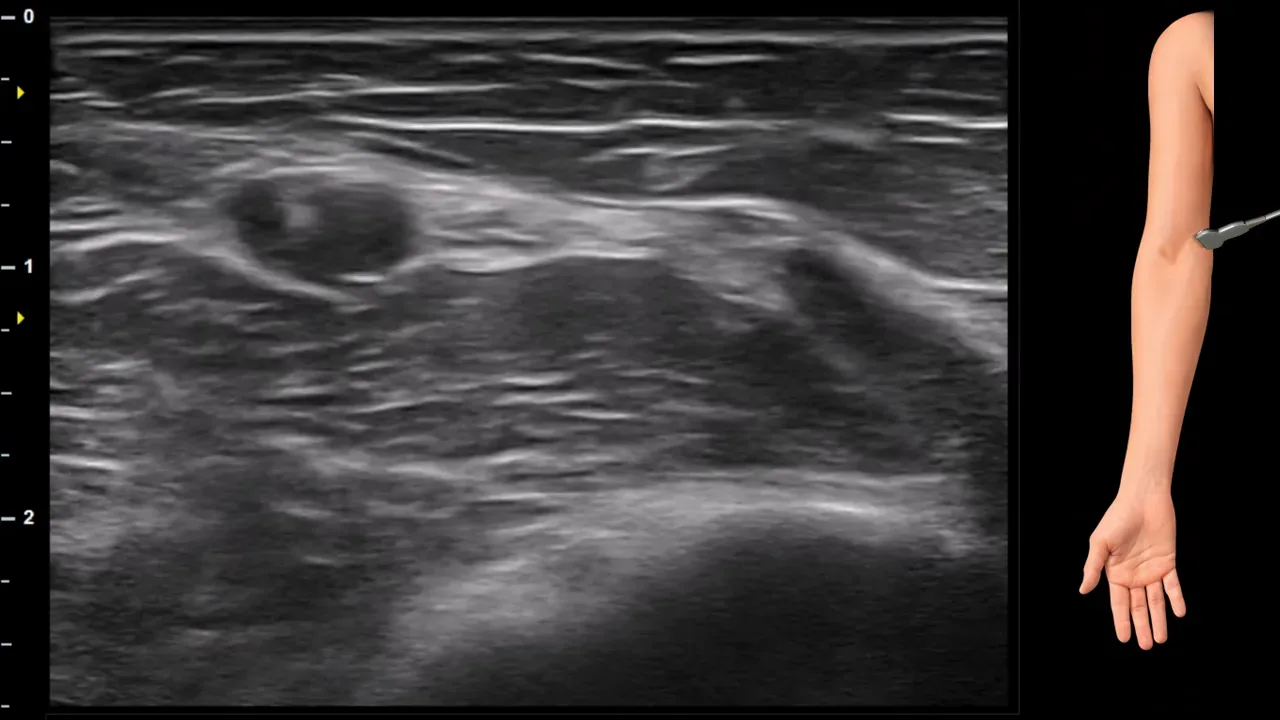
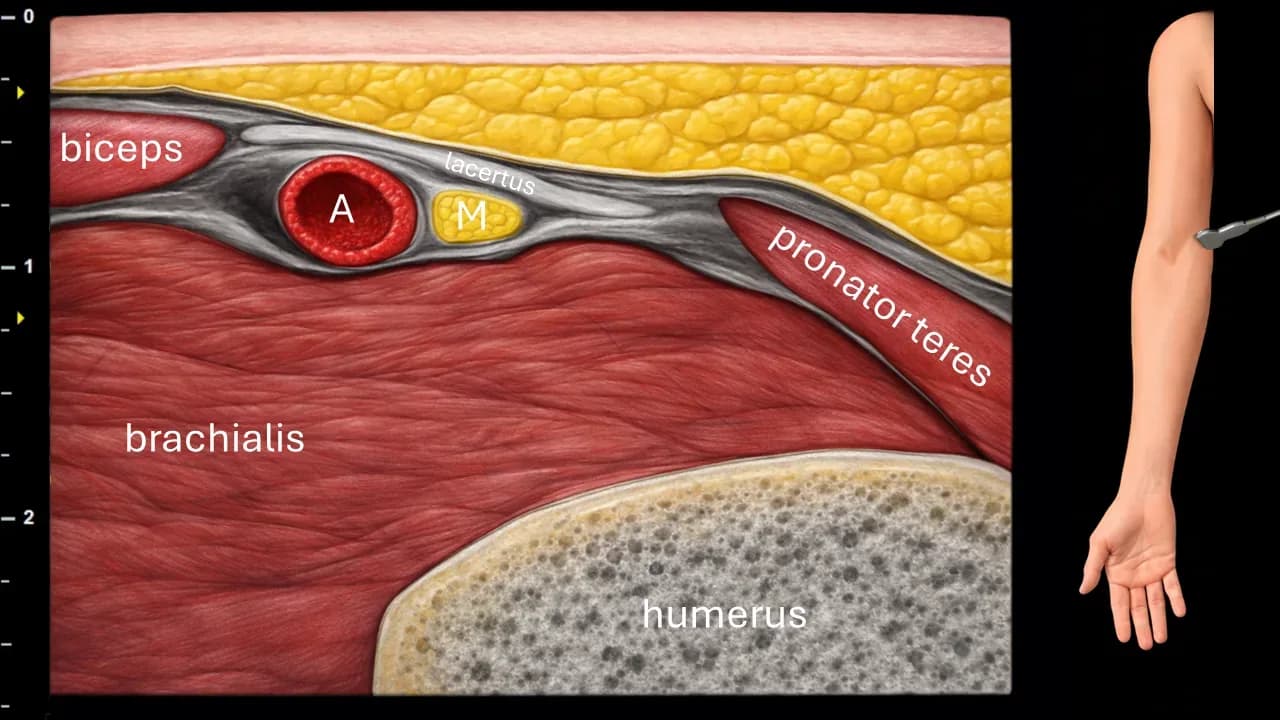
Abbildung 3. Cubitum, Transversalebene. A: A. brachialis, M: N. medianus.
Transversaler sonografischer Schnitt im Bereich der Fossa cubitalis. Das Bild zeigt die A. brachialis (A) und den N. medianus (M), der in dieser Projektion medial der A. brachialis liegt. Der N. medianus verläuft weiter unter dem Lacertus fibrosus und liegt im Raum zwischen dem M. brachialis und dem M. pronator teres. Das Bild erfasst außerdem den M. biceps brachii, den M. brachialis, den M. pronator teres und die Kontur des Humerus.
Klinischer Hinweis
Der Bereich unter dem lacertus fibrosus stellt eine der möglichen Stellen einer Kompression des N. medianus dar.
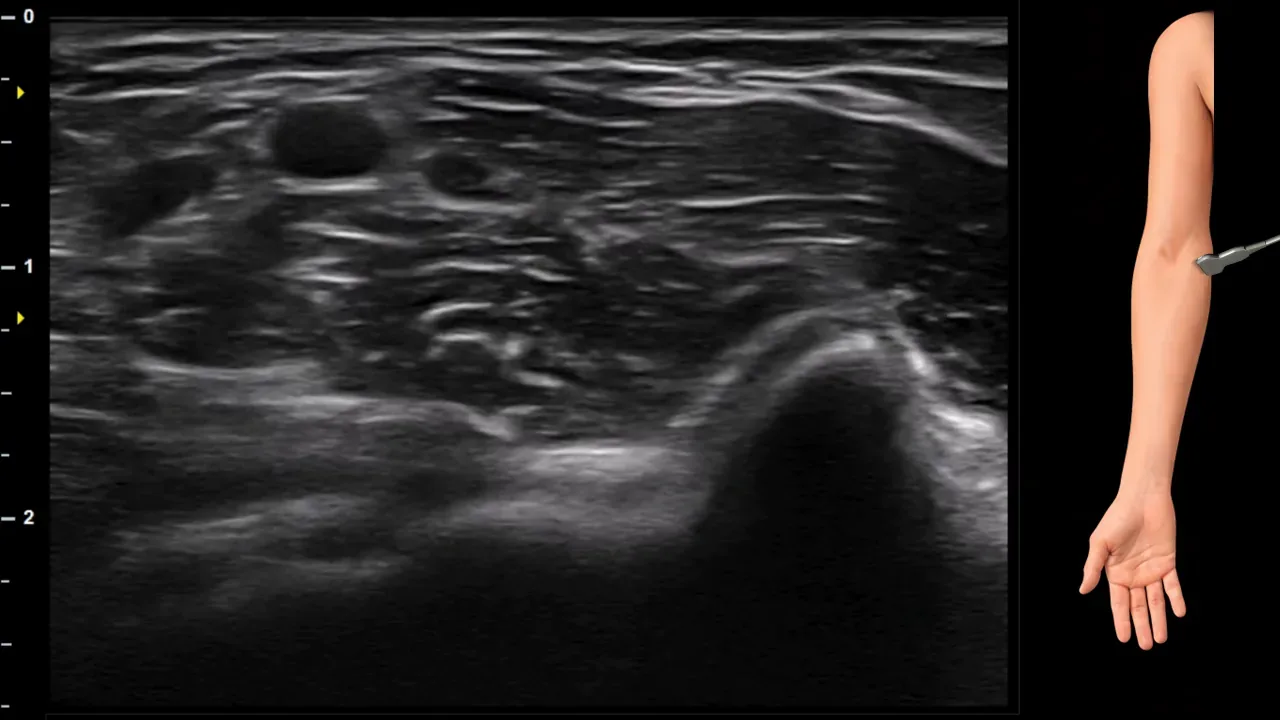
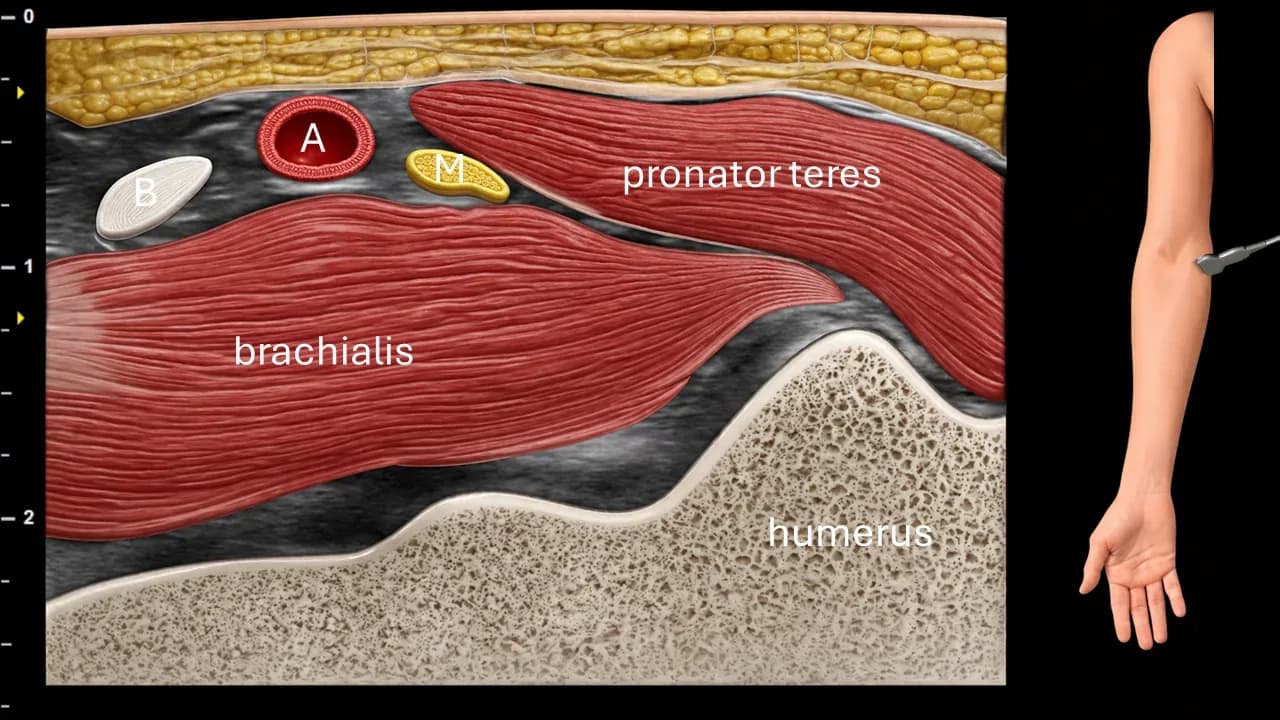
Abbildung 4. Ellenbogen, Transversalebene. A: A. brachialis, M: N. medianus, B: distale Sehne des M. biceps brachii.
Transversaler Ultraschallschnitt im Bereich der Fossa cubitalis. Das Bild zeigt die A. brachialis (A), die distale Sehne des M. biceps brachii (B) und den N. medianus (M). Der N. medianus verläuft in dieser Region zwischen dem M. brachialis und dem M. pronator teres. Das Bild erfasst außerdem den M. brachialis, den M. pronator teres und die Kontur des Humerus.
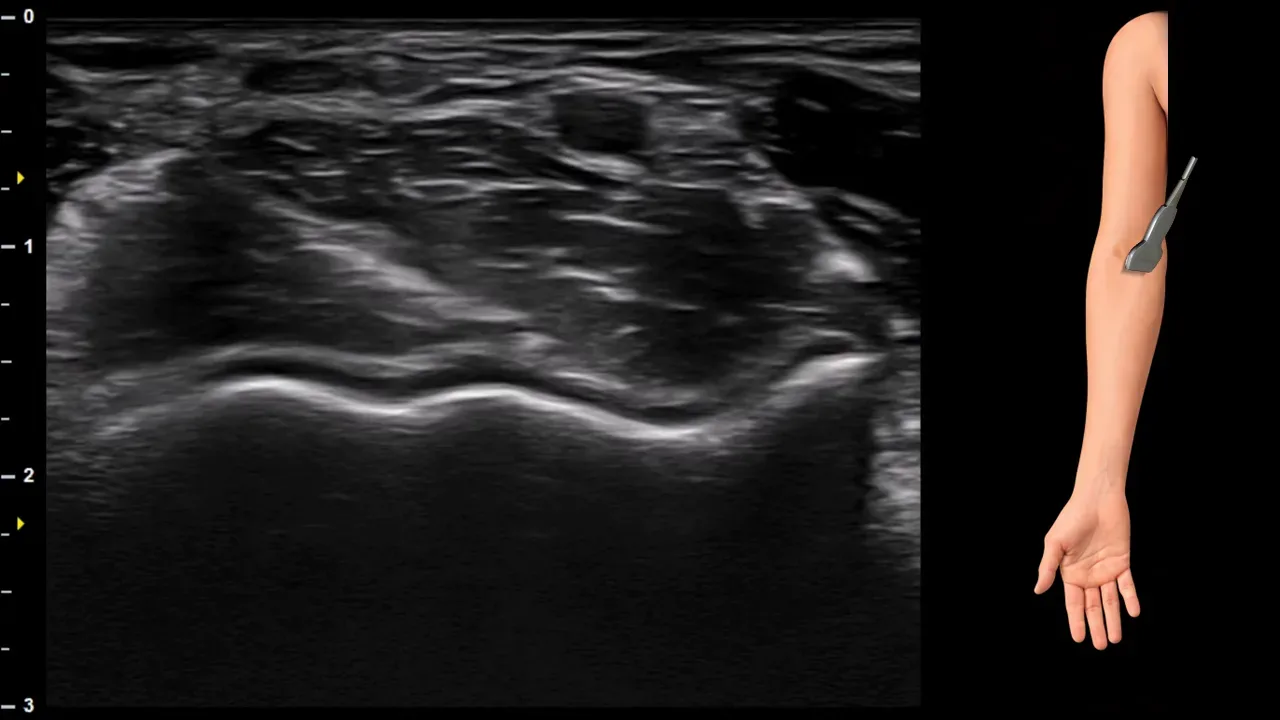
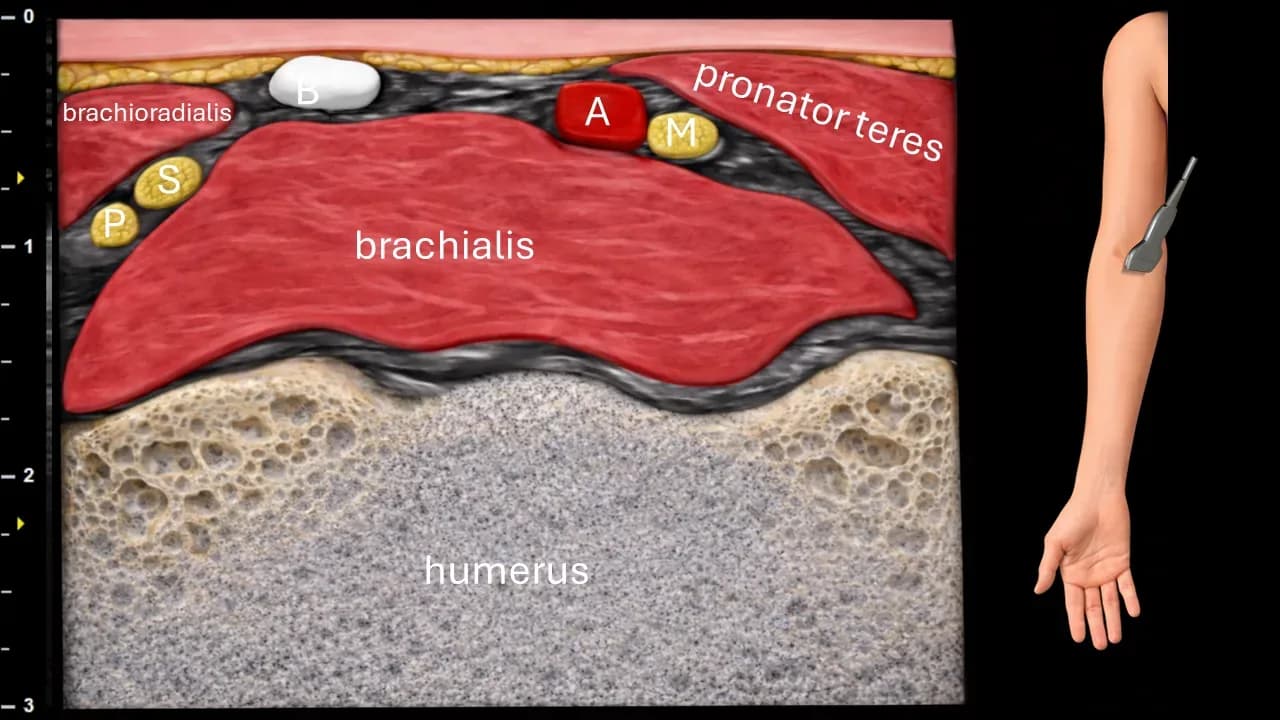
Abbildung 5. Ellenbogen, Transversalebene. A: a. brachialis, M: n. medianus, B: distale Sehne des m. biceps brachii, S: ramus superficialis n. radialis, P: ramus profundus n. radialis.
Transversaler Ultraschallschnitt im Bereich der Ellenbeuge bei der grundlegenden Darstellung des Ellenbogens. Das Bild zeigt die a. brachialis (A), die distale Sehne des m. biceps brachii (B) und den n. medianus (M), der zwischen m. brachialis und m. pronator teres liegt. Lateral sind außerdem Äste des n. radialis sichtbar, insbesondere der ramus superficialis n. radialis (S) und der ramus profundus n. radialis (P). Das Bild zeigt zudem den m. brachialis, den m. brachioradialis, den m. pronator teres und die Kontur des Humerus.
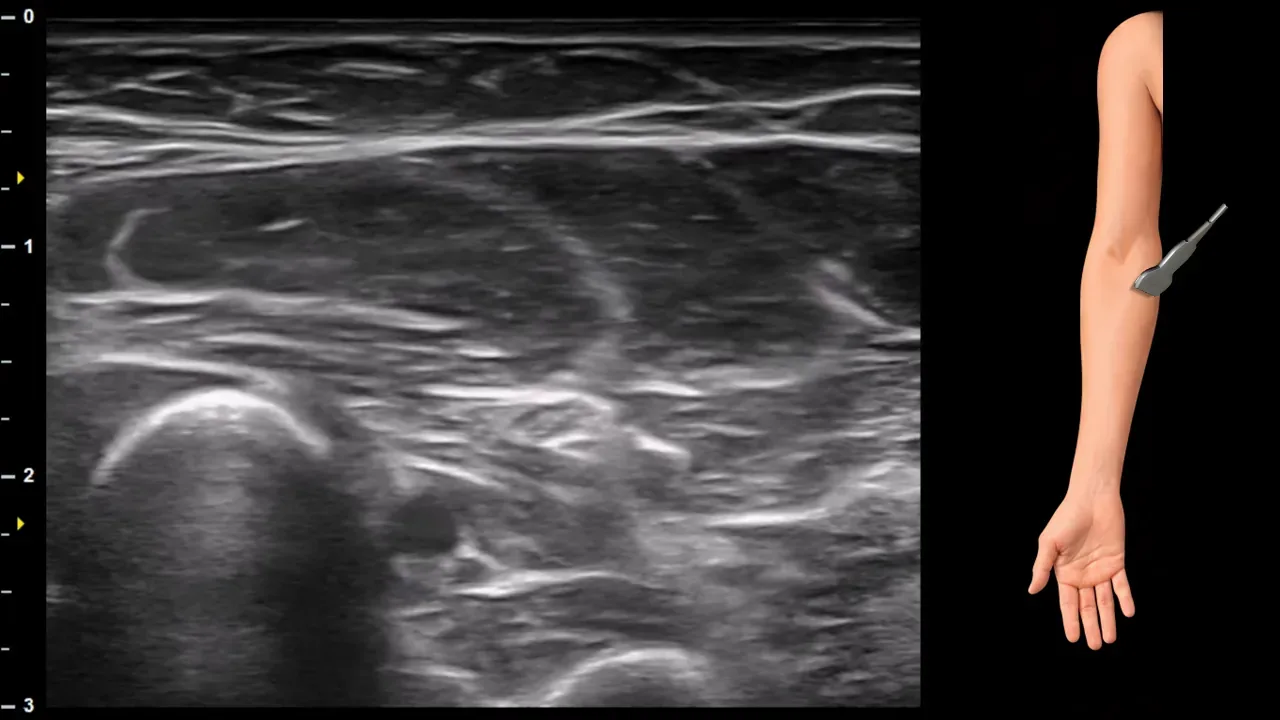
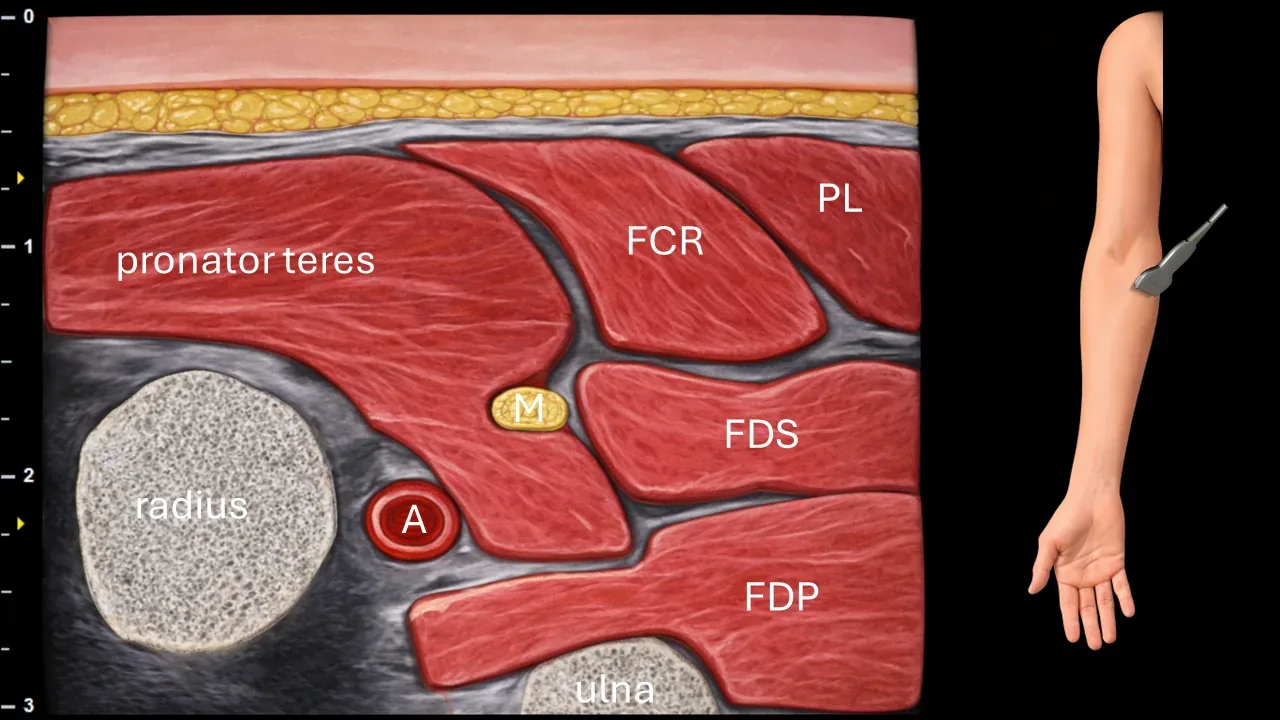
Abbildung 6. Cubitum, Transversalebene. A: a. ulnaris, M: n. medianus, FCR: m. flexor carpi radialis, PL: m. palmaris longus, FDS: m. flexor digitorum superficialis, FDP: m. flexor digitorum profundus.
Transversaler Ultraschallschnitt im Bereich des proximalen Unterarms. Der N. medianus (M) verläuft in dieser Projektion zwischen den beiden Köpfen des M. pronator teres, dem oberflächlichen (humeralen) und dem tiefen (ulnaren) Kopf. Der tiefe Kopf des M. pronator teres trennt den N. medianus von der A. ulnaris (A) und ist bei ungefähr 80% der Personen vorhanden. Das Bild zeigt außerdem den M. flexor carpi radialis (FCR), den M. palmaris longus (PL), den M. flexor digitorum superficialis (FDS), den M. flexor digitorum profundus (FDP) sowie Radius und Ulna.
Klinischer Hinweis
In diesem Bereich kann es zwischen den Köpfen des Musculus pronator teres zu einer Kompression des Nervus medianus kommen, die Ursache eines Pronator-Syndroms sein kann.
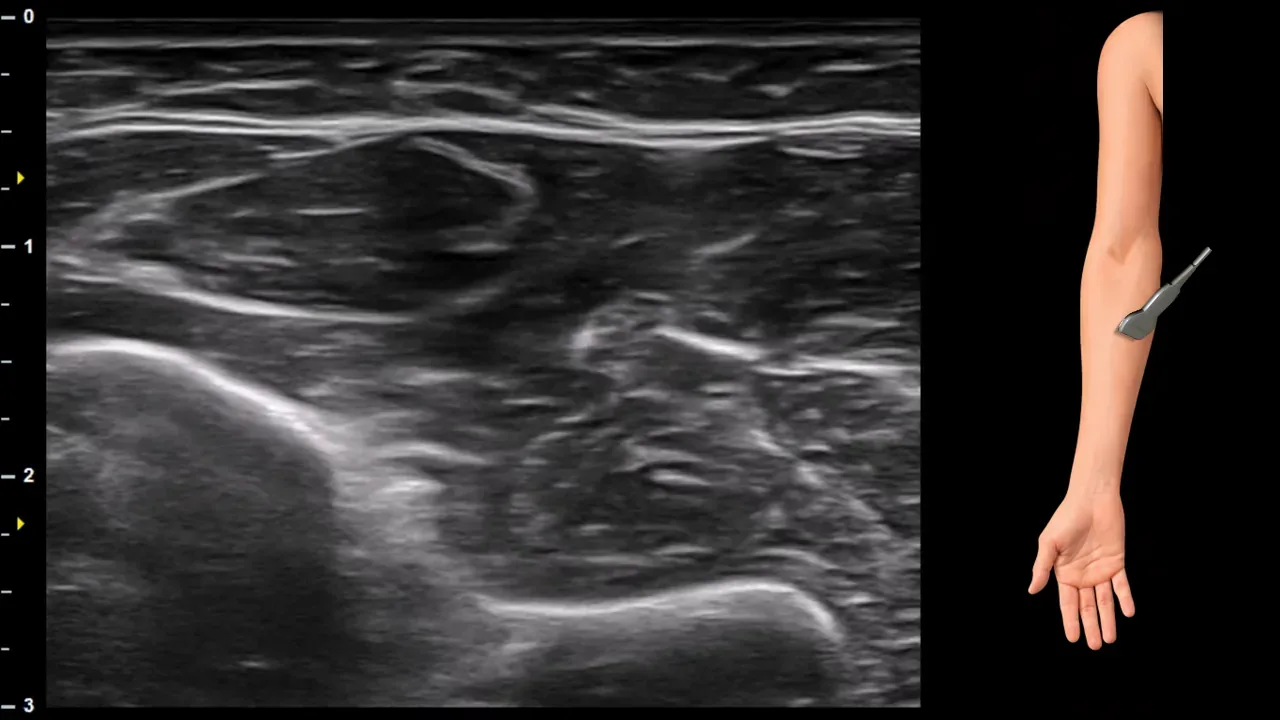
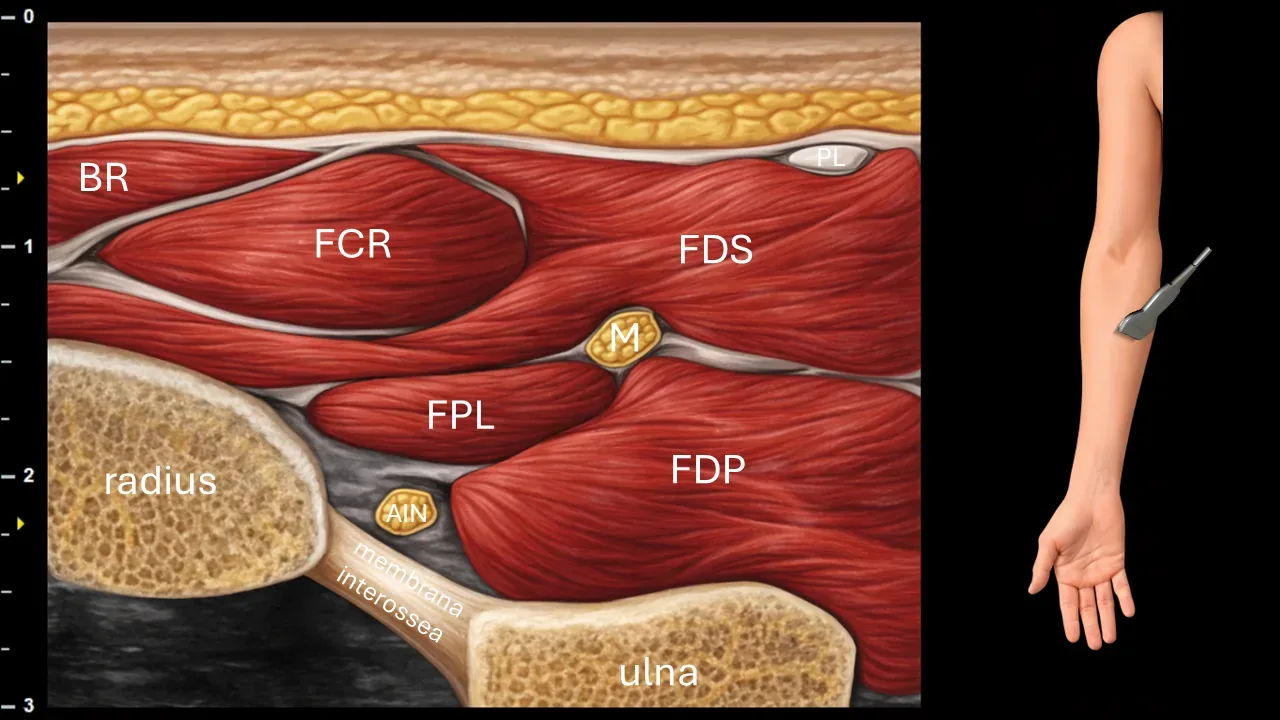
Abbildung 7. Unterarm, Transversalebene. M: N. medianus, AIN: N. interosseus anterior, BR: M. brachioradialis, FCR: M. flexor carpi radialis, PL: M. palmaris longus, FDS: M. flexor digitorum superficialis, FDP: M. flexor digitorum profundus, FPL: M. flexor pollicis longus.
Transversaler sonografischer Schnitt im Bereich des Unterarms. Der N. medianus (M) verläuft in dieser Projektion zwischen dem M. flexor digitorum superficialis (FDS), dem M. flexor digitorum profundus (FDP) und dem M. flexor pollicis longus (FPL). Der N. interosseus anterior (AIN) zweigt hier vom N. medianus ab und zieht zwischen den Flexoren zur Membrana interossea nach distal. Im Bild sind außerdem der M. brachioradialis (BR), der M. flexor carpi radialis (FCR), der M. palmaris longus (PL), der Radius, die Ulna und die Membrana interossea dargestellt.
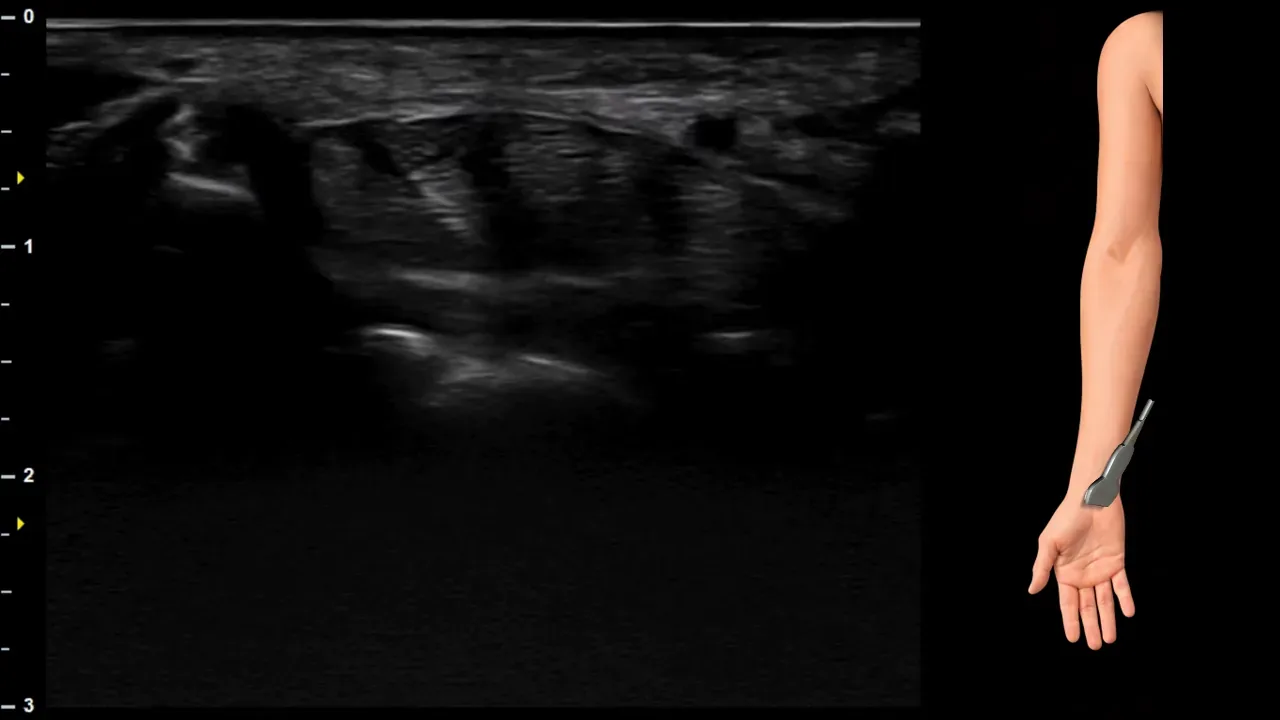
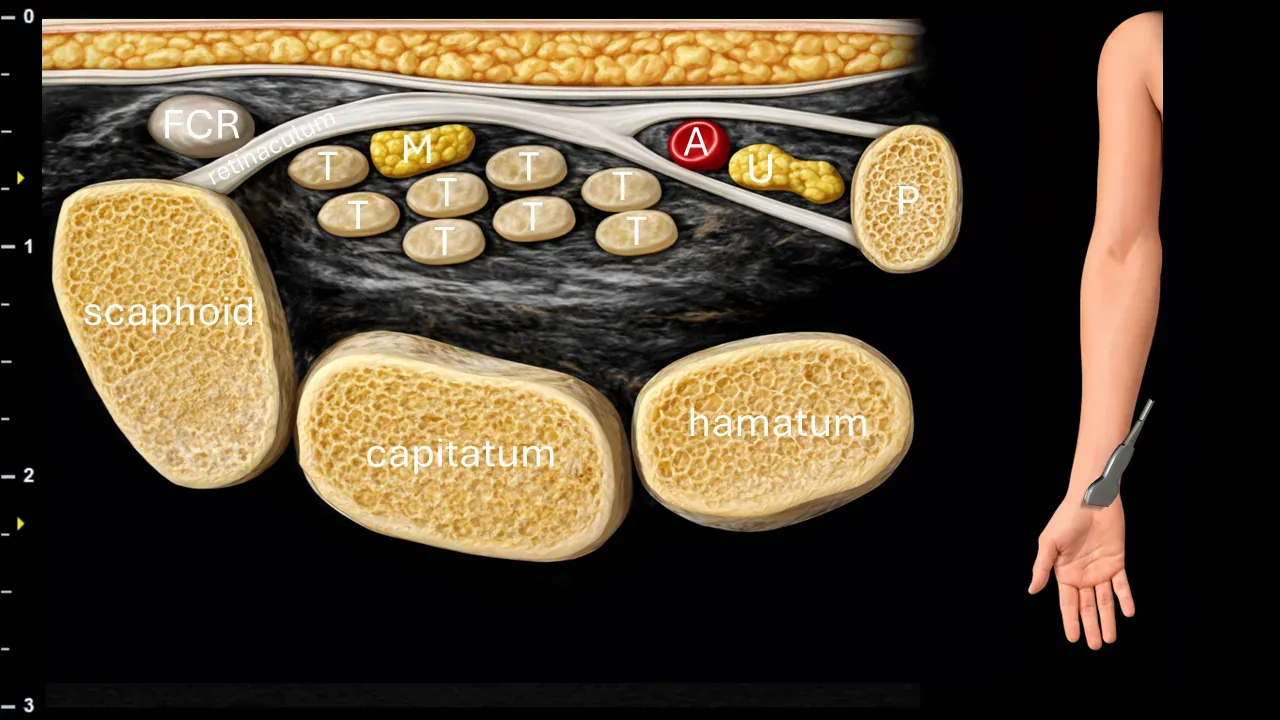
Abbildung 8. Carpus, Transversalebene. M: n. medianus, T: Beugesehnen, A: a. ulnaris, U: n. ulnaris, P: os pisiforme, FCR: Sehne des m. flexor carpi radialis.
Sonografischer Querschnitt in der Karpalregion. N. medianus (M) verläuft unter dem Retinaculum flexorum im Karpaltunnel, wo er oberflächlich über den Beugesehnen (T) liegt. Das Bild zeigt außerdem die Sehne des m. flexor carpi radialis (FCR), die a. ulnaris (A) und den n. ulnaris (U), die ulnar außerhalb des Karpaltunnels liegen, sowie das os pisiforme (P) und die Handwurzelknochen, insbesondere os scaphoideum, os capitatum und os hamatum.
Klinischer Hinweis
Der Bereich des Karpaltunnels unter dem retinaculum flexorum stellt die häufigste Kompressionsstelle des Medianusnervs dar, was zur Entwicklung eines Karpaltunnelsyndroms führt.
2. N. interosseus anterior
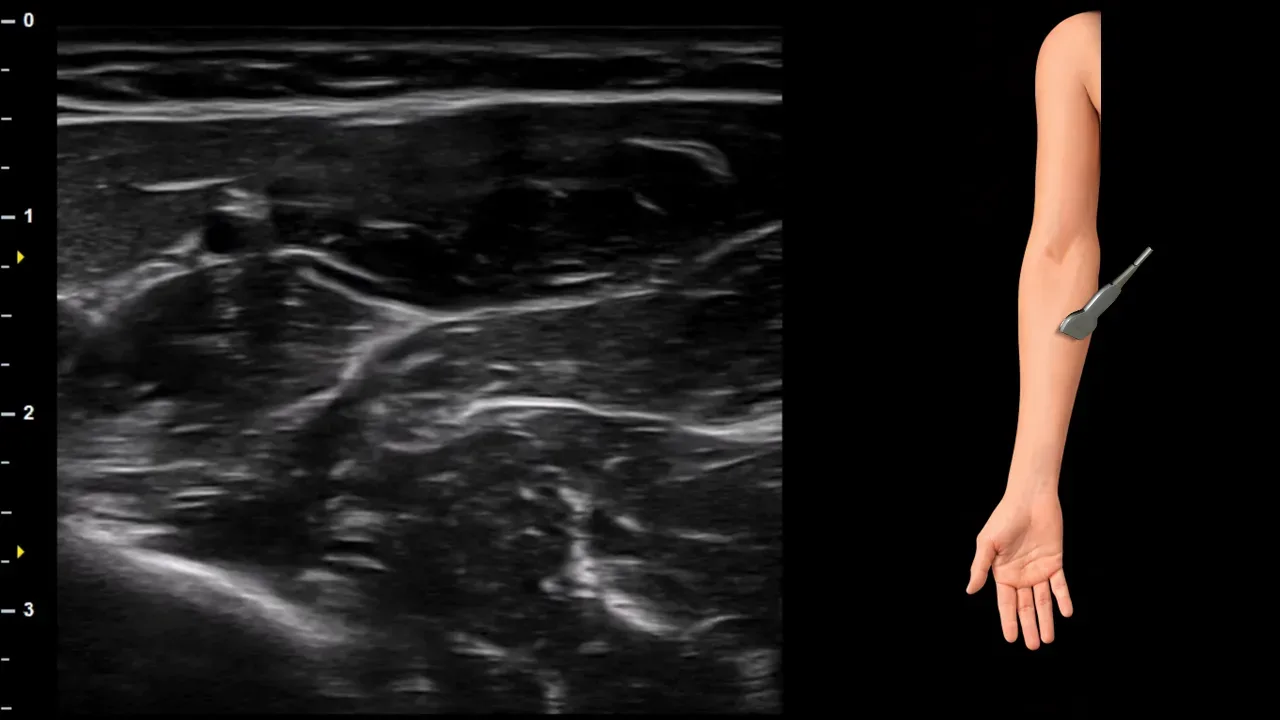
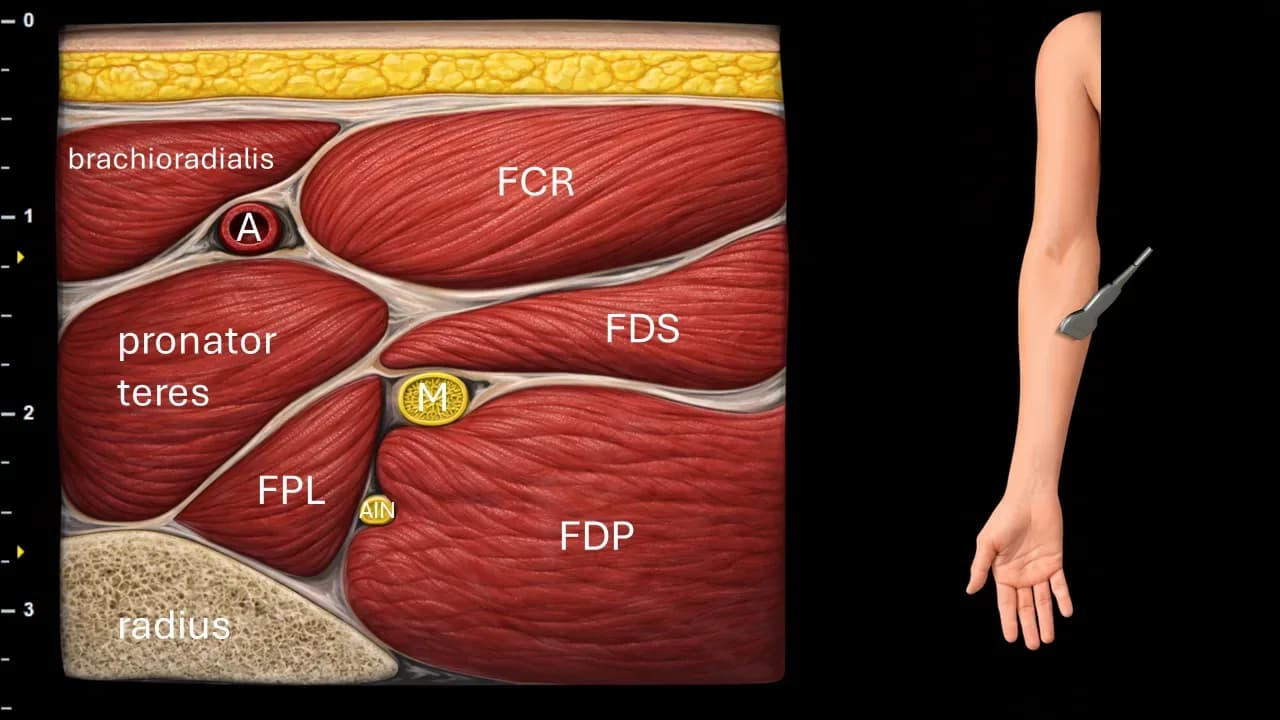
Figure 9. Forearm, transverse plane. A: a. radialis, M: n. medianus, AIN: n. interosseus anterior, FCR: m. flexor carpi radialis, FDS: m. flexor digitorum superficialis, FPL: m. flexor pollicis longus, FDP: m. flexor digitorum profundus.
Transverse ultrasound section in the forearm region. The image shows the n. medianus (M) after passing through the m. pronator teres, from whose main branch the n. interosseus anterior (AIN) arises. The AIN then descends between the m. flexor pollicis longus (FPL) and m. flexor digitorum profundus (FDP) toward the membrana interossea. The image also captures the a. radialis (A), m. flexor carpi radialis (FCR), m. flexor digitorum superficialis (FDS), m. pronator teres, and radius.
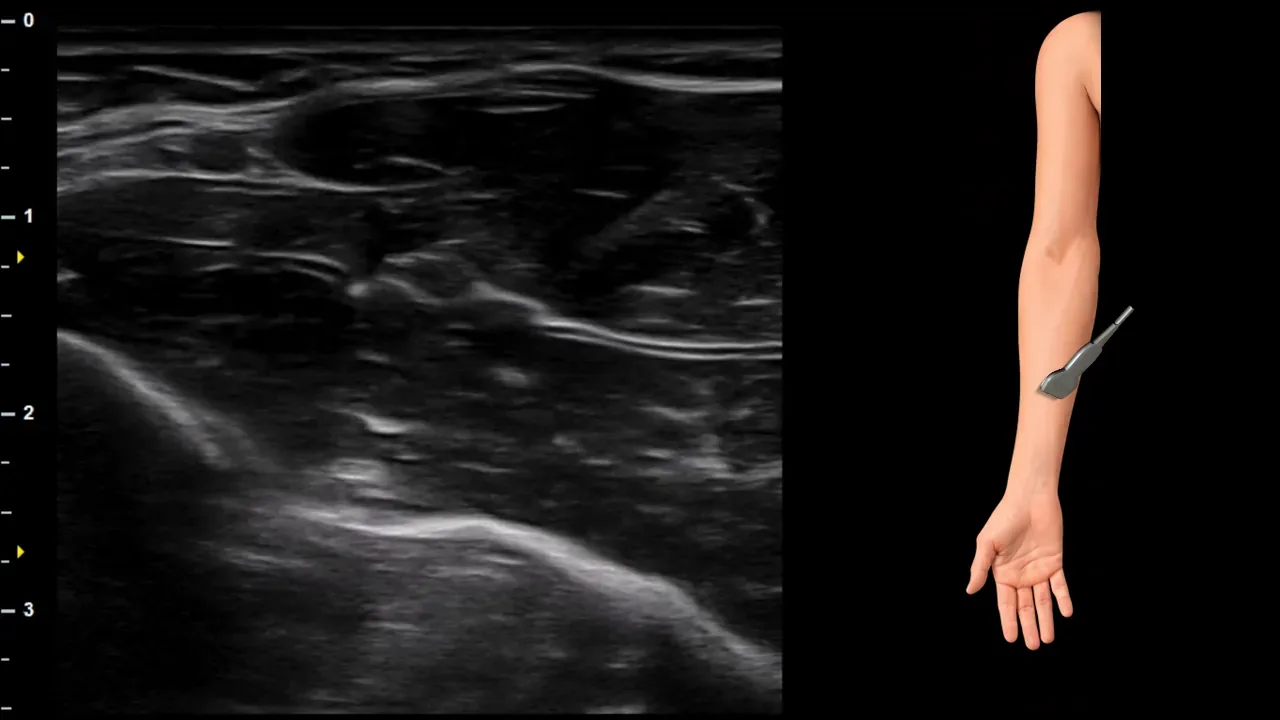
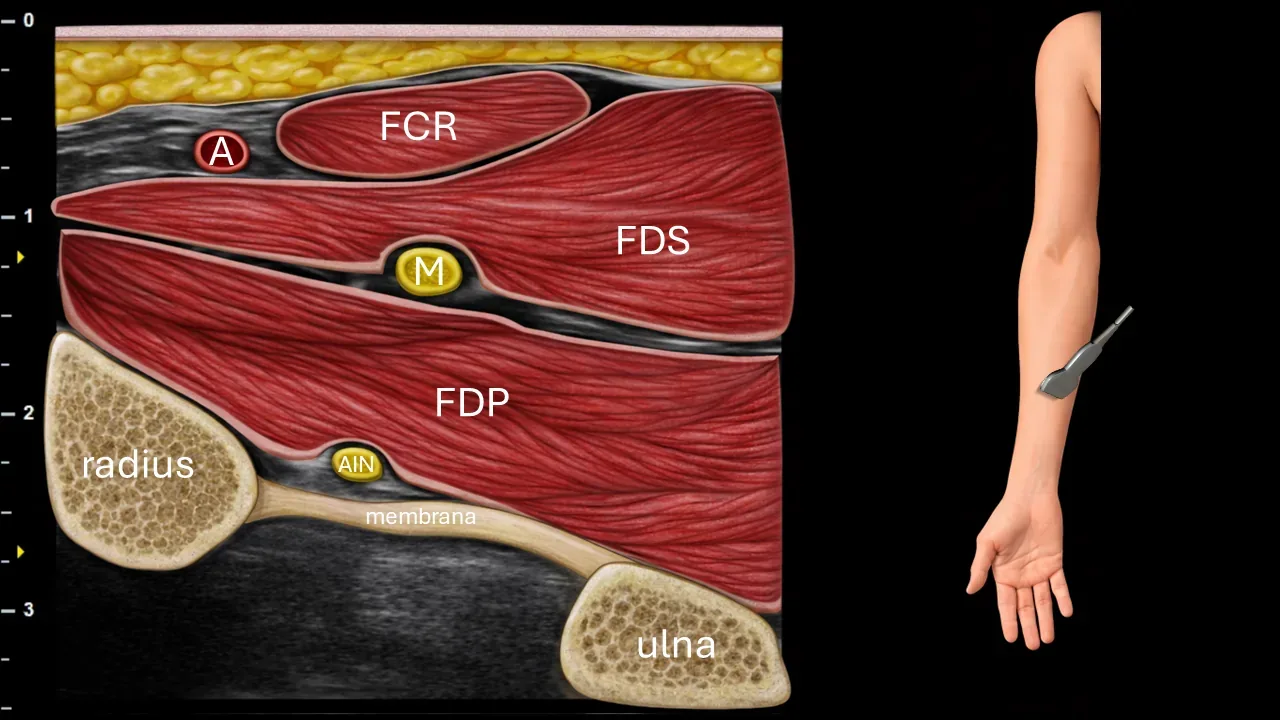
Abbildung 10. Unterarm, Transversalebene. A: a. radialis, M: n. medianus, AIN: n. interosseus anterior, FCR: m. flexor carpi radialis, FDS: m. flexor digitorum superficialis, FDP: m. flexor digitorum profundus.
Transversaler sonografischer Schnitt im Bereich des Unterarms. Der n. interosseus anterior (AIN) verläuft entlang der Membrana interossea tief unter dem m. flexor digitorum profundus (FDP) und zieht distal unter dem m. pronator quadratus weiter. Im Bild sind außerdem der zwischen den Flexoren gelegene n. medianus (M), die a. radialis (A), der m. flexor carpi radialis (FCR), der m. flexor digitorum superficialis (FDS), Radius, Ulna und Membrana interossea sichtbar.
3. Palmarer Hautnerv
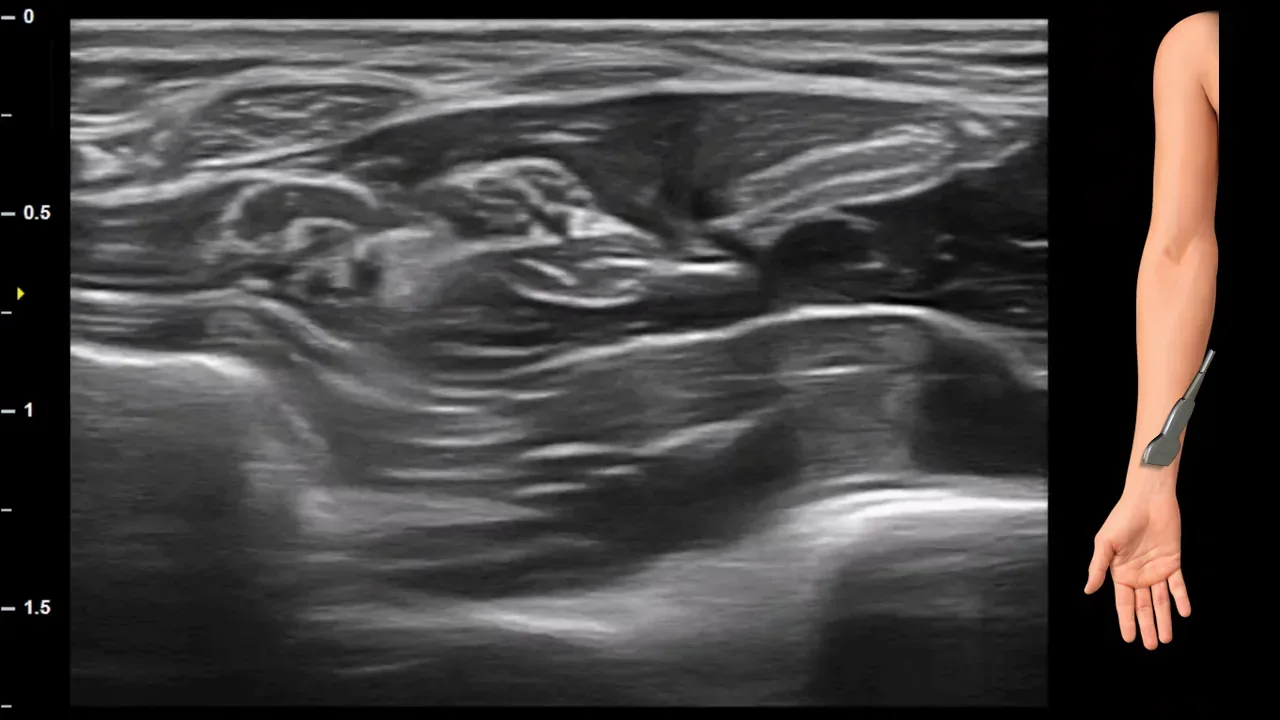
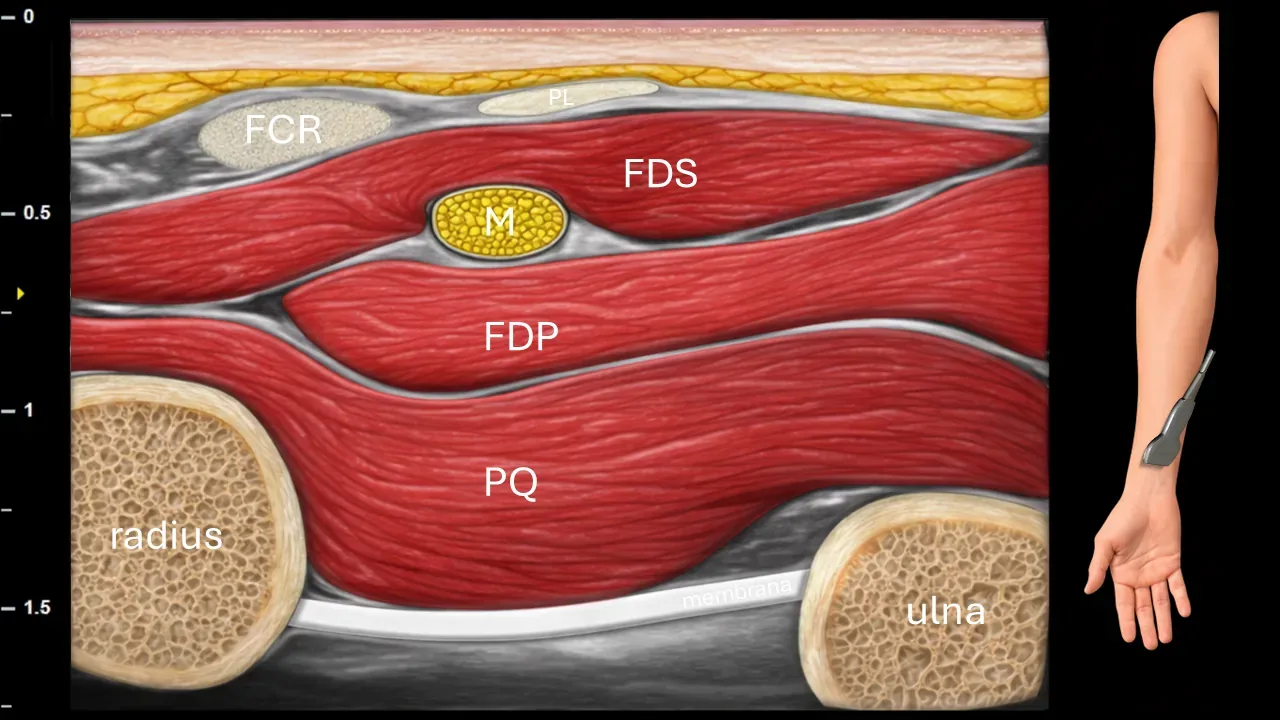
Abbildung 11. Antebrachium, Transversalebene. M: n. medianus, FCR: m. flexor carpi radialis, PL: m. palmaris longus, FDS: m. flexor digitorum superficialis, FDP: m. flexor digitorum profundus, PQ: m. pronator quadratus.
Transversaler Ultraschallschnitt in der weiter distal gelegenen Region des Unterarms. N. medianus (M) liegt in dieser Projektion zwischen m. flexor digitorum superficialis (FDS) und m. flexor digitorum profundus (FDP) im Bereich oberhalb des m. pronator quadratus (PQ). Im Bild sind außerdem m. flexor carpi radialis (FCR), m. palmaris longus (PL), Radius, Ulna und membrana interossea dargestellt.
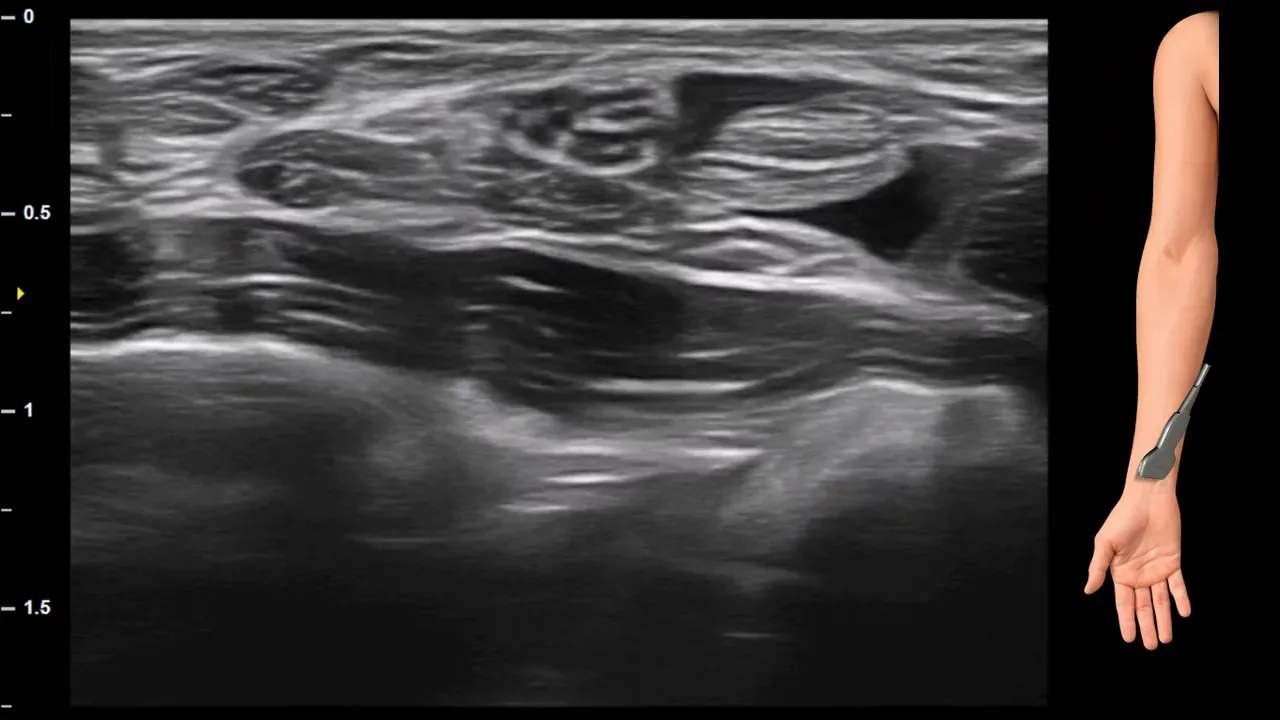
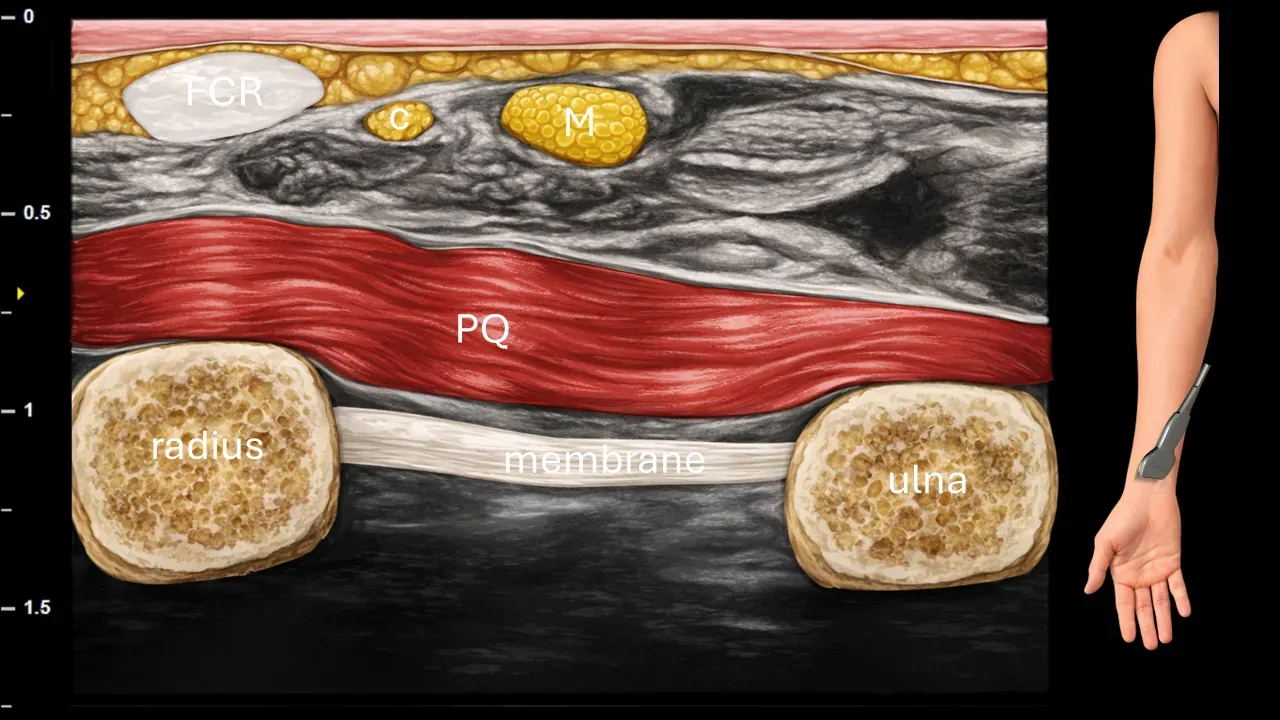
Abbildung 12. Antebrachium, Transversalebene. M: n. medianus, c: ramus cutaneus palmaris n. mediani, FCR: Sehne des m. flexor carpi radialis, PQ: m. pronator quadratus.
Transversaler Ultraschallschnitt im distalen Abschnitt des Unterarms. Der Ramus cutaneus palmaris n. mediani (c) zweigt auf Höhe des m. pronator quadratus (PQ) lateral vom Hauptstamm des n. medianus (M) ab und verläuft oberflächlich in Richtung der Sehne des m. flexor carpi radialis (FCR). Das Bild zeigt außerdem Radius, Ulna, Membrana interossea und m. pronator quadratus.
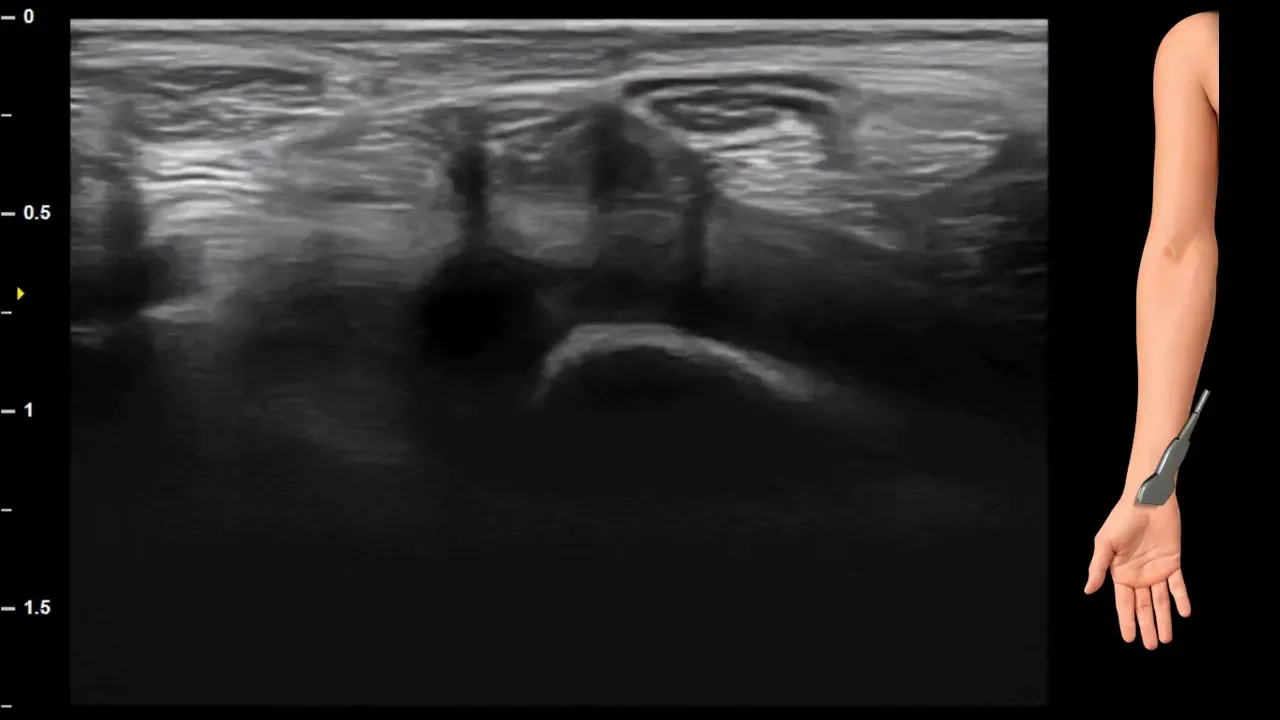
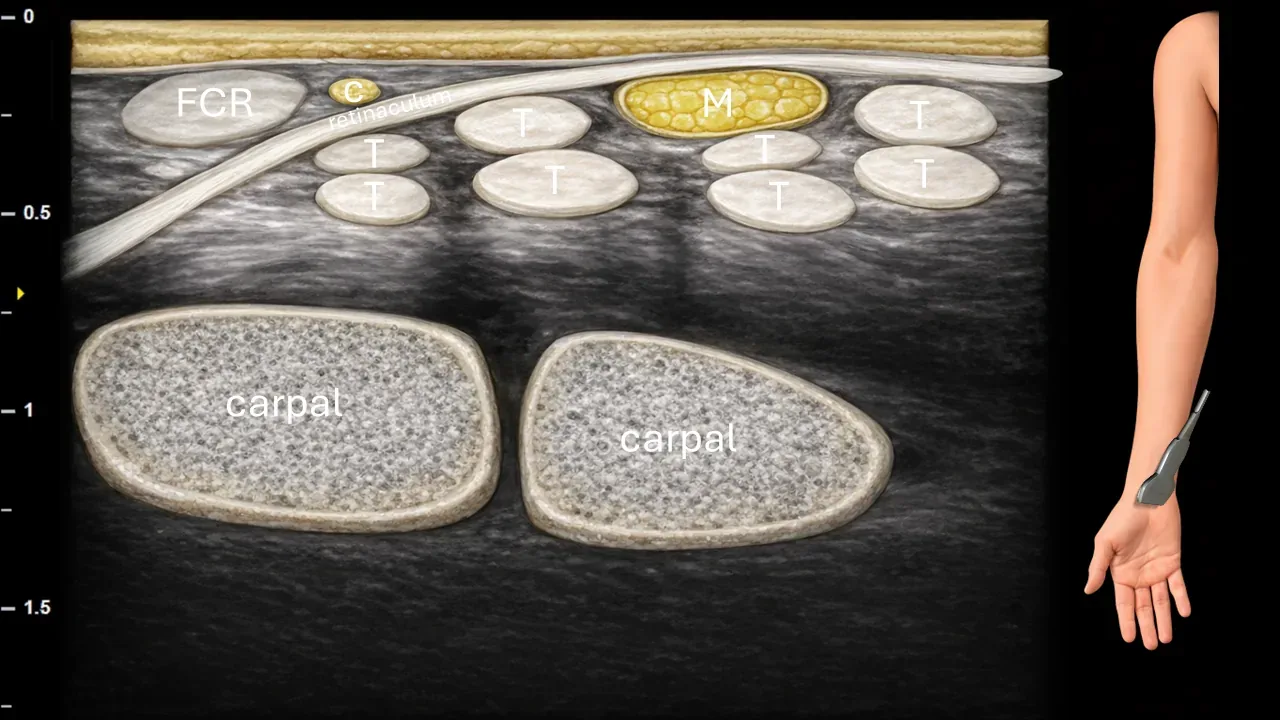
Abbildung 13. Carpus, Transversalebene. M: N. medianus, c: palmarer Hautast des N. medianus, T: Beugesehnen, FCR: Sehne des M. flexor carpi radialis.
Transversaler Ultraschallschnitt in der Karpalregion. Der N. medianus (M) befindet sich im Karpaltunnel unterhalb des Retinaculum flexorum zwischen den Beugesehnen (T). Der palmare Hautast des N. medianus (c) hat auf dieser Höhe bereits die Unterarmfaszie perforiert und verläuft oberflächlich des Retinaculum flexorum in Richtung Handfläche. Das Bild zeigt außerdem die Sehne des M. flexor carpi radialis (FCR) und die Handwurzelknochen.
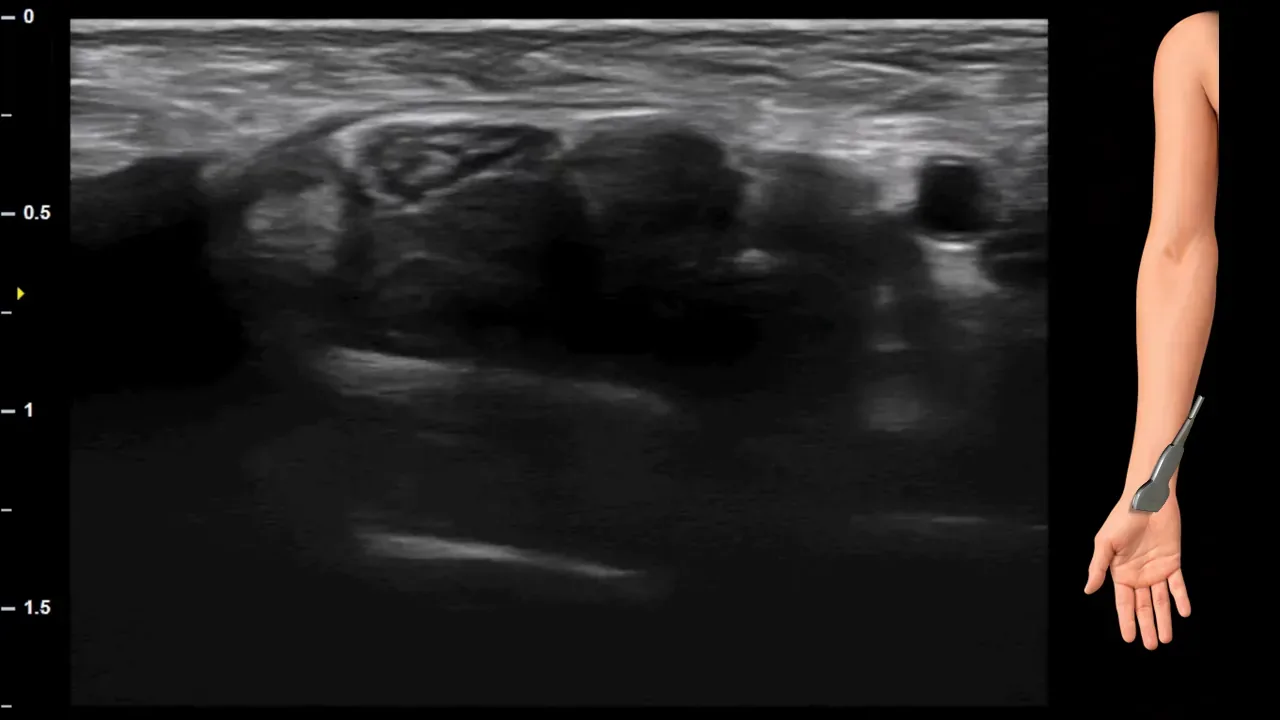
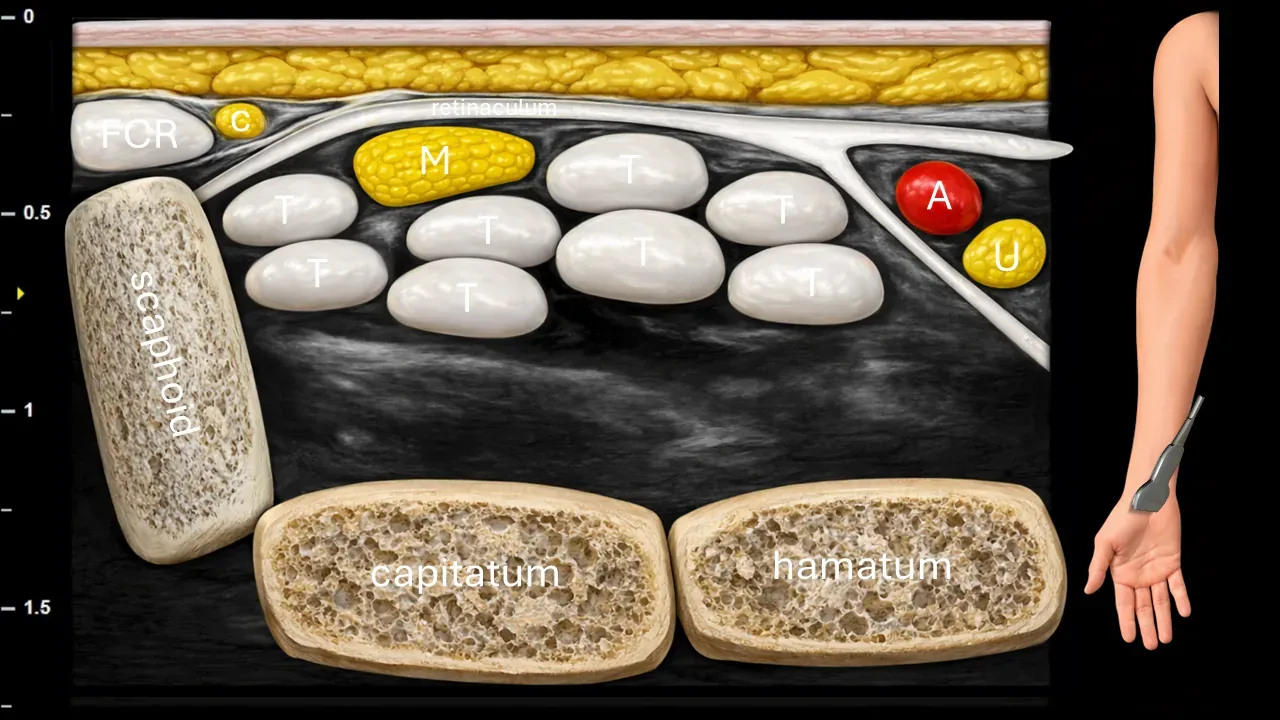
Abbildung 14. Carpus, Transversalebene. M: n. medianus, c: ramus cutaneus palmaris n. mediani, T: Flexorensehnen, A: a. ulnaris, U: n. ulnaris, FCR: Sehne des m. flexor carpi radialis.
Transversaler sonografischer Schnitt in der Karpalregion. N. medianus (M) befindet sich im Karpaltunnel unter dem retinaculum flexorum zwischen den Flexorensehnen (T). N. ulnaris (U) verläuft zusammen mit der a. ulnaris (A) ulnarseitig des Karpaltunnels im Guyon-Kanal. Der Ramus cutaneus palmaris n. mediani (c) liegt auf dieser Höhe oberflächlich des retinaculum flexorum. Das Bild zeigt außerdem die Sehne des m. flexor carpi radialis (FCR) und die Handwurzelknochen, insbesondere os scaphoideum, os capitatum und os hamatum.
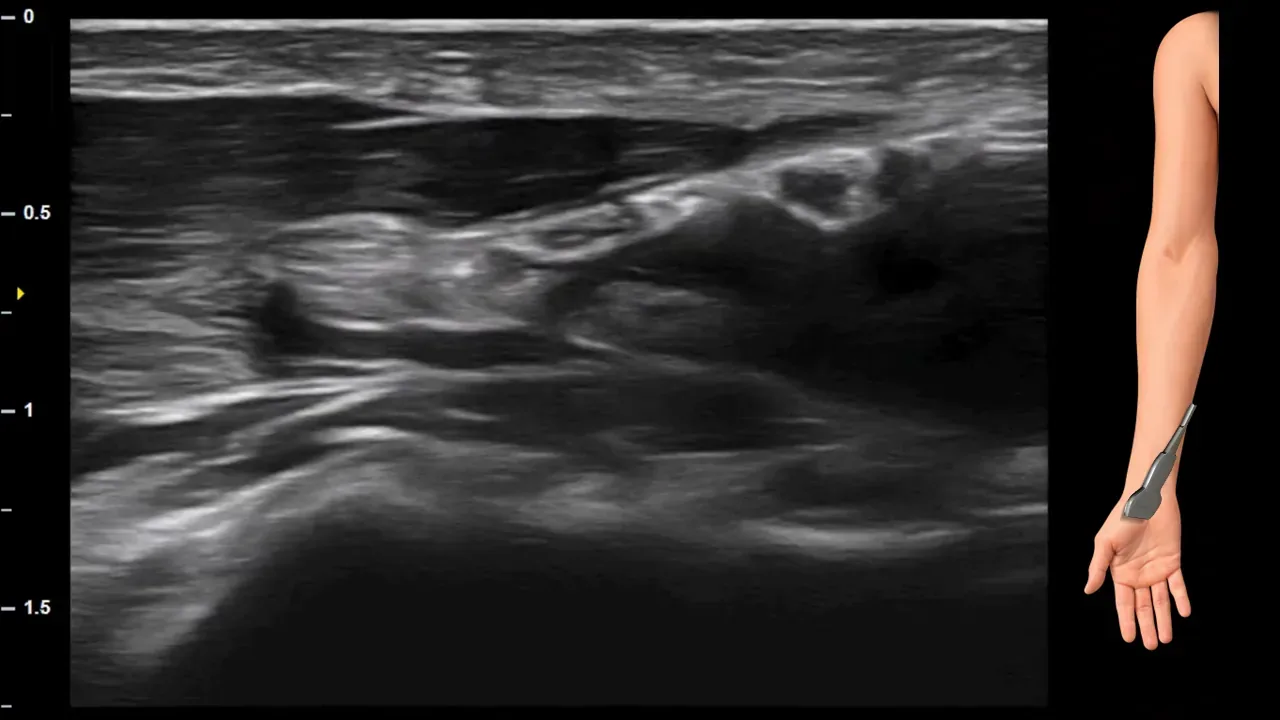
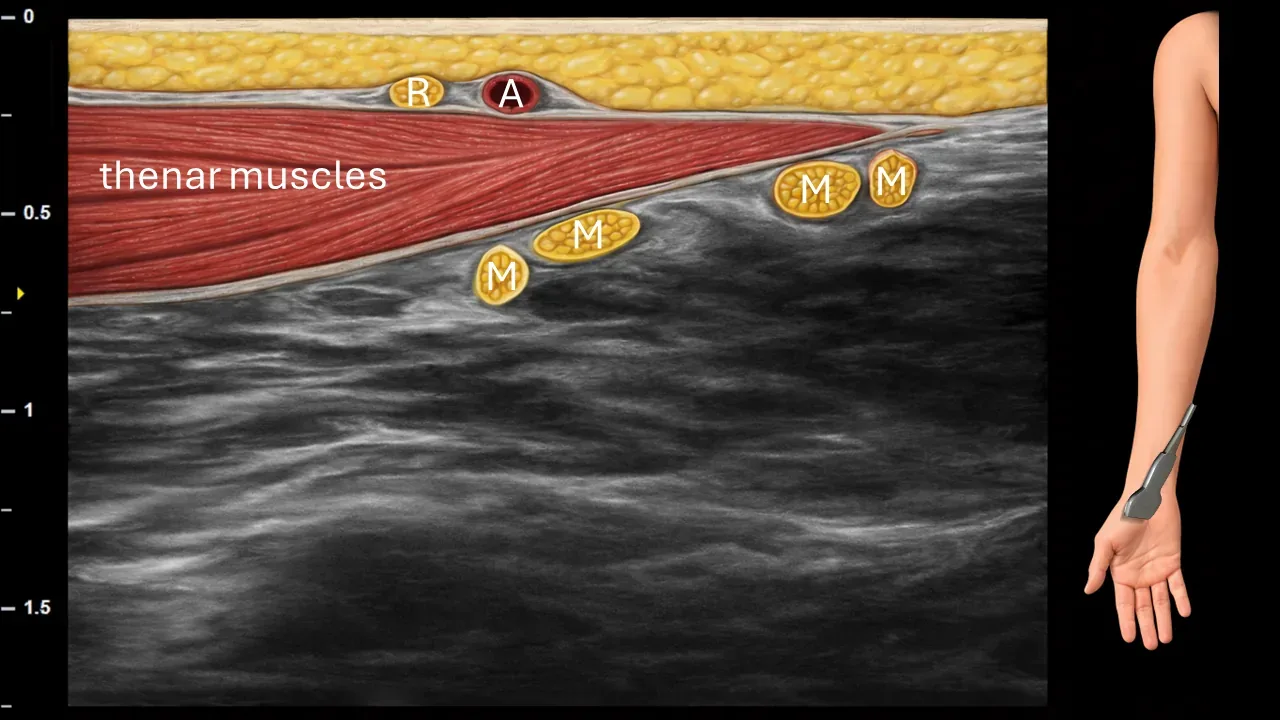
Abbildung 15. Hand, Transversalebene. M: Endäste des n. medianus, R: ramus recurrens n. mediani, A: Arterie in der Thenarregion.
Transversaler sonografischer Schnitt in der Hohlhandregion. Das Bild zeigt die Endäste des n. medianus (M) nach ihrem Austritt aus dem Karpaltunnel und ihre weitere Aufzweigung in der Hohlhand. Oberflächlich in der Thenarregion ist der ramus recurrens n. mediani (R) erfasst, der zu den Thenarmuskeln verläuft. Das Bild zeigt außerdem die Thenarmuskeln und einen kleinen arteriellen Ast (A) in ihrer Nähe.
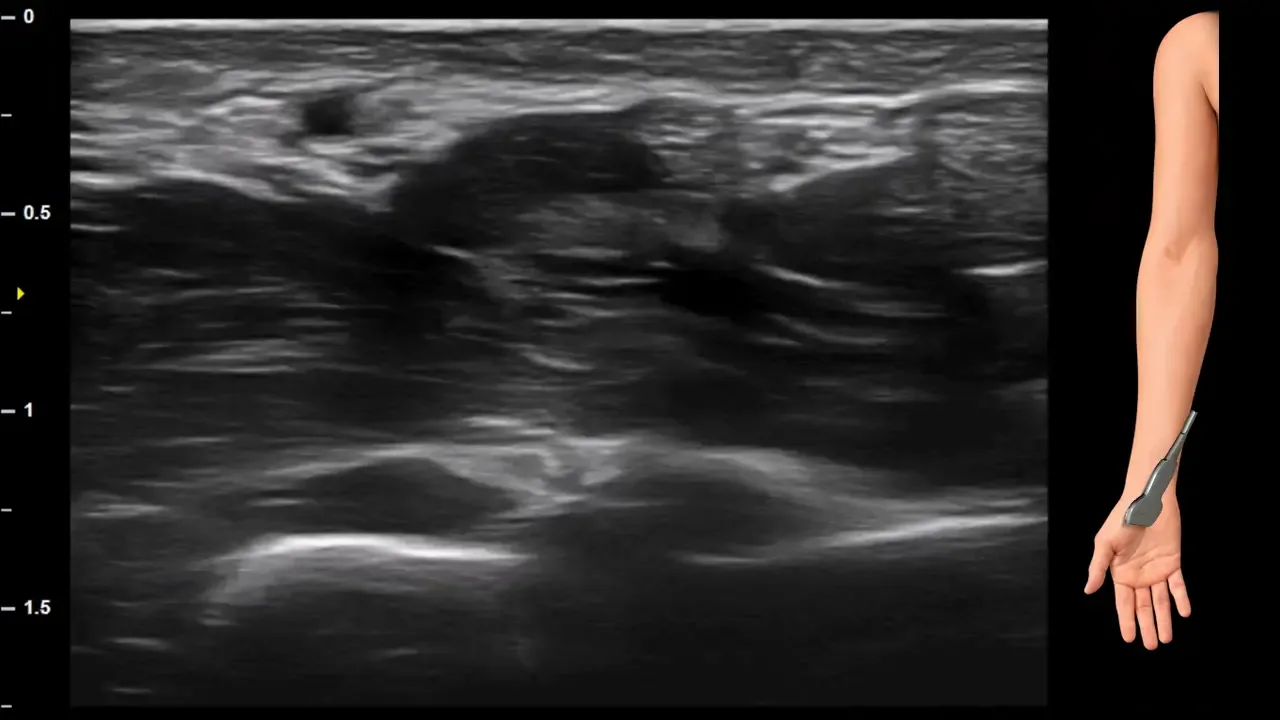
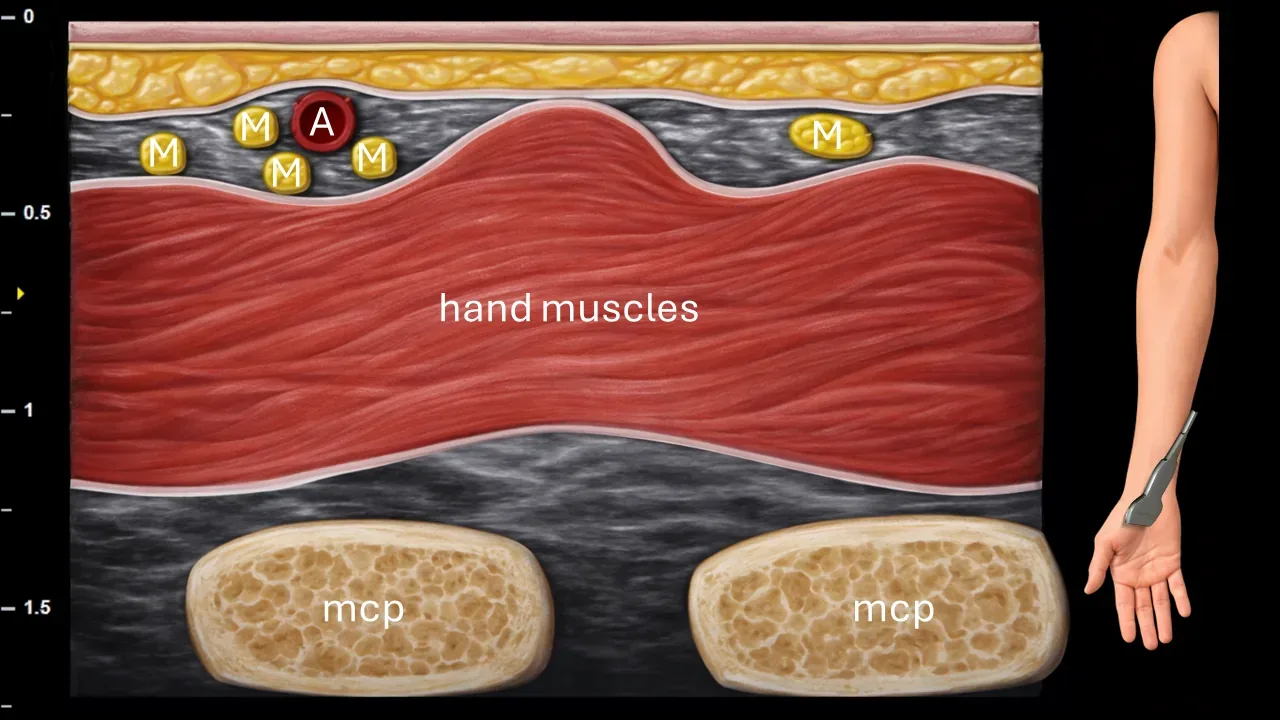
Abbildung 16. Hand, Transversalebene. M: Endäste des Nervus medianus, A: Arterien im Hohlhandbereich.
Transversaler sonografischer Schnitt im Hohlhandbereich auf einer weiter distal gelegenen Ebene. Das Bild zeigt Endäste des Nervus medianus (M) nach ihrer weiteren distalen Aufzweigung in der Hohlhand. Der Ramus recurrens des Nervus medianus nähert sich auf dieser Ebene den anderen Endästen des Nervus medianus. Das Bild zeigt außerdem kleine arterielle Äste (A), Handmuskeln und die Konturen der Metakarpophalangealgelenke (MCP).