 MSK Academy
Ultraschalluntersuchung
Untersuchungsprotokoll
Nervus ulnaris im gesamten Verlauf an der oberen Extremität
- Axilla
- Brachium
- Cubitum
- Unterarm
- Carpus
Ramus cutaneus dorsalis
- Abstand vom Nervus ulnaris
- Verlauf um die Ulna
Endäste
- Guyon-Kanal
- Endäste
Interaktive Funktion, verfügbar in der App
1. N. ulnaris im gesamten Verlauf an der oberen Extremität
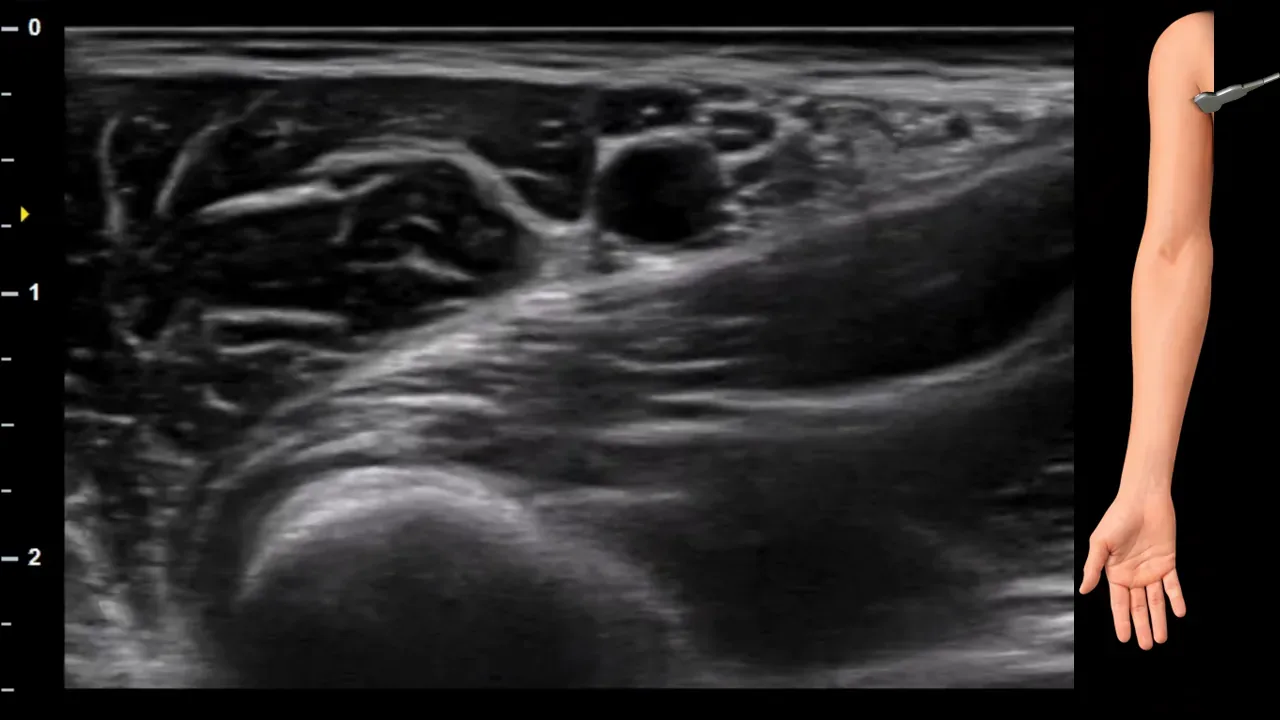
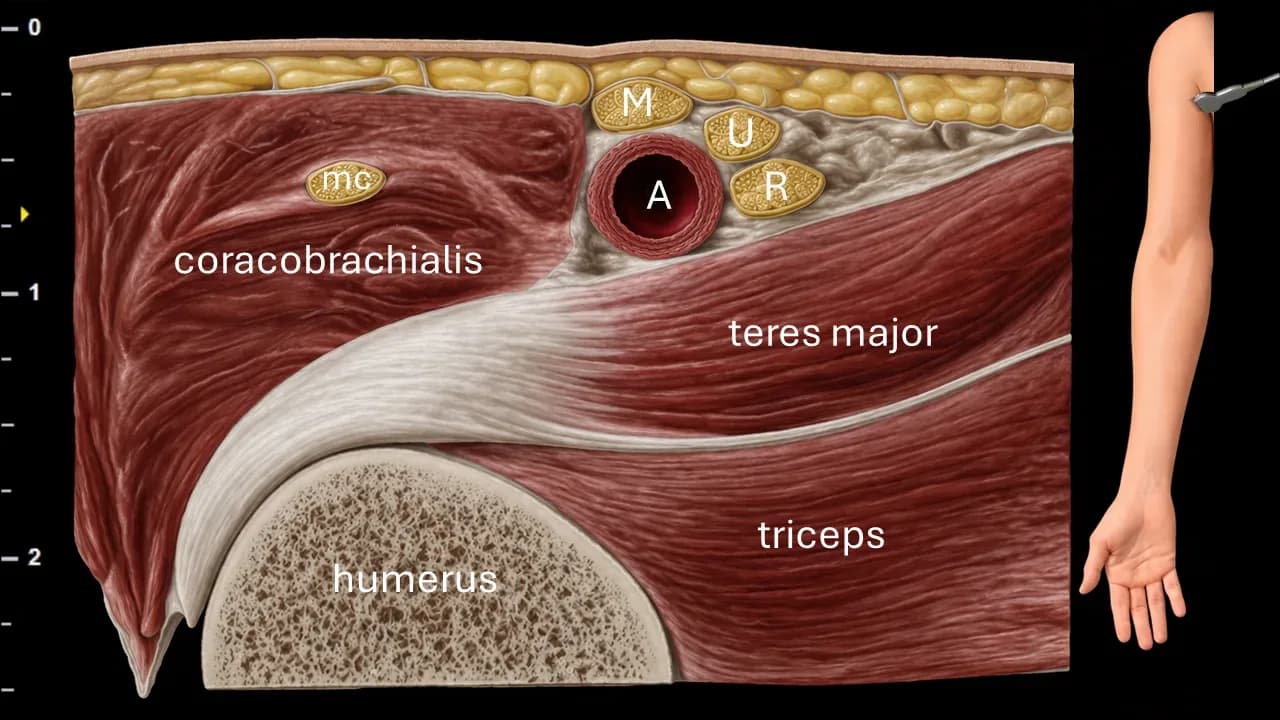
Abbildung 1. Axilla, Transversalebene. A: Axillararterie, M: Medianusnerv, U: Ulnarisnerv, R: Radialisnerv, mc: Musculocutaneusnerv
Transversaler Ultraschallschnitt durch die Axilla. Das Bild zeigt die Axillararterie (A), die die wichtigste Landmarke zur Identifizierung der nervalen Elemente des Plexus brachialis darstellt. Der Ulnarisnerv (U) liegt in dieser Projektion medial und dorsal der Axillararterie. In der Nähe des Gefäßes sind außerdem der Medianusnerv (M), der Radialisnerv (R) und der Musculocutaneusnerv (mc) sichtbar. Das Bild erfasst zudem die umgebenden Muskelstrukturen, insbesondere den Musculus coracobrachialis, den Musculus teres major und den Musculus triceps brachii, sowie die Kontur des Humerus.
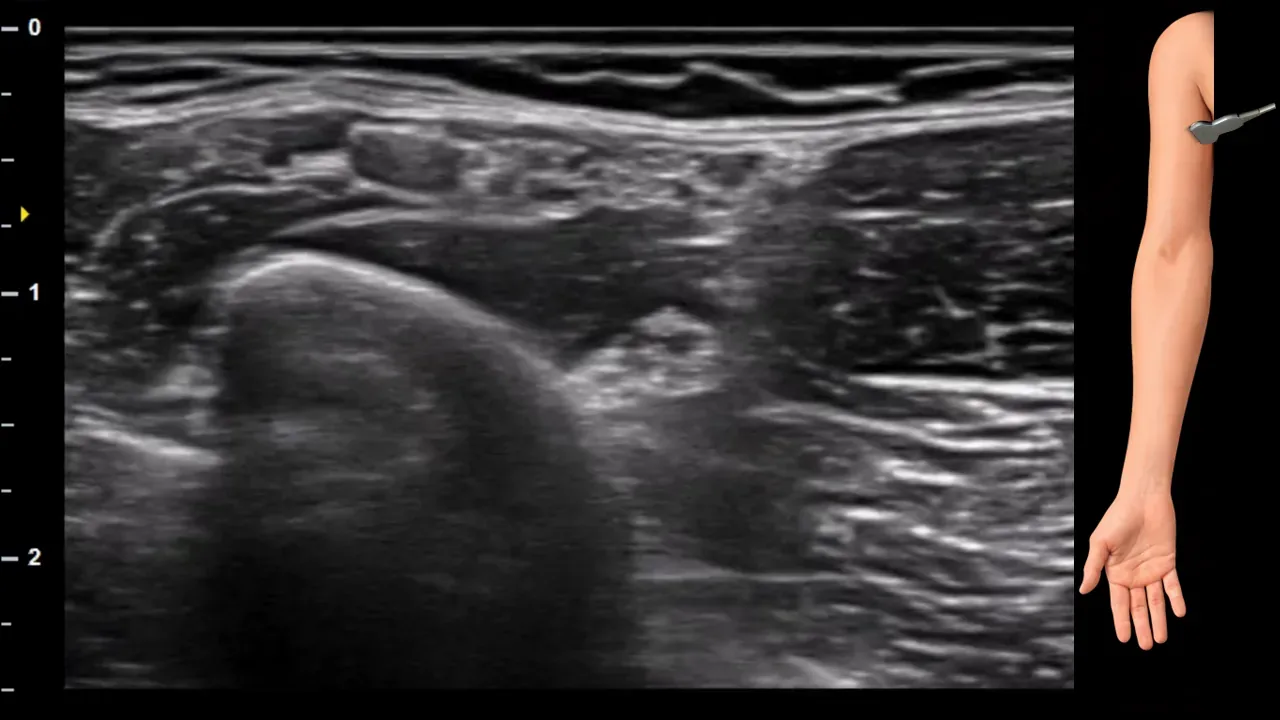
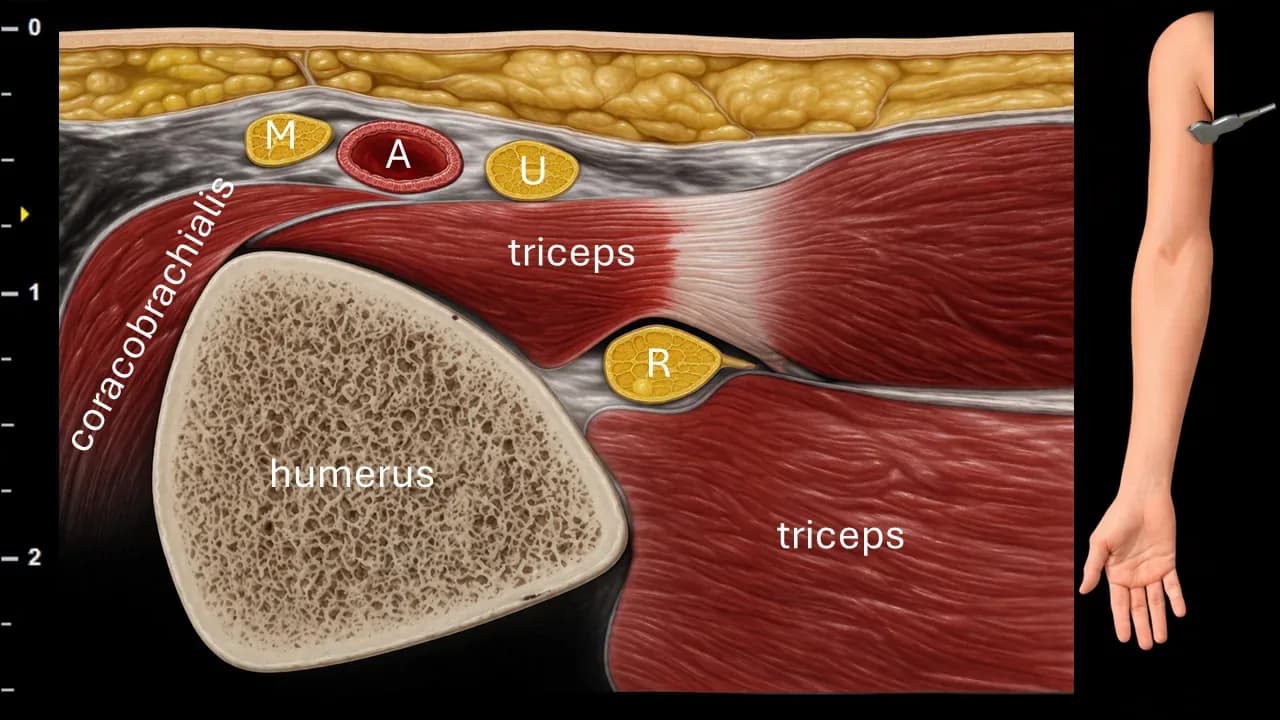
Abbildung 2. Brachium, Transversalebene. A: Arterie, M: n. medianus, U: n. ulnaris, R: n. radialis.
Transversaler Ultraschallschnitt des Oberarms mit Darstellung des n. ulnaris (U), der in dieser Projektion medial und oberflächlich in Nachbarschaft zum medialen Kopf des m. triceps brachii liegt. In der Nähe der Gefäßstruktur ist auch der n. medianus (M) zu identifizieren und tiefer am Humerus der n. radialis (R). Das Bild erfasst außerdem die umgebenden Muskelstrukturen, insbesondere den m. coracobrachialis und den m. triceps brachii, sowie die Kontur des Humerus.
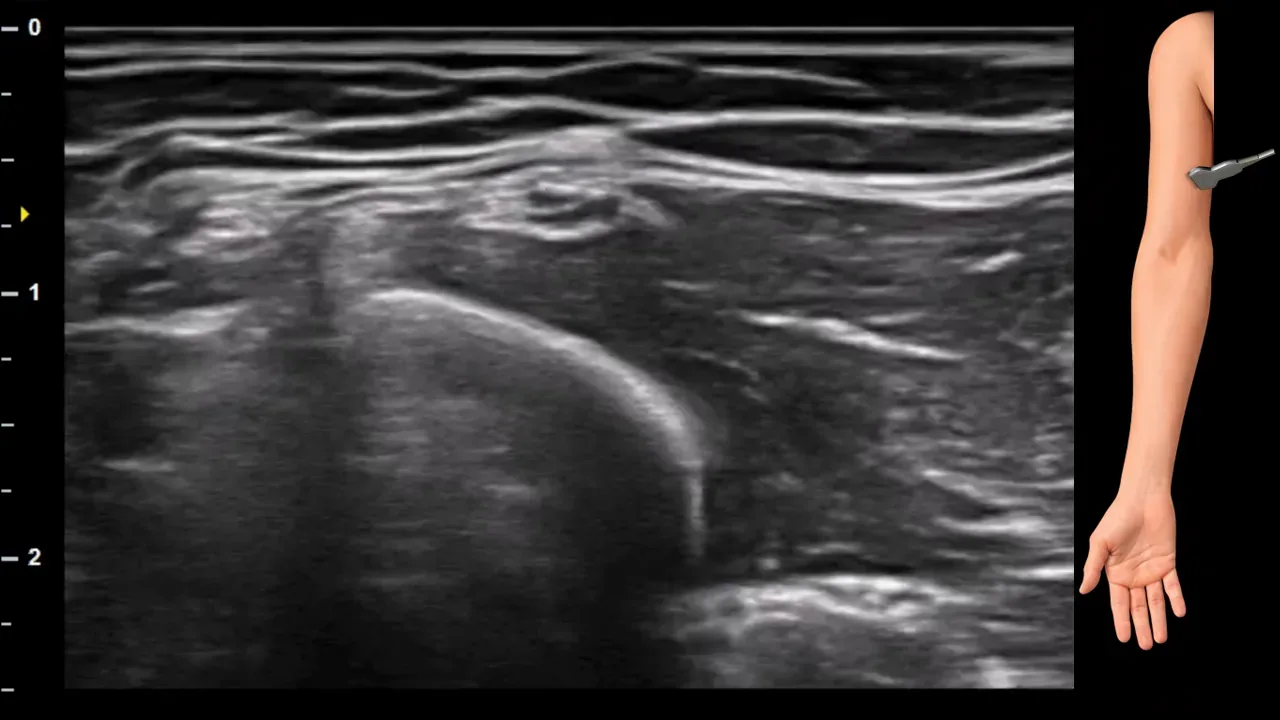
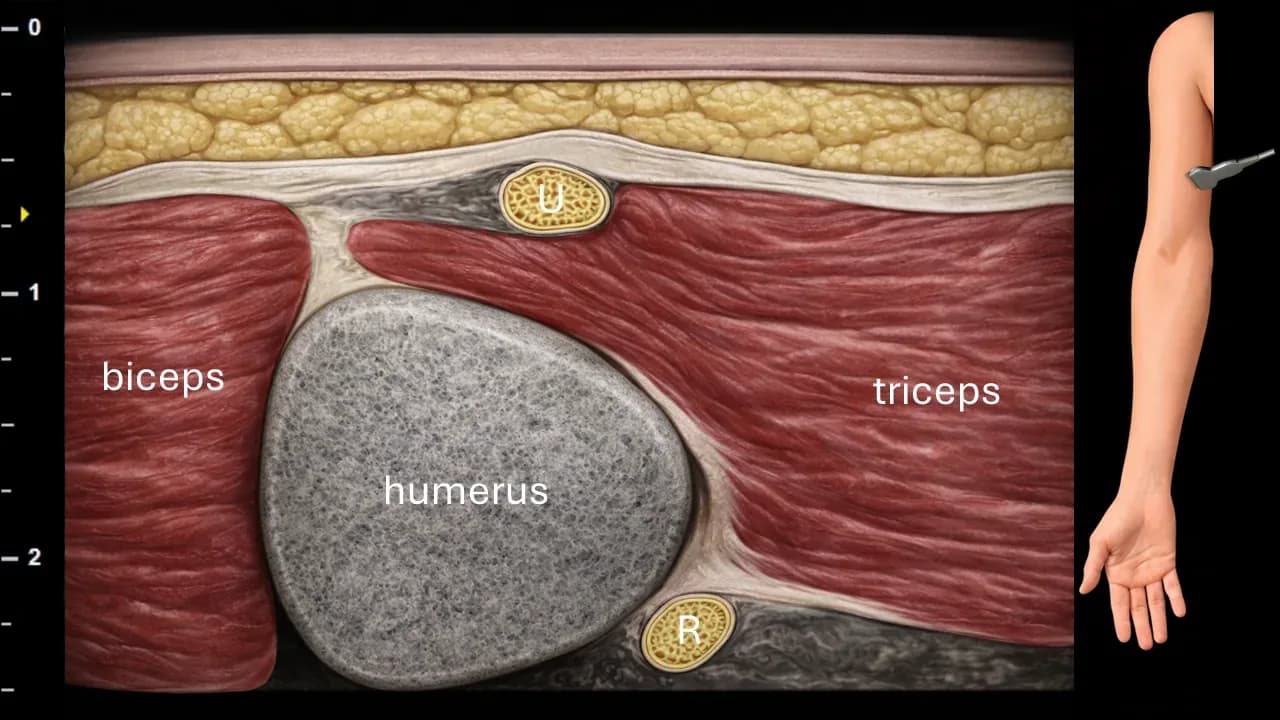
Abbildung 3. Brachium, Transversalebene. U: N. ulnaris, R: N. radialis.
Transversaler Ultraschallschnitt durch den Oberarm auf der Höhe, auf der sich der N. ulnaris (U) nach dorsal wendet und das mediale Septum intermusculare durchdringt. In dieser Projektion liegt der Nerv oberflächlich am Septum zwischen den Muskelstrukturen des Oberarms. Das Bild zeigt die umgebenden anatomischen Strukturen, insbesondere den M. biceps brachii, M. triceps brachii, die Kontur des Humerus und den tiefer gelegenen N. radialis (R).
Klinischer Hinweis
Der Bereich der Perforation des medialen intermuskulären Septums stellt eine mögliche Stelle der Kompression des N. ulnaris dar, entweder durch das Septum selbst oder durch die Struthers-Arkade.
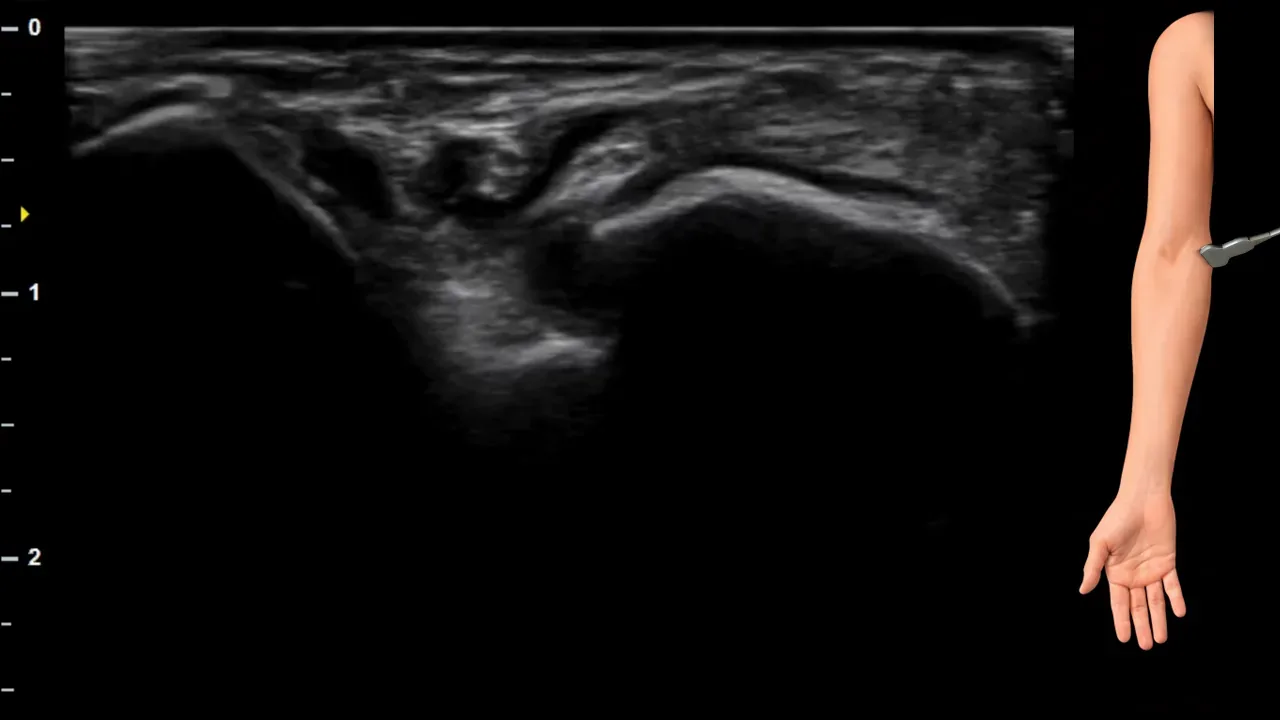
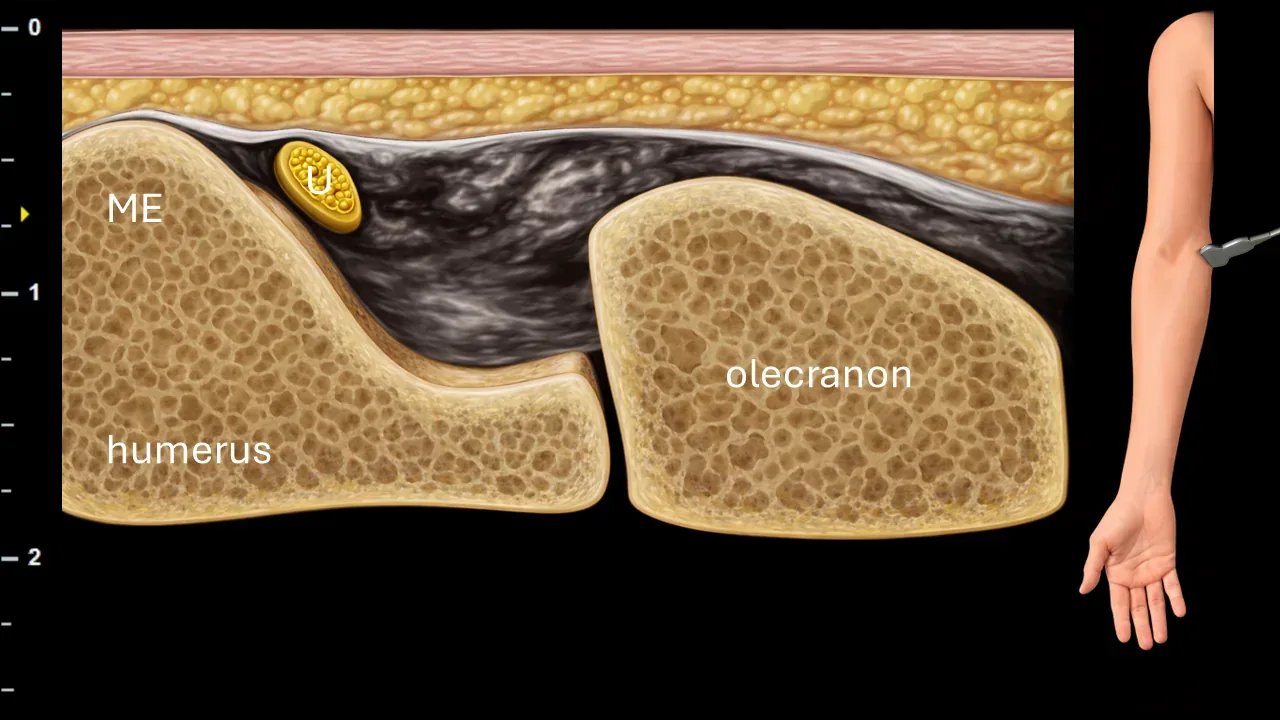
Abbildung 4. Ellenbogen, Transversalebene. U: N. ulnaris, ME: Epicondylus medialis humeri.
Transversaler sonografischer Schnitt im Bereich des Ellenbogens. Der N. ulnaris (U) verläuft dorsal hinter dem Epicondylus medialis humeri (ME) im Bereich des Sulcus nervi ulnaris. Das Bild zeigt außerdem knöcherne Leitstrukturen, insbesondere den distalen Humerus und das Olecranon.
Klinischer Hinweis
In diesem Bereich können Sie die Stabilität des N. ulnaris dynamisch untersuchen, insbesondere um zu beurteilen, ob er bei der Ellenbogenflexion über den medialen Epicondylus humeri schnappt.
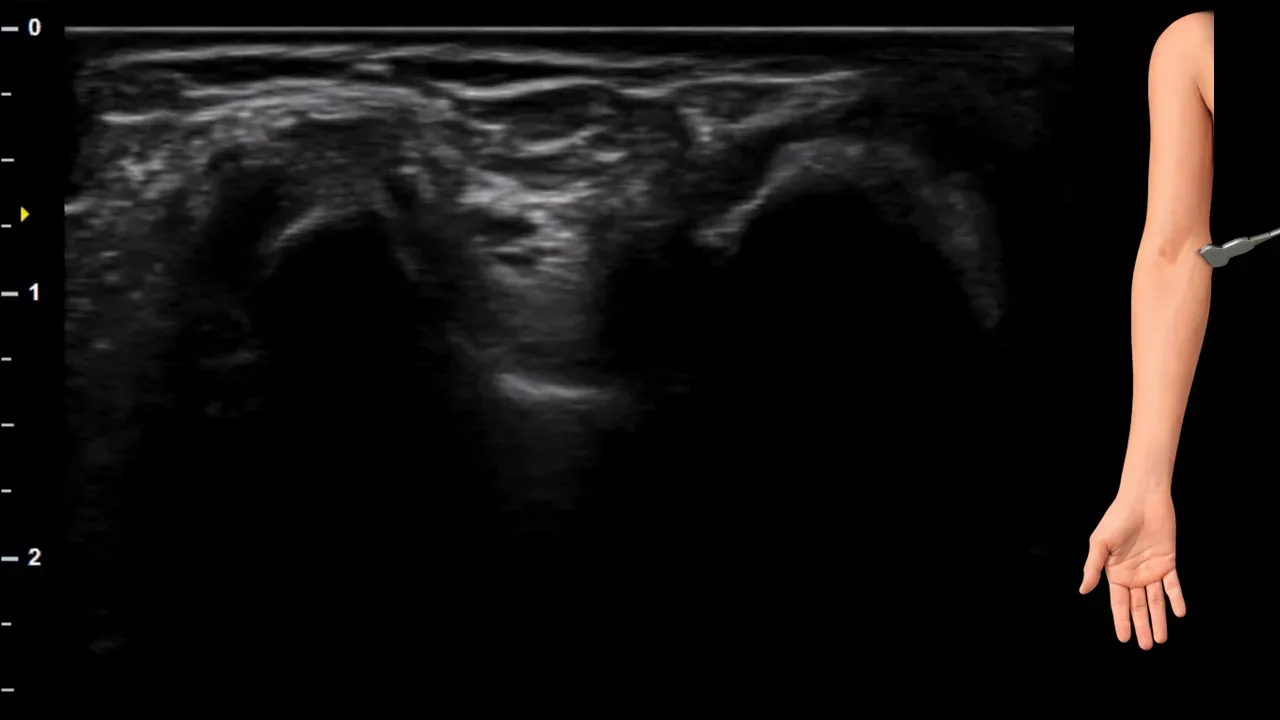
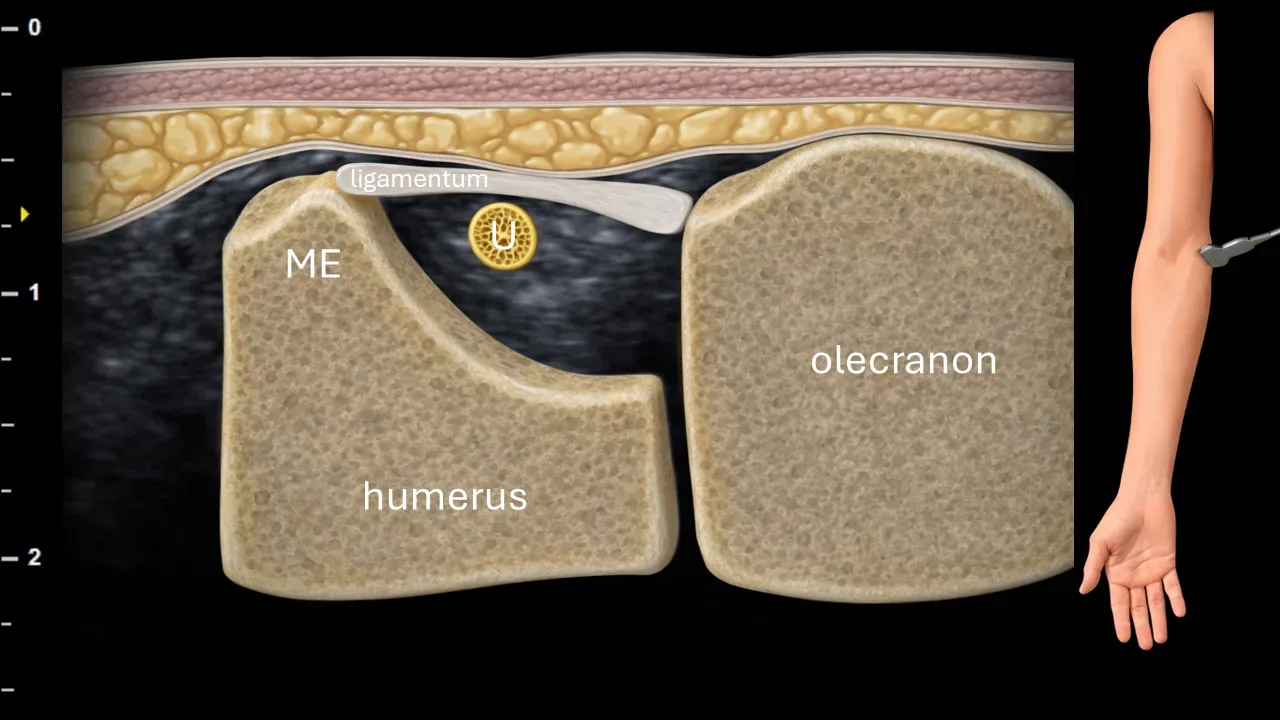
Abbildung 5. Ellenbogen, Transversalebene. U: N. ulnaris, ME: medialer Epikondylus des Humerus.
Transversaler sonografischer Schnitt im Bereich des Kubitaltunnels. Der N. ulnaris (U) liegt zwischen dem medialen Epikondylus des Humerus (ME) und dem Olekranon, wo er in den Kubitaltunnel eintritt. Das Dach des Tunnels wird durch das Osborne-Ligament gebildet, unter dem der Nerv verläuft. Das Bild zeigt außerdem knöcherne Orientierungsstrukturen, insbesondere den distalen Humerus und das Olekranon.
Klinischer Hinweis
In diesem Bereich kann der N. ulnaris durch das Osborne-Ligament komprimiert werden, das eine der typischen Kompressionsstellen beim Kubitaltunnelsyndrom darstellt.
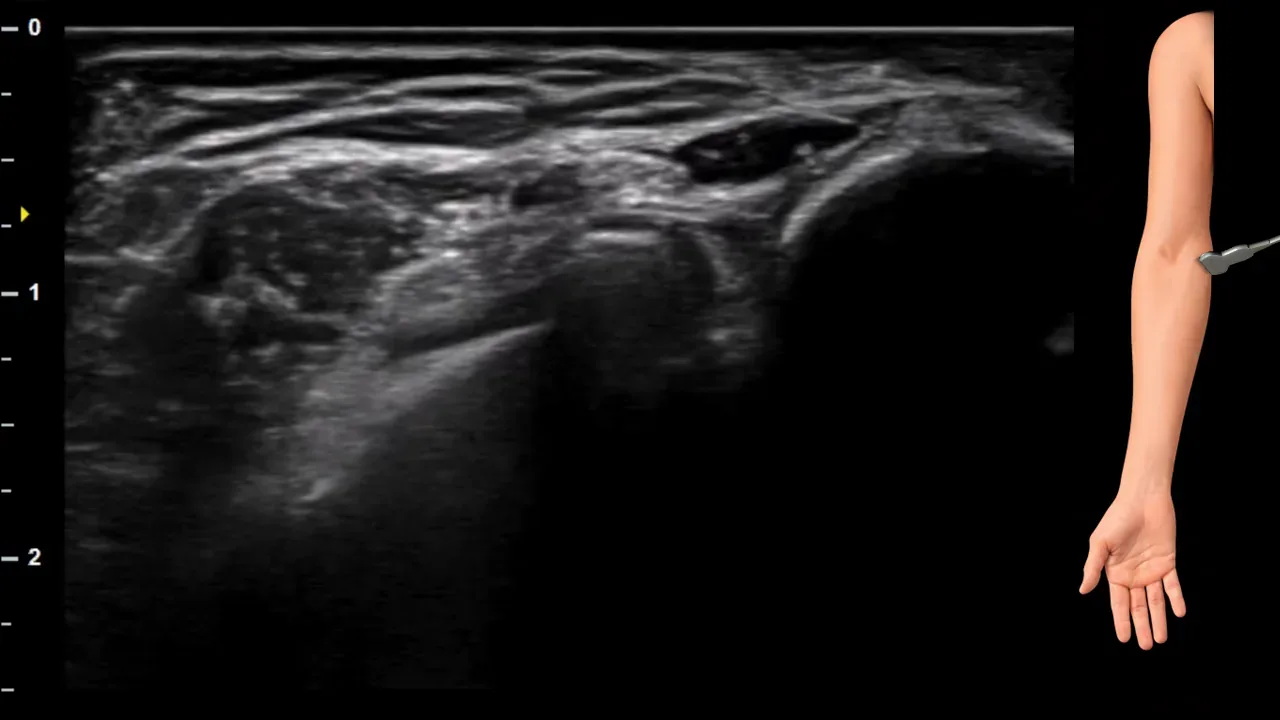
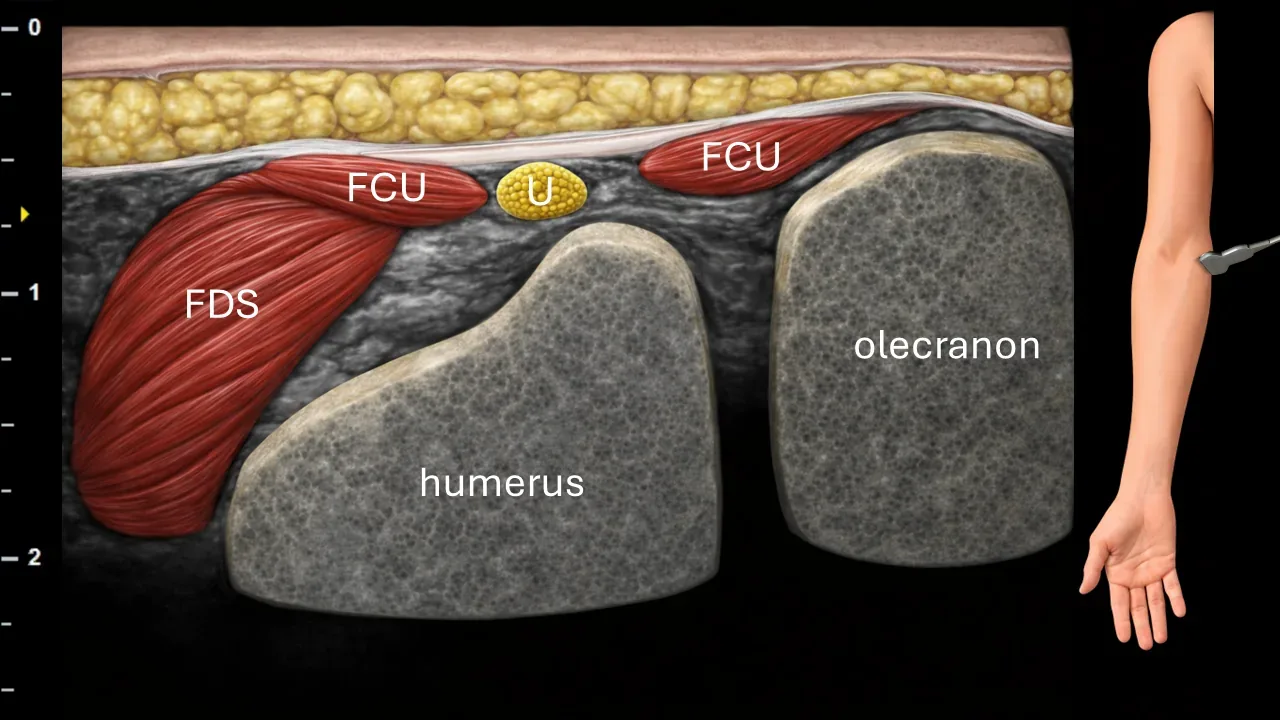
Abbildung 6. Cubitum, Transversalebene. U: n. ulnaris, FCU: m. flexor carpi ulnaris, FDS: m. flexor digitorum superficialis.
Sonografischer Querschnitt in der Ellenbogenregion distal des Kubitaltunnels. N. ulnaris (U) verläuft hier unter dem ligamentum arcuatum, das einen faszial-aponeurotischen Bogen zwischen dem humeralen und dem ulnaren Kopf des m. flexor carpi ulnaris (FCU) darstellt. In dieser Projektion liegt der Nerv zwischen beiden Köpfen des m. flexor carpi ulnaris, angrenzend an die Flexorenmuskulatur des Unterarms. Das Bild zeigt außerdem den m. flexor digitorum superficialis (FDS) und knöcherne Orientierungsstrukturen, insbesondere den distalen Humerus und das Olecranon.
Klinischer Hinweis
Der Bereich unter dem Ligamentum arcuatum zwischen den Köpfen des M. flexor carpi ulnaris stellt eine weitere mögliche Stelle der Kompression des N. ulnaris beim Kubitaltunnelsyndrom dar.
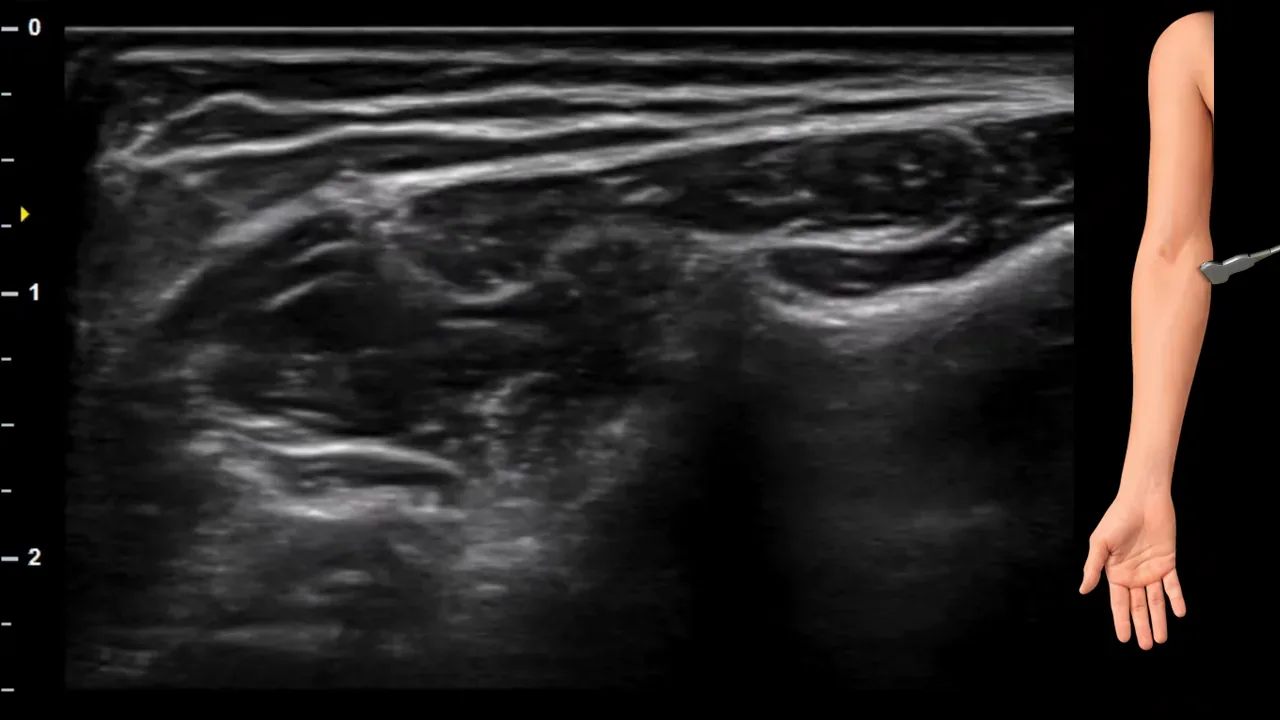
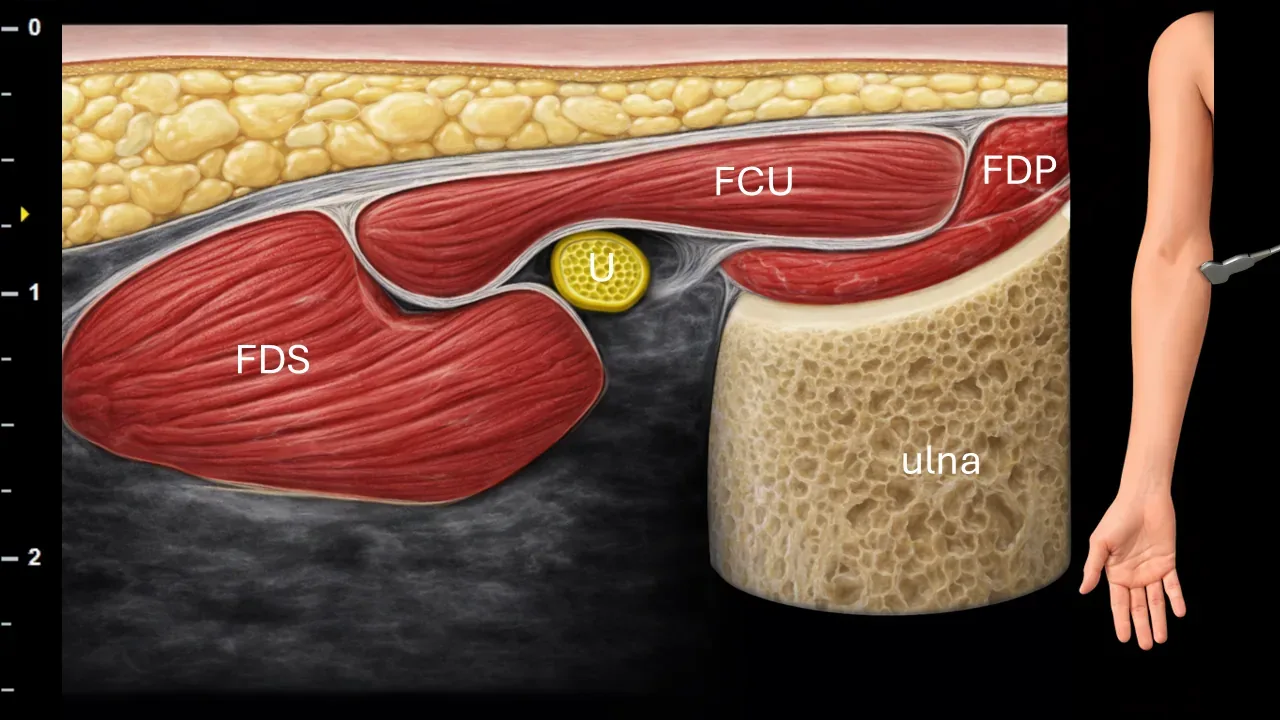
Abbildung 7. Antebrachium, Transversalebene. U: n. ulnaris, FCU: m. flexor carpi ulnaris, FDS: m. flexor digitorum superficialis, FDP: m. flexor digitorum profundus.
Transversaler sonografischer Schnitt des proximalen Unterarms. Der N. ulnaris (U) liegt in dieser Projektion zwischen den Köpfen des m. flexor carpi ulnaris (FCU), beim Übergang aus dem Bereich des Kubitaltunnels in den Unterarm. Das Bild zeigt zudem die umgebenden Flexorenstrukturen, insbesondere den m. flexor digitorum superficialis (FDS) und den m. flexor digitorum profundus (FDP), sowie die knöcherne Kontur der Ulna.
Klinischer Hinweis
In diesem Bereich kann der N. ulnaris beim Austritt aus dem Kubitaltunnel komprimiert werden, insbesondere im Zusammenhang mit der engen Passage zwischen den Köpfen des M. flexor carpi ulnaris.
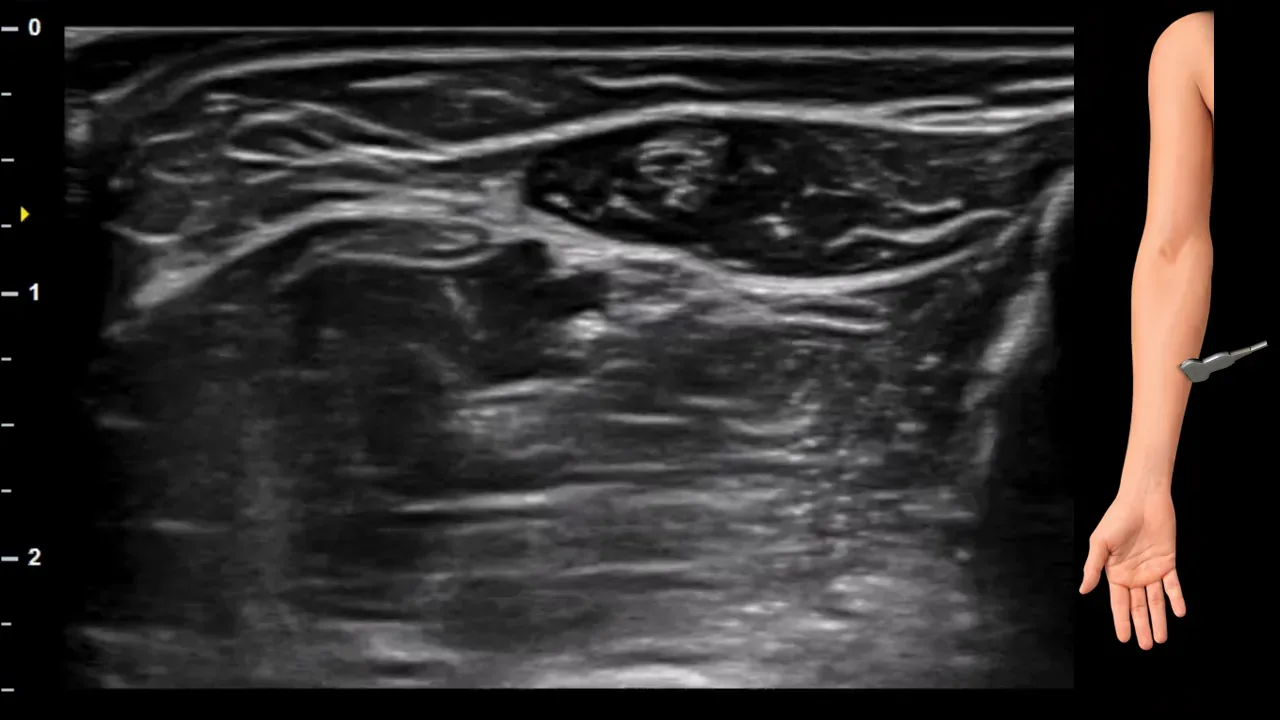
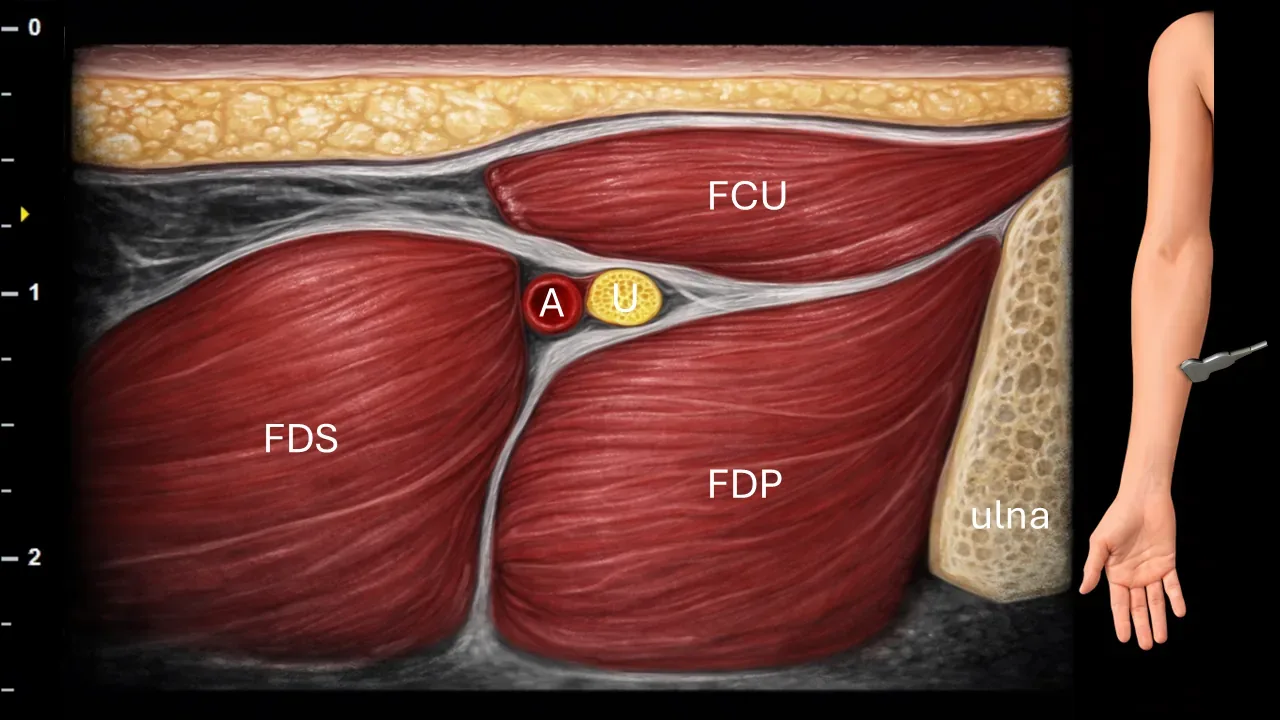
Abbildung 8. Antebrachium, Transversalebene. U: Nervus ulnaris, A: Arteria ulnaris, FCU: Musculus flexor carpi ulnaris, FDS: Musculus flexor digitorum superficialis, FDP: Musculus flexor digitorum profundus.
Transversaler Ultraschallschnitt des Unterarms. Der Nervus ulnaris (U) liegt in dieser Projektion zwischen dem Musculus flexor digitorum superficialis (FDS) und dem Musculus flexor digitorum profundus (FDP). In den weiter distal gelegenen Abschnitten des Unterarms wird der Nerv von der Arteria ulnaris (A) begleitet, die eine wichtige Landmarke für seine Identifizierung darstellt. Oberflächlich des neurovaskulären Bündels ist der Musculus flexor carpi ulnaris (FCU) sichtbar. Die knöcherne Kontur der Ulna ist ebenfalls im Bild erfasst.
Klinischer Hinweis
In diesem Bereich empfiehlt es sich, während der Ultraschalluntersuchung die Beziehung zwischen dem n. ulnaris und der a. ulnaris zu verfolgen, da das Gefäß die Orientierung im weiter distal gelegenen Teil des Unterarms erleichtert und dabei hilft, den Verlauf des Nervs präzise zu lokalisieren.
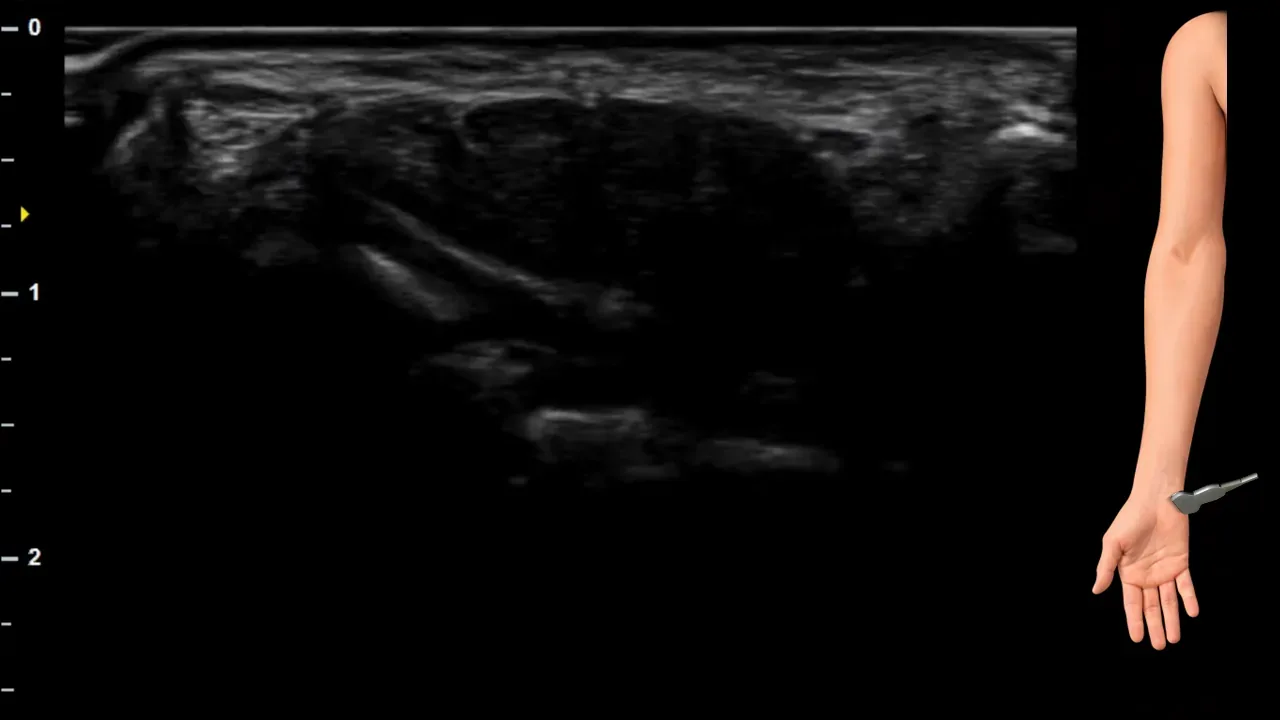
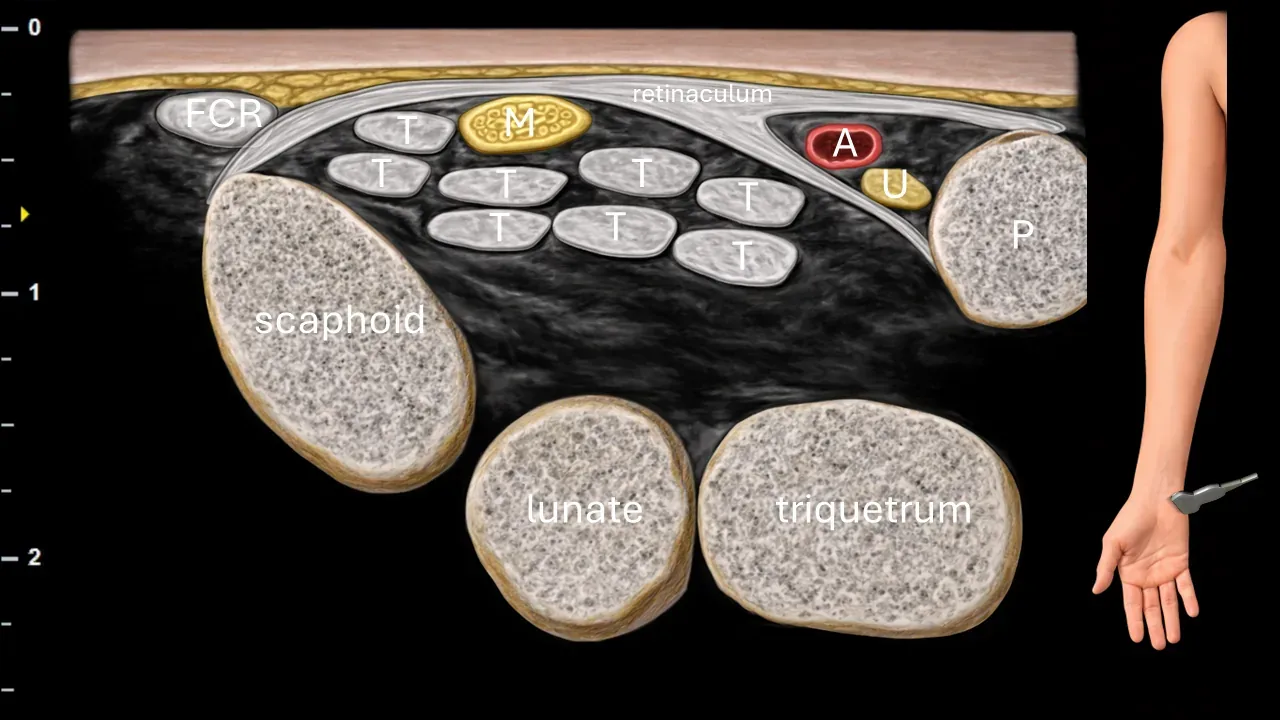
Abbildung 9. Karpus, Transversalebene. U: N. ulnaris, A: A. ulnaris, M: N. medianus, T: Beugesehnen, FCR: Sehne des M. flexor carpi radialis, P: Os pisiforme.
Transversaler sonografischer Schnitt im Bereich des Handgelenks. Der N. ulnaris (U) befindet sich in dieser Projektion in der Guyon-Loge, wo er in enger Nachbarschaft zur A. ulnaris (A) zwischen dem Os pisiforme (P) und oberflächlichen bindegewebigen Strukturen verläuft. Im weiter radial gelegenen Anteil des Bildes ist der N. medianus (M) sichtbar, der unter dem Retinaculum flexorum im Karpaltunnel liegt und von Beugesehnen (T) umgeben ist. Im Bild sind außerdem knöcherne Strukturen des Karpus erfasst, insbesondere Os scaphoideum, Os lunatum und Os triquetrum, sowie die Sehne des M. flexor carpi radialis (FCR).
Klinischer Hinweis
Der Guyon-Kanal stellt eine bedeutende potenzielle Stelle für eine Kompression des N. ulnaris im Bereich des Handgelenks dar. Die Sonografie ermöglicht die Beurteilung des Kanallumens, der Beziehung des Nervs zur A. ulnaris und möglicher Kompressionsursachen wie Ganglion, Hypertrophie umgebender Strukturen oder posttraumatischer Veränderungen.
2. Dorsaler Hautast
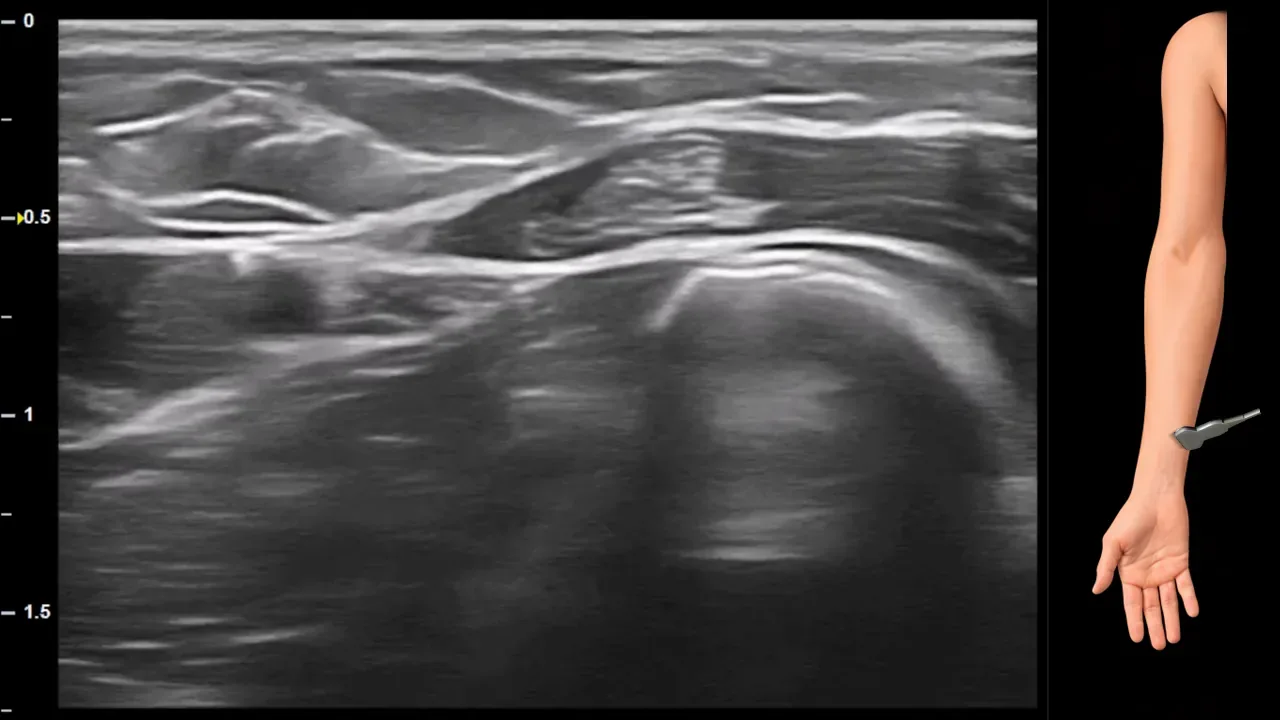
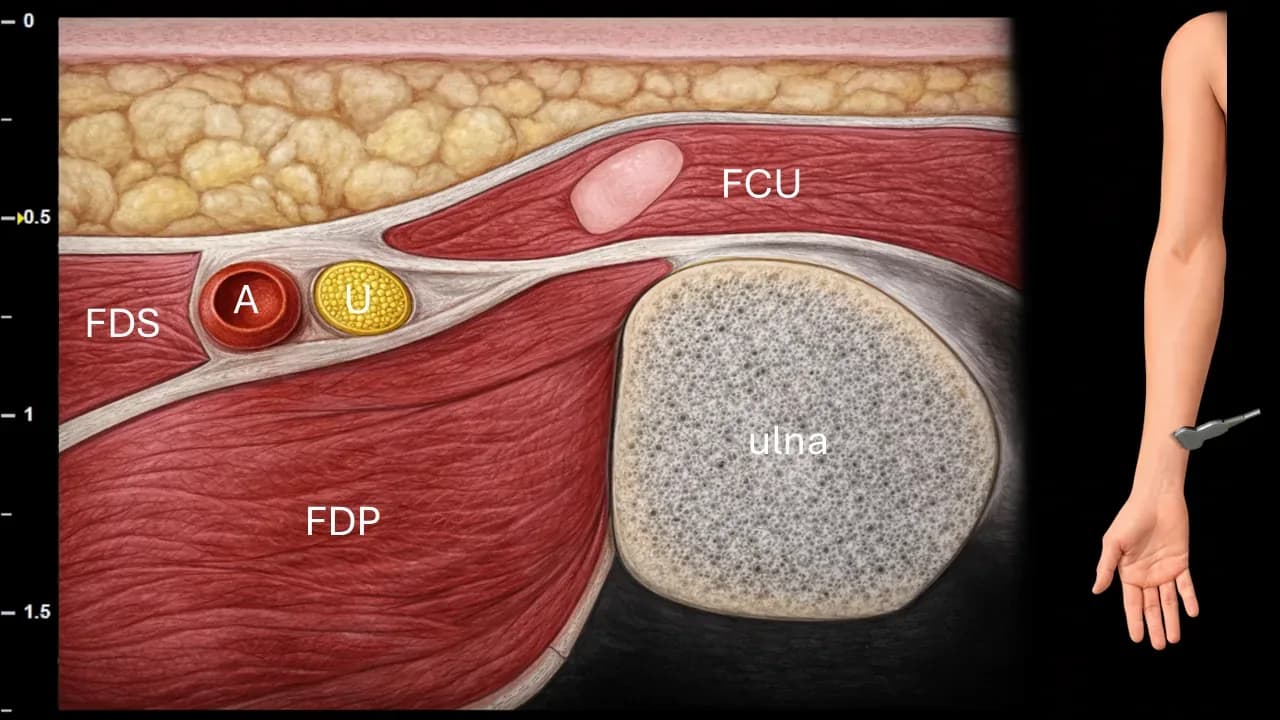
Abbildung 10. Distales Drittel des Unterarms, Transversalebene. U: n. ulnaris, A: a. ulnaris, FCU: m. flexor carpi ulnaris, FDS: m. flexor digitorum superficialis, FDP: m. flexor digitorum profundus.
Transversaler Ultraschallschnitt im Bereich des distalen Drittels des Unterarms. Der n. ulnaris (U) verläuft hier in enger Nachbarschaft zur a. ulnaris (A) zwischen den umgebenden Flexoren. Oberflächlich und ulnar ist der m. flexor carpi ulnaris (FCU) sichtbar, tiefer liegt der m. flexor digitorum profundus (FDP) und weiter radial der m. flexor digitorum superficialis (FDS). Das Bild zeigt außerdem die knöcherne Kontur der Ulna.
Klinischer Hinweis
Auf dieser Höhe kann mittels Ultraschall die Abgangsstelle des ramus cutaneus dorsalis n. ulnaris lokalisiert werden, der typischerweise im distalen Unterarm vom Hauptstamm abzweigt. Dieser Bereich eignet sich daher für seine gezielte Identifikation und anschließende sonografische Verlaufsverfolgung.
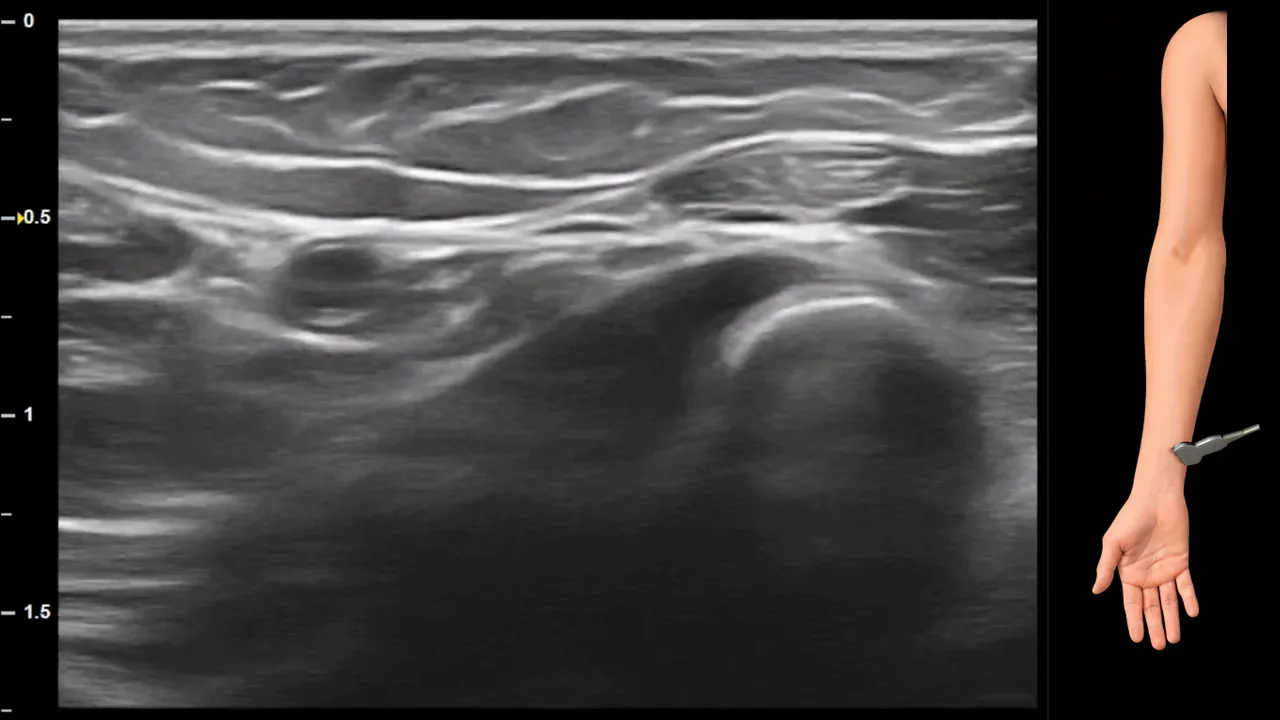
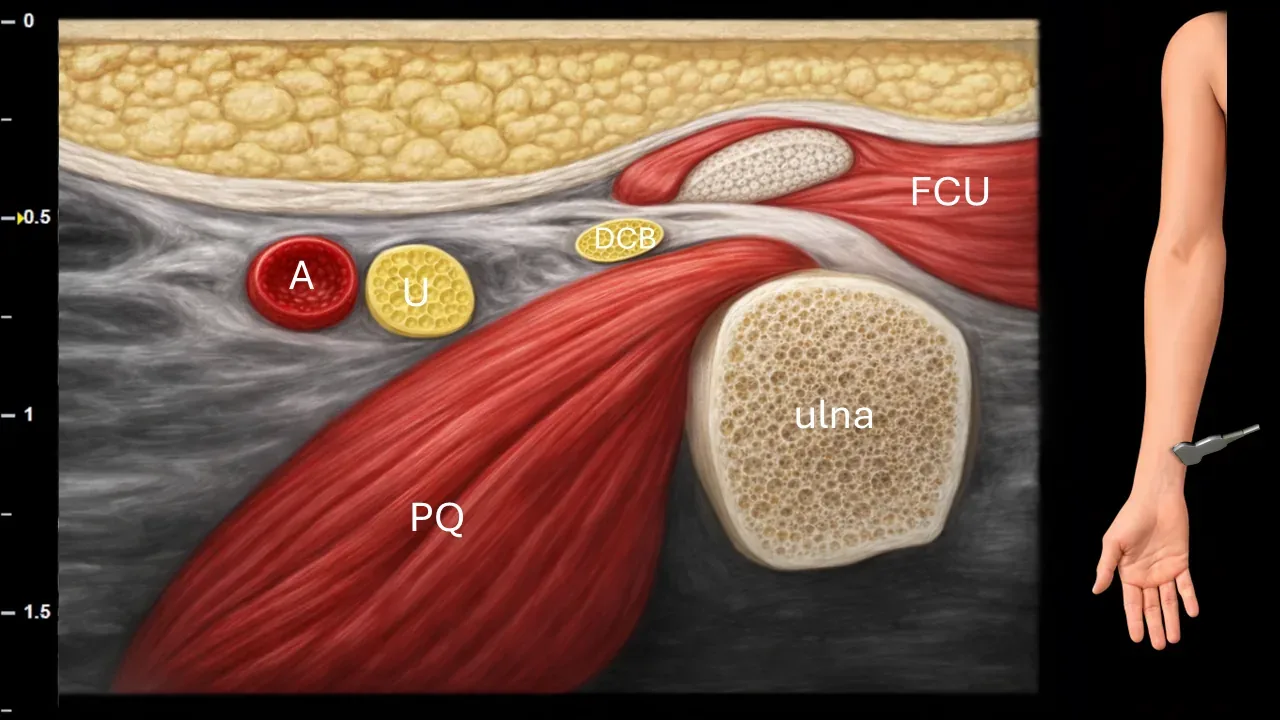
Abbildung 11. Distales Drittel des Unterarms, Transversalebene. U: n. ulnaris, A: a. ulnaris, DCB: ramus cutaneus dorsalis n. ulnaris, FCU: m. flexor carpi ulnaris, PQ: m. pronator quadratus.
Transversaler Ultraschallschnitt im Bereich des distalen Drittels des Unterarms. Der N. ulnaris (U) verläuft hier in unmittelbarer Nähe der a. ulnaris (A). Auf dieser Höhe zweigt von seinem Stamm der dorsale Hautast (DCB, ramus cutaneus dorsalis n. ulnaris) ab, der nach dorsoulnar umbiegt und zum Subkutangewebe zieht. Das Bild zeigt außerdem die umgebenden anatomischen Strukturen, insbesondere den m. flexor carpi ulnaris (FCU), den tiefer gelegenen m. pronator quadratus (PQ) und die knöcherne Kontur der Ulna.
Klinischer Hinweis
Die sonografische Identifizierung des ramus cutaneus dorsalis n. ulnaris ist sowohl bei der Beurteilung von Verletzungen kleiner sensibler Äste als auch zur präoperativen Orientierung wichtig, da dieser Ast eine Ursache lokaler sensibler Beschwerden an der dorsoulnaren Seite der Hand sein kann.
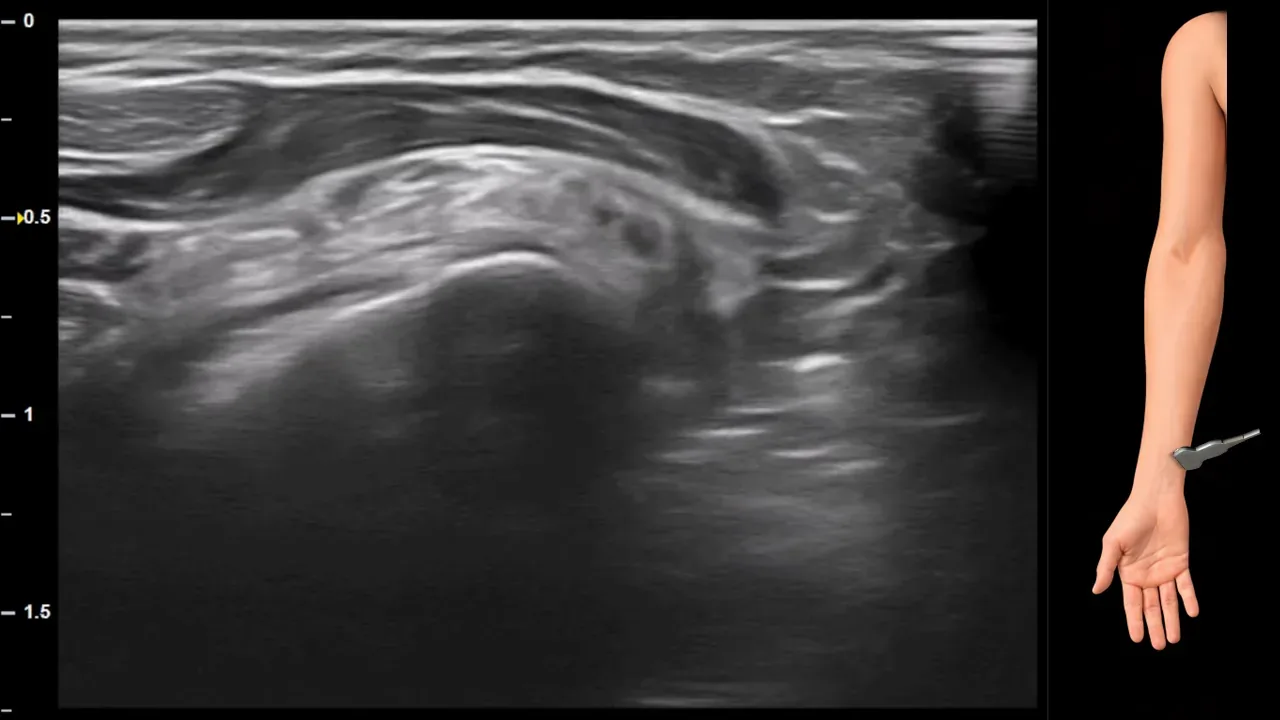
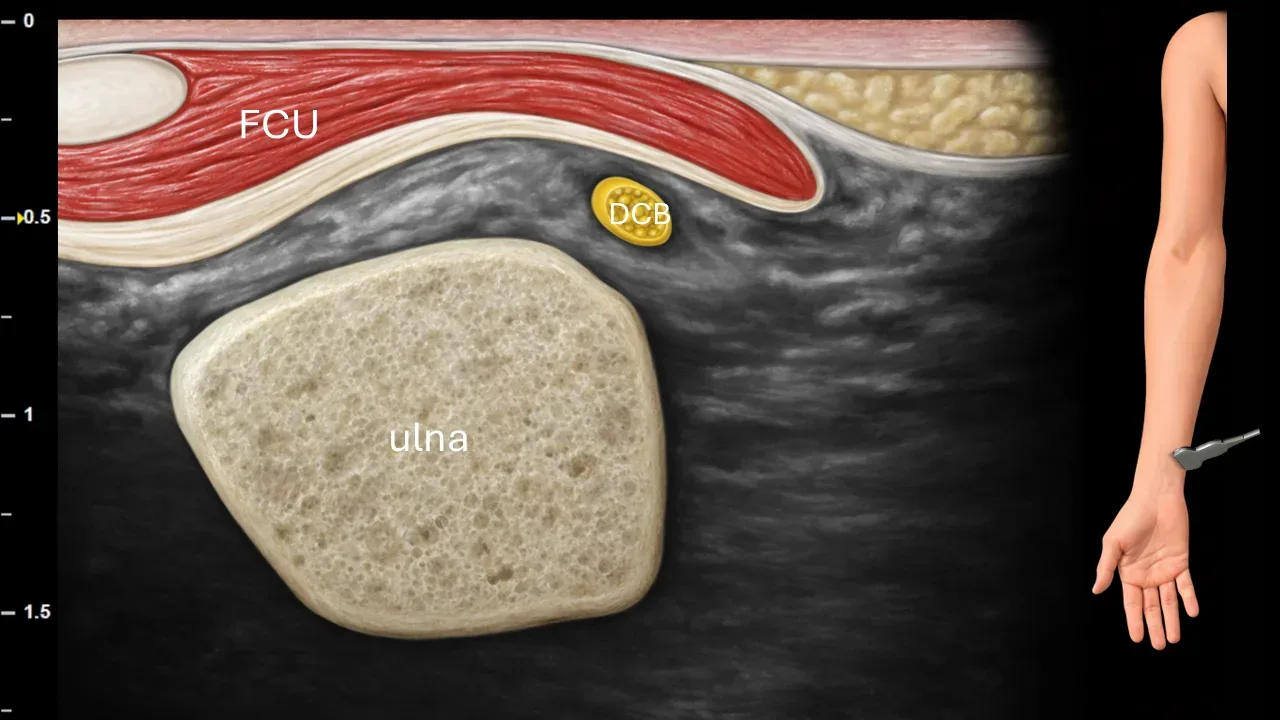
Abbildung 12. Distales Drittel des Unterarms, Transversalebene. DCB: ramus cutaneus dorsalis n. ulnaris, FCU: m. flexor carpi ulnaris.
Transversaler sonografischer Schnitt im Bereich des distalen Drittels des Unterarms. Der dorsale Hautast des N. ulnaris (DCB) trennt sich auf dieser Höhe vom Hauptstamm und verläuft dorsal bogenförmig um die Ulna in Richtung des Subkutangewebes an der dorsoulnaren Seite des Unterarms und der Hand. Im Bild sind außerdem der m. flexor carpi ulnaris (FCU) und die knöcherne Kontur der Ulna sichtbar.
3. Endäste
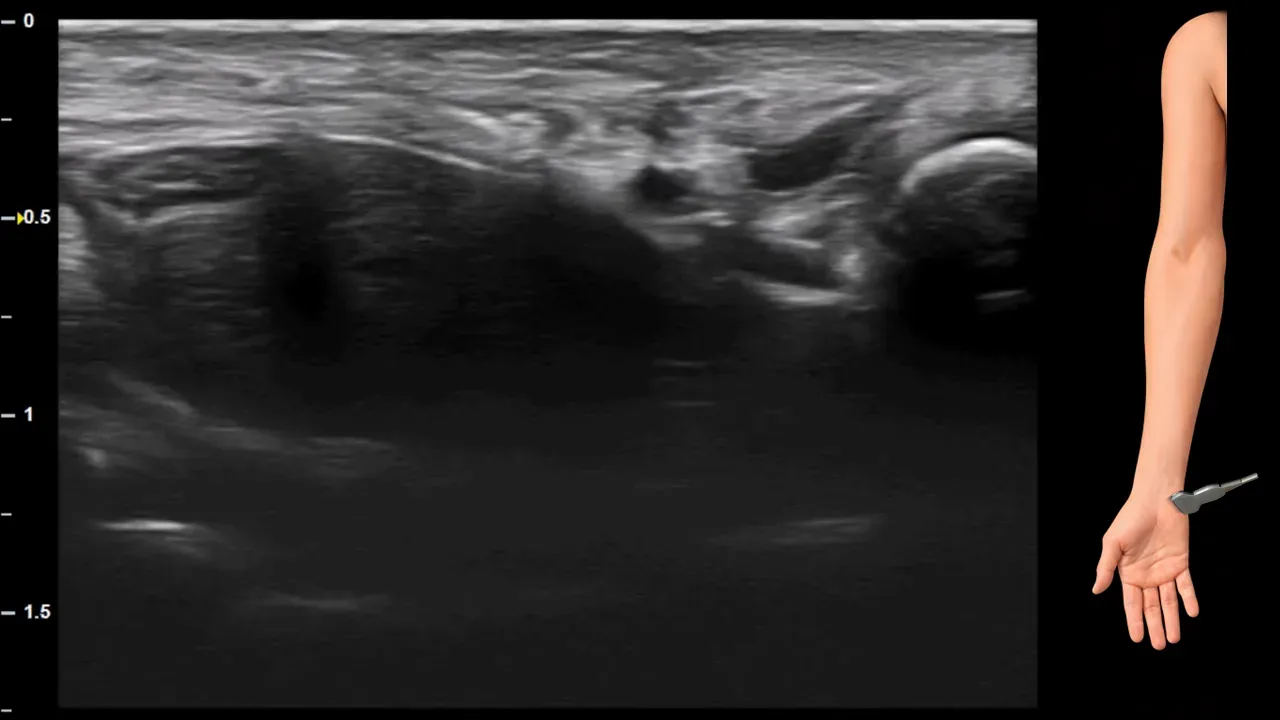
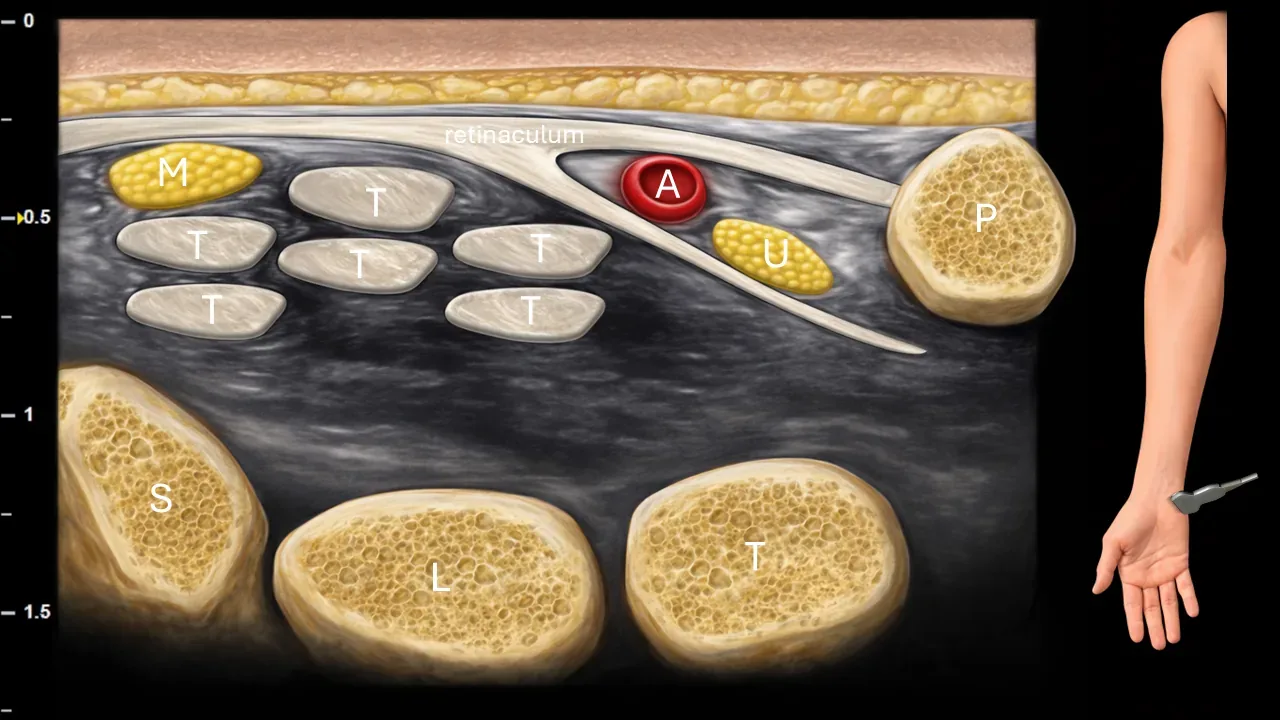
Figure 13. Carpus, transverse plane. U: ulnar nerve, A: ulnar artery, M: median nerve, T: flexor tendons, P: pisiform bone, S: scaphoid bone, L: lunate bone, T: triquetral bone.
Transverse ultrasound section in the wrist area. The ulnar nerve (U) is located in Guyon's canal in close proximity to the ulnar artery (A) at the pisiform bone (P). This projection is suitable as an initial orientation section for tracking the terminal branching of the ulnar nerve in the area of Guyon's canal, where the nerve further divides into its superficial sensory and deep motor branches. In the radial part of the image, the median nerve (M) is visible, located beneath the flexor retinaculum in the carpal tunnel, surrounded by flexor tendons. The image also captures bony structures of the carpus, particularly the scaphoid bone (S), lunate bone (L) and triquetral bone (T).
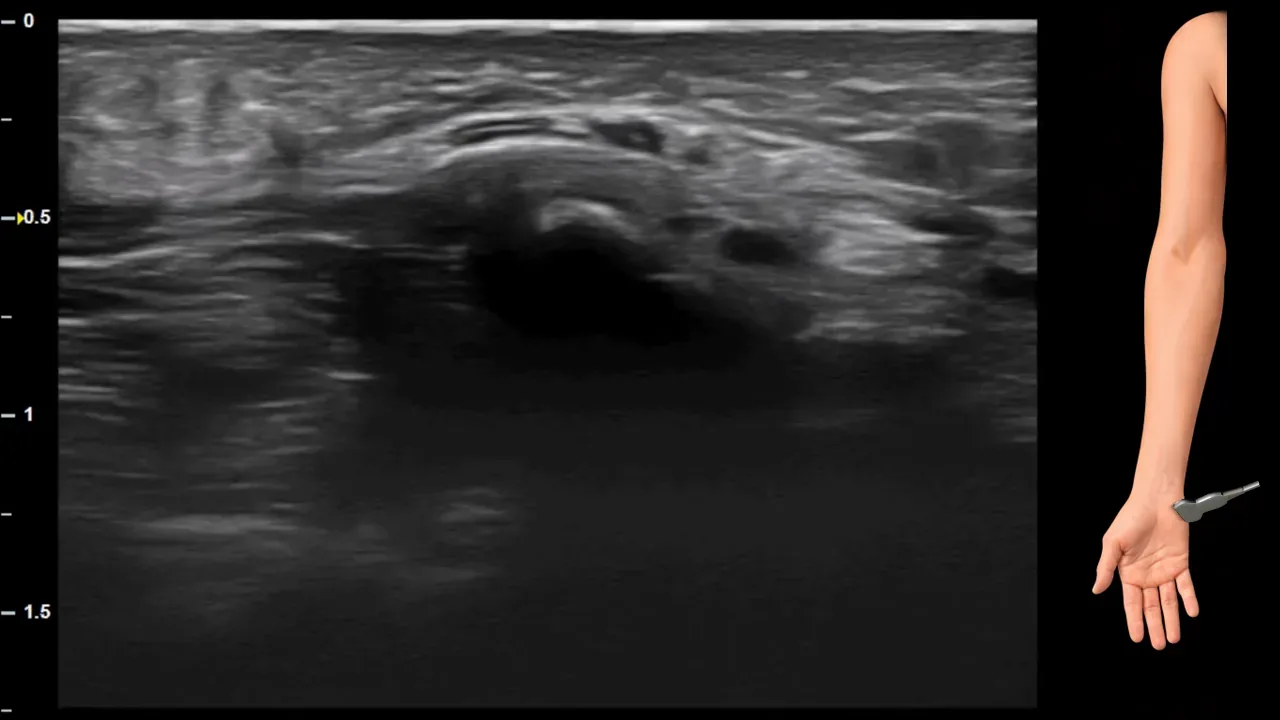
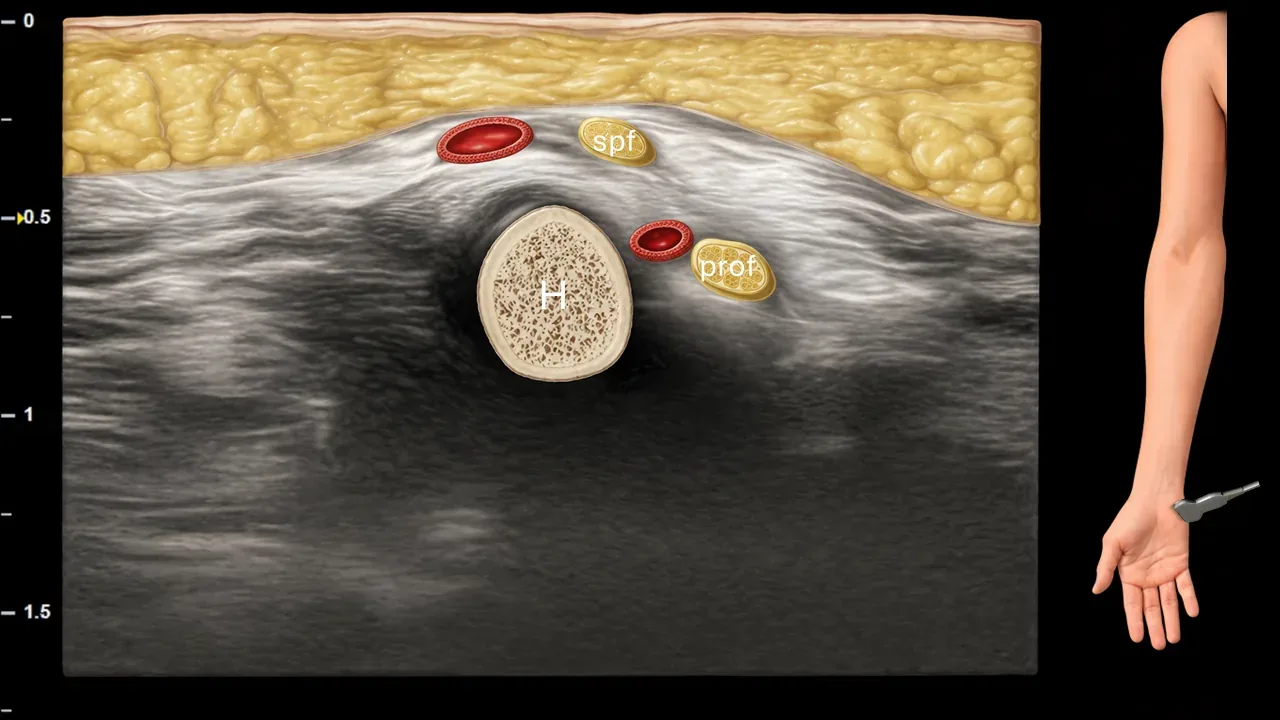
Abbildung 14. Carpus, Transversalebene. H: hamulus ossis hamati, spf: oberflächlicher sensibler Ast des N. ulnaris, prof: tiefer motorischer Ast des N. ulnaris.
Transversaler sonografischer Schnitt im Bereich des Handgelenks auf Höhe des hamulus ossis hamati (H). Auf dieser Höhe erfolgt die terminale Aufzweigung des N. ulnaris in den oberflächlichen sensiblen Ast (spf) und den tiefen motorischen Ast (prof). Der oberflächliche Ast liegt weiter oberflächlich, während der tiefe Ast in enger Beziehung zum Bereich des Hamulus ossis hamati tiefer verläuft. Im Bild sind außerdem Gefäßstrukturen zu erkennen, die die einzelnen Nervenäste begleiten.
Zugang zur gesamten Bibliothek
Voller Zugriff auf Scan-Protokolle, Anatomie und klinische Referenzen. Jederzeit kündbar.
- Alle Protokolle und Anatomiereferenzen
- Originale Ultraschall-Illustrationen und Video-Demonstrationen
- Synchronisierung zwischen Mobilgerät und Web