 MSK Academy
Echogenicity
Written by Jakub Jacisko, MD, PhDUpdated
Echogenicity describes how strongly a tissue reflects ultrasound. On the image it appears as different levels of brightness, allowing structures and their properties to be distinguished.
Key terms: anechoic (no reflection, completely black – typically fluid), hypoechoic (darker than surroundings), isoechoic (same brightness as surroundings), and hyperechoic (brighter than surroundings – strong reflections, e.g. fibrotic tissue or calcifications).
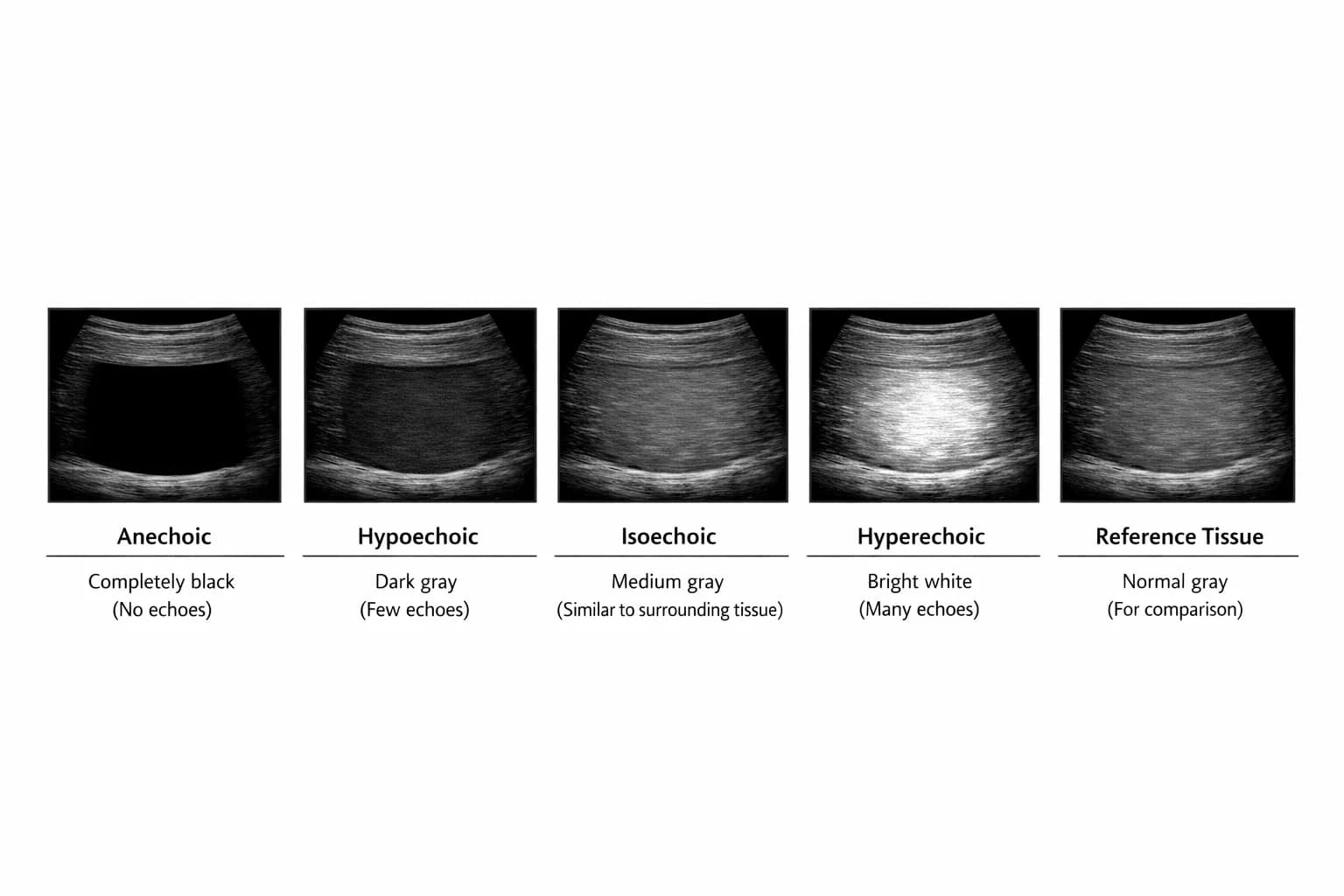
Echogenicity always depends on machine settings (gain, TGC) and on the angle of insonation. It should be judged in context of surrounding tissues and with proper settings.
In practice, the term heterogeneous echotexture is also used to indicate a non-uniform appearance, which can suggest inflammation, degenerative change, or mixed content.
In practice, the term heterogeneous echotexture is also used to indicate a non-uniform appearance, which can suggest inflammation, degenerative change, or mixed content.